

In its September 2, 2026 acquisition announcement, McGraw Hill disclosed that it had bought Teachally to accelerate K–12 curriculum development, localization and translation and to add AI-assisted planning and content tools for educators. The intended model combines Teachally’s technology with McGraw Hill curriculum and embeds resulting capabilities in classroom platforms teachers already use.
According to GeekWire’s September 2 deal reporting, the transaction had closed, all five Teachally employees had joined McGraw Hill, founder Daniel Bernstein became senior adviser for Teachally integration and growth, financial terms were undisclosed, and the startup was working with about eight school districts before the sale. That contrast—a five-person company with a modest customer base entering an established education publisher—is the strategic center of the acquisition.
A small-team acquisition built around technology and operators
The retention of Teachally’s entire workforce makes the deal resemble an acqui-hire-style transaction, although neither company has formally characterized it that way. McGraw Hill acquired a functioning platform together with the people who developed and commercialized it, reducing the separation between buying software and obtaining the expertise needed to integrate it.
Bernstein’s integration role reinforces that reading. Rather than handing the technology to an unrelated product group, McGraw Hill has retained leadership from the startup to help connect the platform with the buyer’s curriculum assets, development processes and routes to schools.
Teachally, in turn, gains access to capabilities that are difficult for a five-person vendor to reproduce: an established content catalog, editorial and product operations, existing classroom platforms and relationships across domestic and international education markets. The acquisition therefore offers a distribution path based on integration into an incumbent’s products rather than continued district-by-district expansion as an independent startup.
Teachally grounds AI work in curriculum and standards
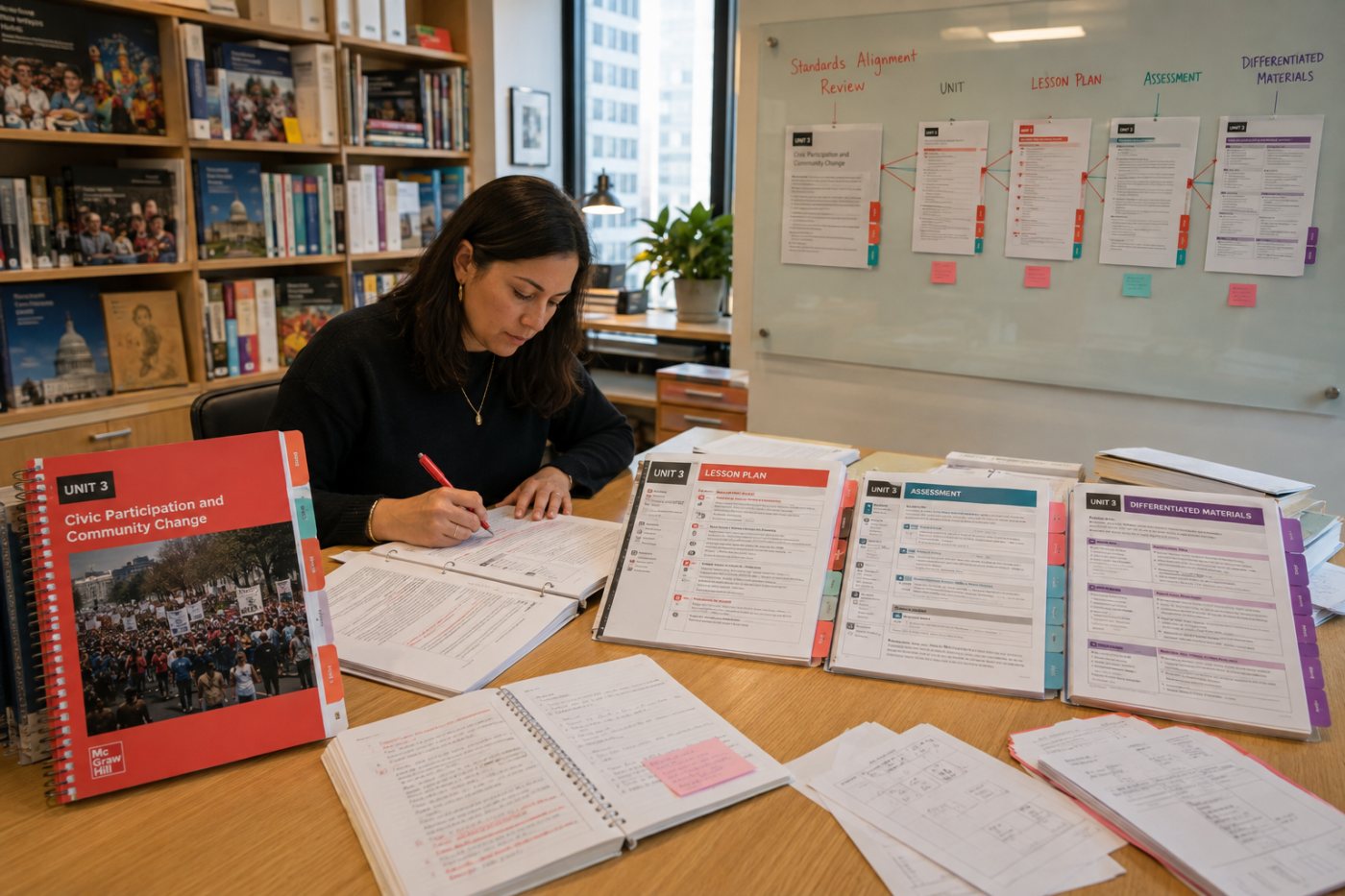
Teachally is positioned as an instructional-production system rather than a general-purpose chatbot placed beside a textbook. It uses curriculum and academic standards as inputs for creating or adapting lessons, assignments, assessments and enrichment materials, with controls for learning goals, rigor and student readiness.
The current McGraw Hill Teachally product page lists national, state, Advanced Placement and specialized standards, tools for adapting McGraw Hill content, and translation into more than 100 languages. It also presents assignments, assessments and differentiated materials as outputs connected to instructional goals.
That design supports two distinct uses inside McGraw Hill. Product teams can apply the technology when developing, revising or localizing curriculum, while educators can use related tools to customize published material for a particular classroom. The distinction matters because internal production tools and teacher-facing features may have different review procedures, permissions and release schedules.
Eight districts become a broader scaling test
Teachally had reached paying institutional use but remained early-stage in distribution. Moving its workflow into McGraw Hill potentially bypasses the long process of independently selling, implementing and supporting the platform across many more districts, subjects and grade levels.
Distribution through an established publisher does not automatically prove that the technology can operate reliably at that larger scope. A workflow used with roughly eight districts must now accommodate more curriculum programs, standards regimes, languages and local requirements if McGraw Hill carries out the breadth of its stated plan.
The difficult work lies in preserving instructional meaning while content changes form. Standards mappings need to match the correct jurisdiction and version; localized material must retain the original learning objective; and generated assessments must measure what the associated lesson is intended to teach. McGraw Hill has not disclosed performance measures for those tasks or identified the first curriculum programs that will receive deeper Teachally integration.
Governance questions follow the technology into the catalog
Curriculum grounding narrows the context from which material is generated, but it does not guarantee factual accuracy, appropriate difficulty or correct standards alignment. School buyers will need deployment-specific information about human review, source traceability, editing controls and responsibility for approving material before classroom use.
Teachally’s terms, last updated April 23, 2026, state that student personal information is not required, AI output may contain inaccuracies, teachers must review content before classroom use, teacher-generated content is not used to train internal or external AI models, and district agreements supersede the general terms where they conflict.
Those provisions describe the standalone service at a particular point in time, not necessarily every future McGraw Hill implementation. As the technology enters other products, districts will need to know which contract governs each deployment, which service providers process data, what administrators can control and whether retention and deletion rules differ across integrations.
The next milestone is a named product integration
The acquisition supplies McGraw Hill with both Teachally’s platform and its full team, but the buyer has not disclosed the price, integration cost, adoption targets or a timetable for named curriculum releases. Its public product page establishes that Teachally is available under the McGraw Hill umbrella, while leaving the depth and sequence of broader catalog integration unclear.
The next meaningful evidence will be a specific deployment identifying the McGraw Hill product, eligible users and market, together with its standards-validation, editorial-review and data-governance controls. Until those details emerge, the deal is best understood as an early-stage AI company taking an incumbent-led route to scale: a small specialist team moving its curriculum-grounded technology into a much larger K–12 product and distribution operation.
Also read:
Source link