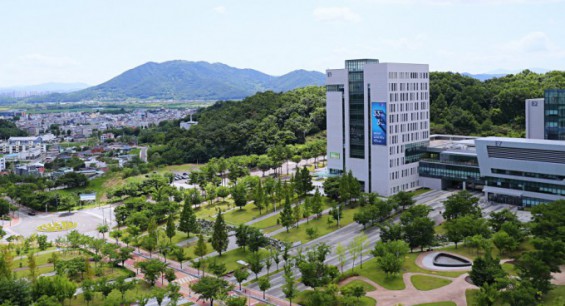
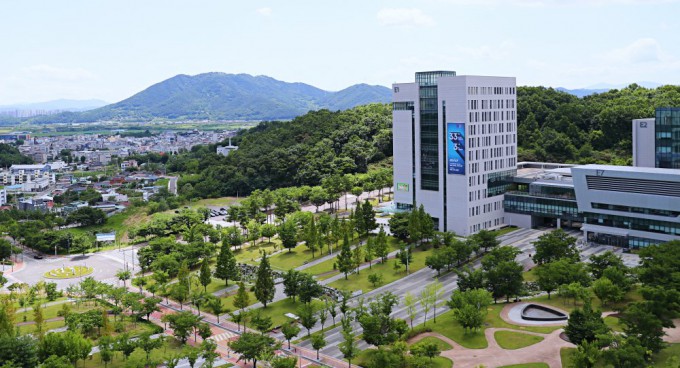
DGIST campus. Provided by DGIST
■ Daegu Gyeongbuk Institute of Science and Technology (DGIST) announced on the 8th that it has been selected for the Ministry of SMEs and Startups’ “Regional Innovation Startup Activation Support Project” and will begin in earnest the “Daegu Deep Tech Startup Hub Construction Project,” with a total budget of 3.5 billion won jointly with Daegu Metropolitan City. Through this project, DGIST plans to establish a deep tech startup base in Dongdaegu Venture Valley that combines high-performance artificial intelligence (AI) computing infrastructure with startup space, and systematically support the growth and settlement of promising regional technology companies. The Daegu Deep Tech Startup Hub will be created in the Daegu Content Center within Dongdaegu Venture Valley. It will enable regional deep tech startups to jointly use the high-performance computing resources, specialized equipment, and workspaces needed in the technology development process, while building a business growth foundation that connects technology development to demonstration and commercialization. A total of 3.5 billion won will be invested in the project, including 2.45 billion won in national funds and 1.05 billion won in local funds.
■ Gwangju Institute of Science and Technology (GIST) announced on the 8th that Professor Kyu-Bin Lee’s team in the Department of Artificial Intelligence (AI) has developed a technology that reduces the burden of “data annotation work,” which involves marking the location and area of objects in images needed for AI training to create ground-truth data. The technology developed by the research team allows AI to learn even from data for which humans have not directly provided ground-truth labels, automatically processes results that can be judged with relatively high confidence, and focuses human review only on results that are difficult to determine. Compared with the conventional method, where humans must check and correct all data one by one, this approach enables the construction of AI training datasets with less time and effort. The team developed a new data annotation system that combines semi-supervised learning and active learning, and calibrates AI’s confidence scores to match data characteristics. To verify the effectiveness of the proposed system, the team conducted experiments using the “Cityscapes” dataset; as a result, the time humans spent on data annotation decreased by 46.3% compared with the existing method and by 68.4% compared with fully manual annotation. AI image recognition performance also improved, and the precision of automatically processed results reached 85.8%.
■ DGIST announced on the 8th that it will host the international forum “Meet the Pioneers: Liquid Biopsy 2026” to discuss the latest trends in liquid biopsy on September 9 at 3 p.m. in the B1 auditorium of Korea Bio Park in Pangyo. Organized by DGIST and co-hosted by CityCells and the Korea Biotechnology Industry Organization, the forum has been prepared to share research outcomes by inviting leading international scholars representing the field of liquid biopsy. The event will feature lectures by Professor Klaus Pantel and Professor Catherine Alix-Panabiere, authorities in circulating tumor cell research. Before the keynote lectures by overseas scholars, DGIST Professor Minseok Kim will present the research and development direction and potential of the newly emerging “AI-native autonomous laboratory” in the liquid biopsy field. The event will run from 3 p.m. to 6 p.m. and is expected to serve as a networking venue for researchers and industry professionals interested in liquid biopsy and advanced bio-convergence technologies.
Copyright ⓒ DongA Science. All rights reserved.