“Was the tumor tissue removed properly?” Immediate verification in the operating room… Ultra-lightweight specimen CT is coming
KAIST student-founded startup “Covite”
Developing Ultra-Small CT “Majin X” Viewed in 3D Video
Seo Ji-heun (CEO): “Rapid provision of necessary information during surgery”
[For more diverse corporate information on the startups mentioned in this article, please visit the Unicorn Factory big data platform ‘Data Lab‘.]
“I want to contribute to reducing unnecessary waiting times in the operating room and the possibility of reoperations. We will grow into a company that helps medical staff verify necessary information more quickly during surgical procedures.”
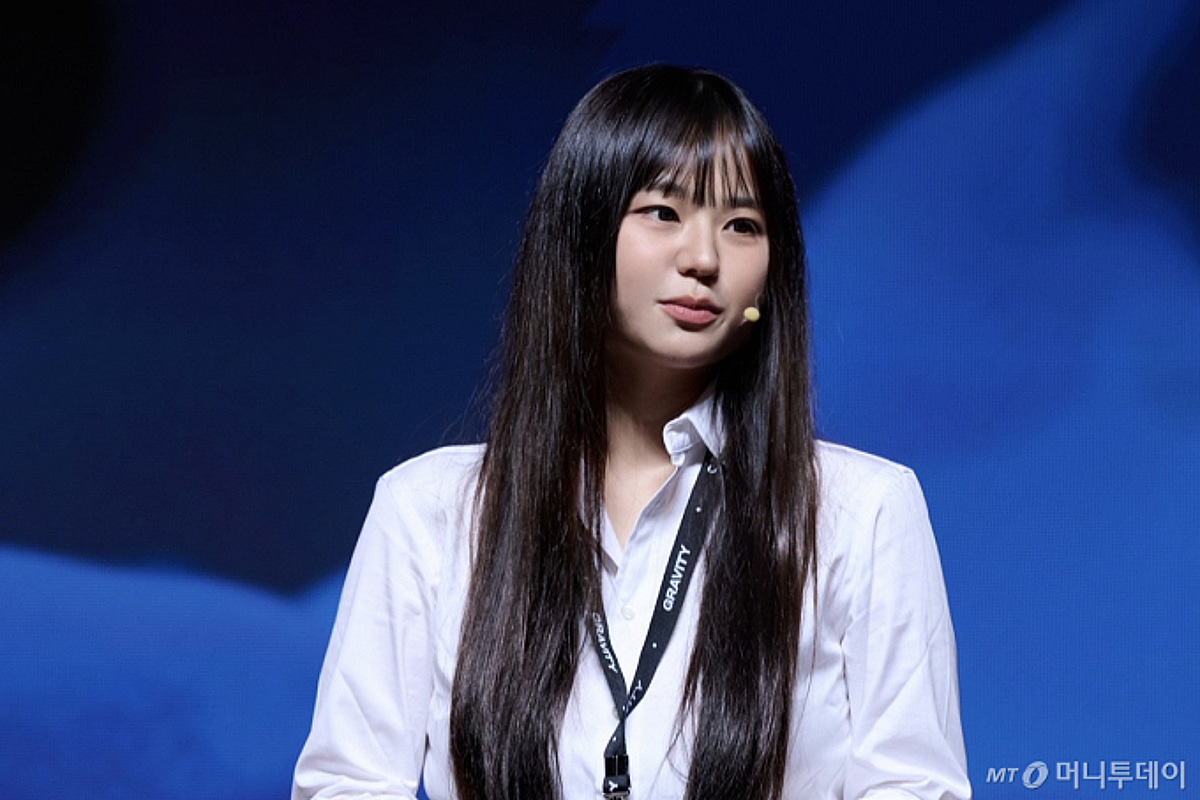
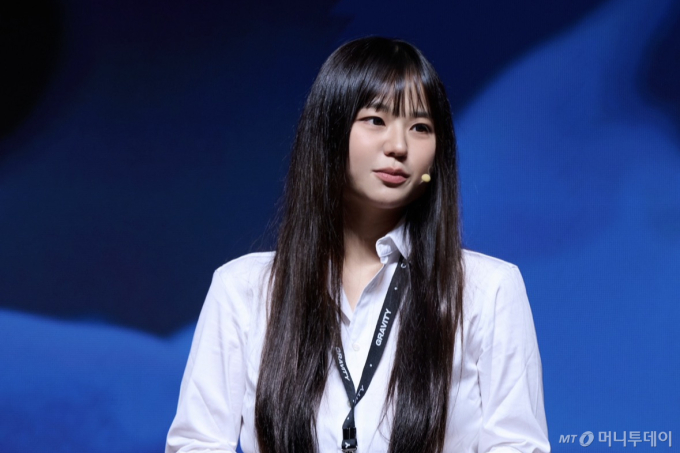
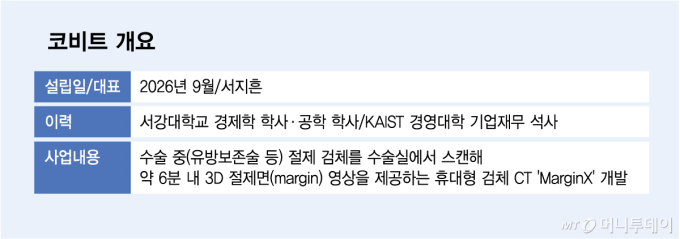
Seo Ji-heun (CEO), who leads KAIST (Korea Advanced Institute of Science and Technology) student startup Cobit, is developing “MarginX,” an ultra-miniature CT that allows surgeons to view removed tissue in three-dimensional images on-site during surgery. The goal is to complete the process from imaging to image review within six minutes.
During cancer surgery, a frozen section test may be performed to determine whether any cancer cells remain at the resection margin. This procedure involves rapidly freezing the tissue sample, cutting it into thin slices, staining them, and having a pathologist examine them under a microscope. If multiple areas are tested repeatedly, the waiting time can exceed one hour. Breast-conserving surgery, which is widely performed for breast cancer, may also require additional surgery if cancer cells remain on the resection margin. According to a study analyzing U.S. insurance claim data, 21.1% of privately insured patients underwent additional surgery within one year after breast-conserving surgery.
Seo (CEO) founded the company after witnessing a close person’s breast cancer surgery. “Even after the operation was over, I worried about whether a follow-up surgery would be necessary,” he said. “I came to realize that the issue of confirming whether any cancer remained on the resection margins extended surgical time and increased uncertainty.” Seo (CEO) studied economics and engineering at Sogang University and earned a master’s degree in corporate finance from KAIST. He has previously launched two businesses, including remote psychiatric care and a pet dog-related venture. “I learned that what works in real medical settings is different, and the importance of rapid validation,” he said.
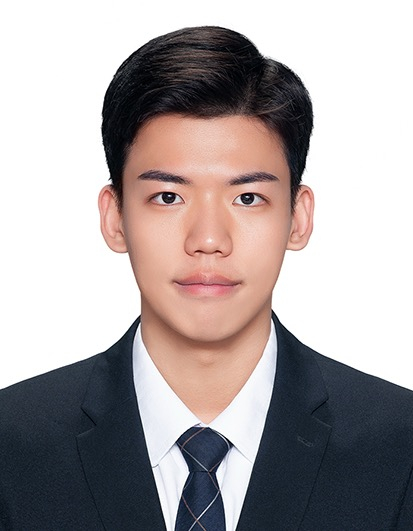
Amar Prasad Gupta, the company’s co-founder and CTO, is a researcher who has been studying carbon nanotube (CNT)-based miniature X-ray devices. He met Seo (CEO) at a KAIST foreign student networking event in January of this year. Cobit has incorporated feedback from medical professionals in surgery, pathology, and radiology into its equipment since the early stages of development.
In the operating room, two-dimensional specimen X-rays are sometimes used to quickly examine resected tissue; however, because these images are flat, overlapping structures can make it difficult to assess the depth between a lesion and the resection margin. MarginX captures 360-degree images of the resected tissue, displaying the spatial relationship between the lesion and the resection margin in three dimensions. This allows surgeons to examine the tissue in three dimensions while waiting for frozen section test results in the operating room.
While 3D imaging equipment for tissue dissection is not new, existing devices are mostly large cabinet-type units weighing from several dozen kilograms to over 100 kilograms. Seo (CEO) pointed out, “To bring the equipment into an operating room, it may be necessary to change the existing layout and the movement paths of medical staff,” adding, “This creates a burden for surgeons who have to alter their familiar surgical workflow.” This is why Marginex is pursuing battery-powered operation and internal 3D reconstruction of the device. The equipment can be placed on a mobile cart or similar platform and moved to the required operating room regardless of the location of electrical outlets.
The core of the weight reduction lies in radiation shielding. Instead of the conventional method of wrapping the entire cabinet with thick material, a structure was developed that calculates the actual path through which X-rays pass and places high-density shielding material only where it is needed.
Cobit aims to obtain domestic regulatory approval in the second half of 2027 and proceed with U.S. FDA procedures from late 2027 to early 2028. The company is currently raising seed investment, with plans to use the funds for prototype refinement and validation, as well as preparation for regulatory approval.
In the long term, the company plans to supply equipment to U.S. ambulatory surgery centers (ASCs) and similar facilities. This decision is based on the assessment that ASCs, where surgeries are performed without hospitalization, often have more limited medical infrastructure than large hospitals. The company is also considering expanding the scope of application to cancer types in which preserving normal tissue is critical, such as thyroid, head and neck, and prostate cancers.
Traffic accident analysis shortened from “one week to one hour”…AI assistant aids loss assessment
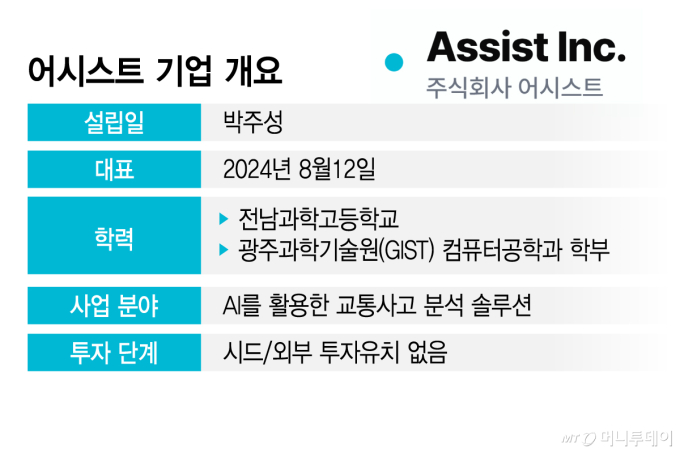
Student startup “Assist” from Gwangju Institute of Science and Technology (GIST)
Accident scenarios are reproduced in detail within a three-dimensional virtual environment for analysis and judgment.
Park Ju-seong (CEO): “We will build a ‘zero-touch’ system covering everything from insurance intake to compensation.”
“I wanted to change the reality where fault determinations in traffic accidents vary depending on who is assessing them. The goal is to objectively reconstruct and analyze the circumstances at the time of the accident using AI (artificial intelligence), thereby automating the complex process that extends from accident investigation to loss assessment and insurance payout.”
Park Ju-seong (CEO), a student-founded company at the Gwangju Institute of Science and Technology (GIST), recently spoke with Money Today’s startup-focused media platform, “Unicorn Factory,” saying the following.
When a traffic accident occurs, black box or CCTV (closed-circuit television) footage must be analyzed to determine the circumstances of the incident and the liability ratio. However, black box footage has limitations in accurately assessing the actual situation due to shooting angles and distortion caused by wide-angle lenses. Hand-drawn diagrams of the accident scene may also reflect the author’s subjective perspective. The process from accident analysis to report preparation can take anywhere from a minimum of eight hours to more than a week.
Assist is a deep tech startup aiming to use AI to address the subjectivity and inefficiency of accident analysis processes. The company is developing technology that analyzes black box or CCTV footage to classify accident types and reconstructs vehicle movements and collision scenarios in a three-dimensional (3D) virtual environment.
The startup idea originated from the traffic accident prediction research conducted by Park (CEO) at GIST. He explained, “I judged that if a technology for predicting accidents in advance is applied in reverse, it can also objectively reconstruct accidents that have already occurred.”
Initially, the company had planned to apply its technology to police traffic accident investigations, but it expanded its business scope after identifying demand for AX (AI transformation) in the insurance industry. Park (CEO) stated, “It is difficult to establish a clear revenue model with traffic accident analysis technology alone,” adding, “We must combine expertise in insurance, automobiles, and AI to develop services that can be utilized in the actual market.”
Assist analyzes traffic accidents in two main ways. One method involves reproducing the vehicle’s movements and collision circumstances at the time of the accident in detail within a three-dimensional (3D) virtual environment. The other uses AI to analyze relevant information, such as vehicle speed and location, from accident footage to quickly provide the type of accident.
The 3D reconstruction method works by processing input from black box data or CCTV footage, using AI to recognize vehicles and lane markings, and extracting information necessary for accident analysis, such as vehicle positions and movements. Based on this data, the accident scene is recreated in a virtual space using “Unreal Engine,” a 3D graphics production tool commonly used in game development.
In the process of rapidly determining the type of accident, AI analyzes factors such as the time of the accident, the vehicle’s direction of travel, and its movements to derive the fault ratio chart results corresponding to that specific accident type. The system is designed to present not only the determination result but also the underlying rationale, enabling the responsible personnel to review it.
Assist recently verified the accuracy and processing speed of its AI module, which analyzes traffic accident types, through a proof of concept (PoC) conducted with a major insurance company.
The ultimate goal of Assist is to build an AI platform that connects the entire process from the occurrence of a traffic accident to the payment of insurance claims. The company envisions implementing a “Zero-Touch” compensation system in which, once accident footage and vehicle driving data are secured, the AI analyzes the basis for determining the type of accident and liability, prepares a report, and then links into the insurance filing and compensation procedures.
However, since determining fault is a sensitive area that can lead to insurance payouts and legal disputes, the current structure involves AI presenting analysis results while humans conduct the final review. Park (CEO) stated, “We do not simply present the judgment result; we also provide the basis for the judgment so that any errors can be verified,” adding, “Once the accuracy of the analysis is sufficiently validated, we plan to expand the scope of automation.”
Handed out “Yangsan” as a customer gift, and… an “ESG/CSR report” was quickly put together
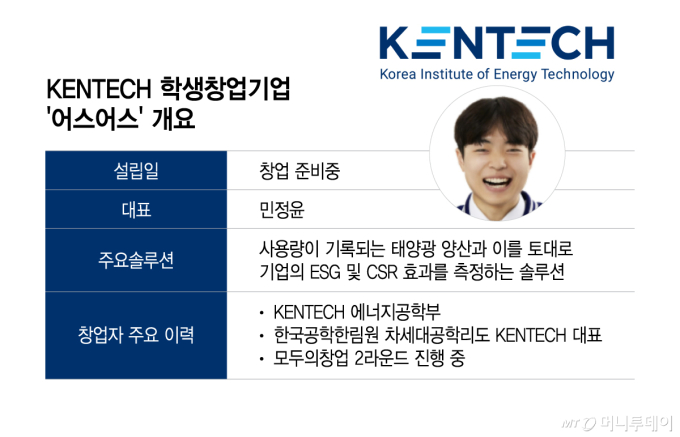
Korea National University of Science and Technology (KENTECH) student-founded startup “Earth Earth”
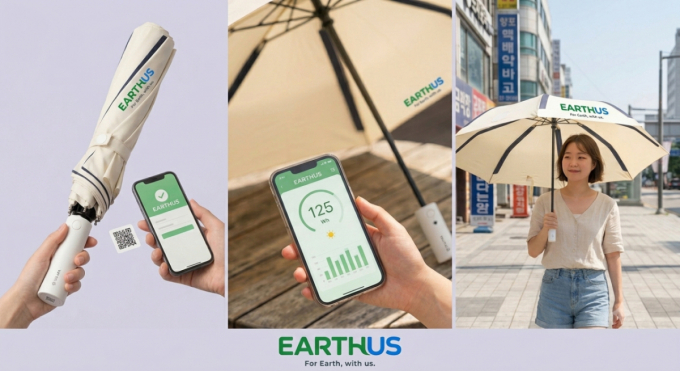
“Yangsan,” a solar-powered device capable of measuring usage, has been developed for use in corporate promotions and other applications.
Aspiring entrepreneur Min Jung-yoon: “I want to increase the utilization of renewable energy in everyday life”
As extreme heat has become a daily occurrence every summer, an increasing number of companies are offering “Yangsan” as gifts or promotional items. This is because they are not only effective for escaping the scorching heat but also allow brands to be exposed on the streets, enabling companies to expect marketing and publicity effects.
However, the impact of Yangsan is merely an “expectation” on the part of the company, whether from a corporate social responsibility (CSR) perspective or a marketing one. This is because it is impossible to measure how much consumers actually use the Yangsan provided by the company. From the company’s standpoint, whether to maintain or discontinue Yangsan-related campaigns can only be decided based on the intuition and feel of the practitioners involved.
Two students at the Korea National University of Science and Technology (KENTECH) are developing “Yangsan,” a solar-powered system capable of measuring usage, to address this issue. The method involves placing a small module inside the complimentary Yangsan items to measure and record how much they have been used. This data is then transferred to the Yangsan providers and organized into metrics such as ESG (environmental, social, and governance) indicators.
To measure and record usage, Earthers added a thin-film solar cell to the sunshade portion of the Yangsan and a small module to the handle. The thin-film solar cell (cell) sewn onto the sunshade generates an electric current simply by unfolding the Yangsan under sunlight, powering the module inside the handle. This module measures whether the Yangsan is in use based on the power supplied from the solar cell and transmits usage status information to the user’s smartphone via Bluetooth communication.
EarthUs used a film-type CIGS (copper, indium, gallium, and selenium) thin-film solar cell that is more than 20 times thinner and lighter than conventional silicon wafer-based solar cells in order to meet requirements for durability, thickness, and weight. The idea leveraged the specialized technical expertise of founding team members who graduated from KENTECH’s Department of Energy Engineering.
Min Jeong-yoon, an undergraduate student in the Department of Energy Engineering at KENTECH who leads EarthUs, said, “While studying my major and thinking about renewable energy, I have continuously been considering how to apply renewable energy-related technologies to everyday life.” He added, “I developed a startup idea by utilizing CIGS thin-film solar cells that are lightweight, flexible, and durable.”
He added, “Earth Earth’s goal is not limited to Yangsan alone; rather, it aims to enable the use of solar cells in a variety of everyday settings.” He stated, “Starting with Yangsan, we plan to challenge ourselves by expanding our solutions to diverse areas such as building curtains and blinds, camping supplies, and more.”
Earthus has completed the production of its first prototype and is now moving into full-scale technology refinement. The company was also selected for the first round of the Ministry of SMEs and Startups’ national entrepreneurship program, “Everyone’s Startup,” and is currently in its second round.
Six major science and technology universities’ deep tech startups clash at COEX on the 30th
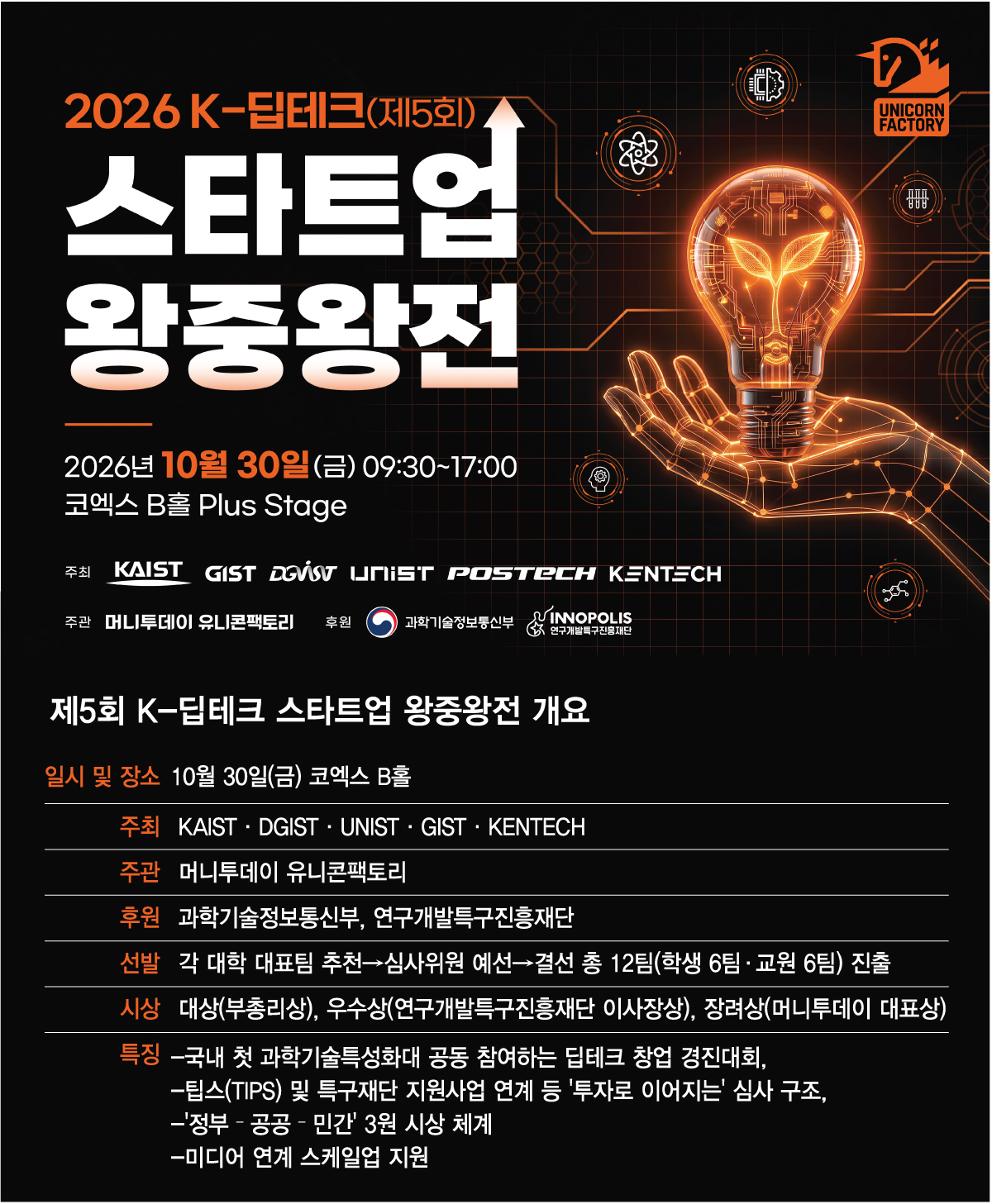
Meanwhile, Covit, Assist, and Earthus will compete in the finals of the “5th K-Deep Tech Startup King of Kings Tournament,” a special side event to be held at COEX in Seoul on the 30th of this month as part of “Smart Energy Plus (SEP) 2026.”
This is the fifth edition of the King of Kings tournament. The event is organized by Money Today’s startup-focused media platform, Unicorn Factory, with support from the Ministry of Science and ICT, and hosted by six science and technology specialized universities across the country. KENTECH joined this year. The tournament was established to promote R&D technology transfer and commercialization, support the growth of promising deep tech startups, and build regional innovation and growth ecosystems.
A total of 12 teams advanced to the finals, comprising six faculty and student startup companies each from the six major science and technology specialized universities. Executives from Samsung Electronics C-Lab, GS Vendors, L&S Venture Capital, Ecopro Partners, LB Investment, Blue Point Partners, CNTech, Series Ventures, Korea Science & Technology Holdings, and the R&D Special Zone Promotion Foundation will serve as judges.
One team each from the faculty and student startup categories will receive the Vice Prime Minister’s Award (Ministerial Award of the Ministry of Science and ICT) along with a prize money of 3 million won. The winning teams will also receive additional support, including connections for follow-on investment and recommendations for the Technology Innovation Promotion System (TIPS). Two teams each in the Excellence and Encouragement categories will be awarded prizes of 1 million won and 500,000 won, respectively, in addition to the awards ceremony.
Date and time: Friday, October 30, 9:30 a.m. to 5:00 p.m.
– Location: Hall B, COEX, Seoul, PLUS STAGE
– Target: Deep tech startups and investment professionals at venture capital firms
– Hosts: KAIST, DGIST, UNIST, GIST, POSTECH, KENTEC, Money Today Unicorn Factory
– Application: https://forms.gle/McNBqdiBts8RJazVA
[Money Today Startup Media Platform Unicorn Factory]
Source link