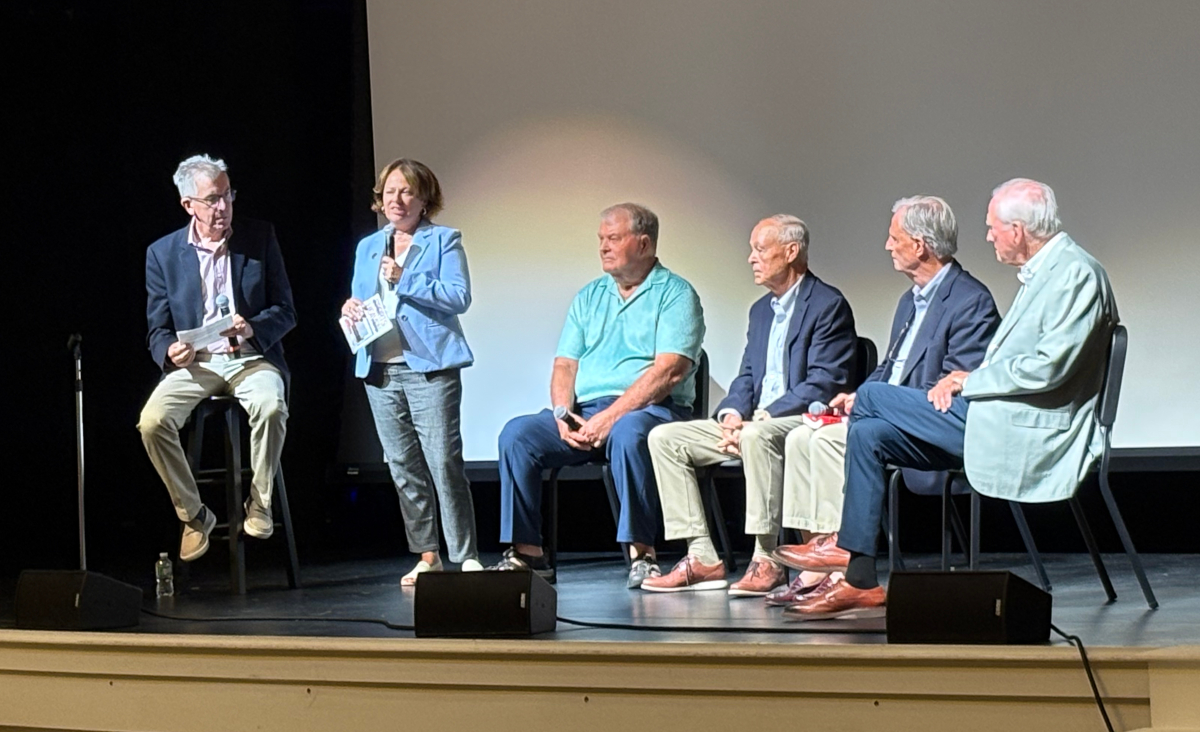
The screening of “Sports Heaven,” a documentary on the beginning of ESPN aired Thursday, Sept. 10, at the Rockwell Theater on Memorial Boulevard. Before the documentary aired, Mike Soltys, ESPN historian, led a discussion with former mayors Mike Werner and John Leone, former Redevelopment Authority member Tom O’Brien and architect Geoff Bray. Each was involved with the deliberations leading up to ESPN’s decision to come to Bristol.
Mayor Ellen Zoppo-Sassu introduced the evening program.
Here is a lightly edited transcript. The audio is also available below.
Mayor Ellen Zoppo-Sassu: Good evening, everyone, and thank you for joining us for tonight’s presentation. I’m Ellen Zoppo-Sassu, and I’m proud tonight to introduce you to some of the people who are responsible for the decision that landed us ESPN, here in Bristol.
Right here we have former mayor, Mike Werner, who is also the youngest man ever elected mayor. We have former mayor, John Leone, … Also joining us tonight is Geoff Bray who was the architect responsible for the first buildings…
Last but not least, Tom O’Brien, a member of the Redevelopment Authority who took the famous vote to allow that parcel to be purchased (off Middle Street) and create that entity.
I also want to take a minute to shout out some of the people who are here representing others. We have Jim Murphy in the audience, the son of Jerry Murphy, also on the Redevelopment Board. Where are you, Jim?
We also have Steve Allaire here who is an attorney, was on the council, who had various other roles. Steve’s right there.
We also have family members of Sam Kasparian, who ran the Redevelopment Authority for many years.
As a generational issue, we now have several of our existing city councilmen with us tonight, poised again to make generational decisions, hoping to position Bristol in a better place than how we found it, just like these gentlemen did.
So, before I turn the program over to Mike Soltys to run tonight’s little chat before we watch the documentary, I did want to take a moment to thank our sponsors. Tonight, we had several presenting sponsors that allowed us to come in and host this event, use this beautiful theater, which again is part of our economic revitalization for downtown. And that is our friends at the Bristol Event Center in Doubletree, which is again a great destination, down near ESPN.
We have attorney Dale Clift and his wife here, who are our sponsors as well. We have Tabacco & Sons Building and Tabacco Trucking. We also have members of our Bristol Fire Dept., local 773 in the back. And we have Bill and staff from ACG North America, another great contracting firm here locally that’s done a lot of great work.
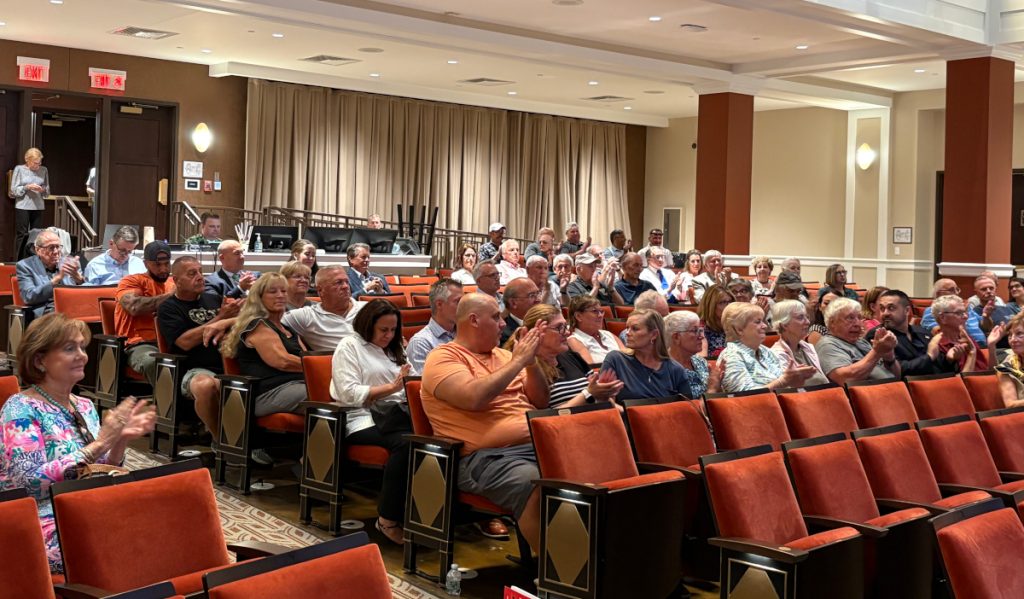
\The crowd at the Rockwell for the ESPN program airing the documentary “Sports Heaven,” preceded by a discussion with officials involved with ESPN locating in Bristol. | David Fortier
And we have the Bristol Sports Hall of Fame. I believe we have some friends as well from Eversource. We work very closely with them on lots of projects, so thank you for supporting this forum. Also our friends from Fury, Donovan, and Cooney Law Firm are over there as well.
So thank you so much for being here. Bristol is fueled by a very strong civic ethic, and so we’re very appreciative of those who come out and support these community events; for everybody that’s supporting this theater, which actually predated downtown, and now we have a reason to come to the theater, and now we have restaurants to go to in downtown.
I am sure many of you remember as these gentlemen do that the only reason to come downtown was to buy stamps or to get your birth certificate. And so now we have this whole rebirth of what’s happening there, and it’s been fueled by a lot of the decisions that have happened across generations: the Southeast Industrial Park, the first technology park–229, and all of the other decisions that have followed.
So tonight we get to take a little step back. Oh, I forgot to introduce Alan Weiner, one of our original planners, … So now we get to take a step back and visit those decisions and those conversations that are all going to be PG.
Former Mayor Mike Werner: My daughter mentioned to me the other day that whoever put this panel together must have been a little crazy because, Do they have any idea how many F-bombs Leone and I are going to drop? … We’re going to attempt to behave.
ESPN historian Mike Soltys: Thank you, Ellen, we appreciate you hosting this event. She’s always been very enthusiastic about Bristol’s history and so was excited about the idea when she first saw this documentary and the opportunity to show it here in this beautiful theater.
My name is Mike Soltys. I got hired by Bill Rasmussen, the founder of ESPN, as an intern in the summer of 1980. Bill just recently passed away, but I’ve been good friends with him ever since. And I have been working on Middle Street for most of that time, including the last two years, part time as the company’s official historian. The main first project I did was to serve as producer on “Sports Heaven, the Birth of ESPN,” which you’re going to see in a few minutes.
There’s also an accompanying book, which if you didn’t get the chance to purchase, I’m happy to sell it to you afterwards, or you can get it online as some people did in advance. There’s also a wonderful audio book.
If reading quotes from John Leone and Geoff Bray aren’t enough that you need to hear their voices, you can do that with the audiobook…We’re going to do a panel discussion for about 30 minutes with this group and then show the film, which is 65 minutes long.
Then this group will come back up for questions from anyone in the audience. “Sports Heaven,” I want to point out, is very much a Connecticut and Bristol success story.
Bill Rasmussen is living in Farmington Woods in 1978. He gets fired on Memorial Day weekend by both Hartford Whalers and the Howe family, Gordy Howe’s family, because he was working for Howe Enterprises.
He’s a guy living in central Connecticut looking for his next challenge. And the next 18 months were just an incredible ride, which led to our launch here in Bristol in September of 1979.
But beyond that connection, his original idea was he wanted to show UConn sporting events to the state of Connecticut. He had a lot of conversations up in Storrs. As with any big idea, I guess good fortune and serendipity come into it.
John Toner, who was the athletic director at UConn at the time, also was a rising executive within the NCAA ranks, and he was able to open the doors for Bill for what became the NCAA contract, which really played a major role in the later success of March Madness.
It’s also a Plainville, Conn. story. The company first started in Plainville. Fortunately for Bristol, Plainville had an ordinance against satellite dishes. And Bill was renting space from United Cable, who had their office, the local office in Plainville, who then contacted the Bristol officials.
They needed a spot for their singular satellite dish and worked out the deal. And we’ll get into that. That worked into how ESPN started in Bristol. So I’m going to start with Tom.
The first connection for you between Bill Rasmussen and his son, Scott, was with the Redevelopment Authority. I mentioned that Plainville wouldn’t allow it. United Cable was here. Tell us, Tom, what you recall.
We’re now in 1978. What do you recall of that early encounter?
Former Redevelopment Authority member Tom O’Brien: Well, Bill appeared before the Redevelopment Agency with a strange concept about broadcasting UConn games. You may know that he used his credit card, it’s a famous story, to buy a spot on satellite, which only had five spots that they could use to come down to the satellites. Ted Turner of TNT had one for the Braves; Channel 11 had one for the Yankees; WOR had one for the Cubs; and Bill secured one for UConn basketball.
At the time he first appeared, there was no talk about Sports Center. It was just sending games to UConn alumni, both here and nationwide. And it was met with some skepticism, as you can imagine. Cable TV at that time only had 15% penetration. And the networks weren’t interested in using satellite because they felt who would pay for TV.
And then a great stroke of luck happened. They set up a second satellite, which had a lot of interest and it exploded. And therefore, they had a five-year jump start to market his ideas.
John Paul Getty and Getty Oil came up with the original financing that allowed Bill to secure the site through the redevelopment agency and start the broadcasting.
So, the one quick question I have is why the E? Everyone has always wondered why isn’t it just the sports programming network if that was the original concept?
I think Bill was covering his bases a little bit in the hope that if that didn’t work out, he could expand into entertainment and sports programming network. Not everyone seems to remember, but, I recall that for the first few years, they were the CNBC. They broadcast the New York Stock Exchange for two or three years in the mornings from 9 to 3 to generate additional revenue.
Soltys: “Business Times” was the show, and then “Nation’s Business Today,” two different attempts. The theory was that their audience was very similar, but wanted sports news and wanted business news.
Personally, I was never a fan of it, but it did last for a few years, and that was what the morning programming was.
O’Brien: All right, and of course at that time there were only three minutes of sports on the 6 and 11 o’clock news, and those are the highlights and scores that were available to the public until ESPN came up with a concept of expanded Sports Center.
Soltys: Sports Center was the first show that ESPN ever aired in Bristol, September of 1979. Bill was a frustrated over the air guy. If you ever used to get Channel 40 out of Springfield, he was your sports guy on Channel 40.
And like every other guy who did sports, and it was guys back then, they would get their three minutes and be very frustrated. That’s all they could do. When Bill was at the Whalers, another Connecticut angle on it, he had the idea to do sports only, which he rented time from Channel 18, which was a religious channel, UHF channel in Hartford He did a time buy, and he created a daily half-hour sports news show in the fall of 1976 called”Sports Only,” and that was where the original idea of “Sports Center” came from. So, even in the creation of “Sports Center,” there’s great connective ties.
Mike, you were the mayor at this time, the youngest mayor, apparently.
What are your thoughts? Do you remember when you first heard about the concept for ESPN?
Werner: Well, and he really doesn’t get enough credit, but Sam Kasparian was our director of redevelopment at the time, and he heard that Mr. Rasmussen wanted to go with a full time sports network and that he couldn’t do it in Plainville. Sam thought, you know, before this guy decides to go down to Fairfield County or something, we got to talk him into coming to Bristol.
So, Sam, many of you probably knew him, was a great schmoozer. He had dinner with Bill a few times … then he brought Bill to see me. And I explained to them, that you know, I can’t make that decision. The land is owned by the
Redevelopment Agency, and they’ve got a policy of only selling land to industrial properties. So, we may have to twist some arms and talk to some people and get the votes. We needed them, we needed the zoning board. I won’t go into all the details, but we did. We talked to some of the commissioners who got their votes, and the rest is history.
If I could expand on that a little. That was the last lot that redevelopment owned in that area. And we thought, Sam was the one who thought of it, he said, look, if they ever want to expand, we got to own some land, more land. So we need to build an industrial park across the street. So lo and behold, that land was owned by Angelo Tomasso.
I was like a 28- or 29-year old kid. And I got to go meet with Angelo Tomasso to talk to him and tell him we’re going to take his land. So the morning of the meeting, in all honesty, I had diarrhea. As they say, I was scared shitless. And before I left the house, I had to throw up. And all the way there, I’m thinking, I’m going to Mr. Tomasso’s office in, I don’t know if it’s Plainville or New Britain, but it’s right on the line there, and I’m thinking, if this doesn’t work out, I’m going to be sleeping with Luca Brasi.
I get there, and fortunately, now here I am, and fortunately, (Werner’s wife) Sandy’s grandfather was a welder and he did some welding for Angelo years ago. I kind of threw that at him. So we had a few little talks about Sandy’s grandfather and welding and that kind of thing. Then we got down to business.
I said, Mr. Tomasso, we’ve got to buy your land.
–My land’s not for sale.
–Well, you’re not using it. I mean, you haven’t done anything there for years. I mean, we could really use it to build our industrial base.
— Our land’s not for sale.
–Well, unfortunately, in the emiment domain law, there’s a provision that allows us to take your land and we’ll take title to it within two weeks and let the courts decide what the price would be.
And he hit the frigging roof. He was not a happy guy.
I said, look, if you won’t sell it to us, we’re taking it.
And that’s what happened. A few buildings went up. We designed the park and the whole nine yards. That’s another long story. But a few buildings did start going up. And then I got a call from the Jim Delehant, then-vice president of ESPN at that time. He was in charge of all their facilities.
He said, Mike, Mr. Mayor, he used to call me. We got a problem. We need to expand.
I said, yeah, we got a bunch of land across the street.
He said, we’ve already looked into that. We can’t go on that side of the road. We have to stay on this side of Middle Street. Now, there’s a building right next door that’s vacant, and we’ve been talking to the owner, and I’m not getting anywhere with him. Can you help me?
I said, sure, we’ll work something out.
So I got a hold of Jim, I got a hold of Dick Lamothe, member of the Board of Finance, because I figured the city’s going to have to come up with money for something here, and also the owner of the factory.
We met at the Friendly across the street from ESPN. So we’re going back and forth and back and forth. Finally, it’s getting a little complicated. So I flip over my placemat and take the notes on the back of the placemat.
In between bites of my tuna sandwich, I’m writing notes on what’s going on. I’m crossing stuff off and I’m drawing arrows and everything. Finally, e have an agreement.
I said, okay, guys, you all have to sign this because I don’t want you telling me a month from now I didn’t say that. So I did, I got that, and then I needed to bring him to our corporation council so he could put it in contract form.
Ed Krawiecki Sr. was a Yale law guy, real button down lawyer. He had never done anything off the back of a placemat before.
So, I didn’t go to Catholic school, so my handwriting was not real good. So I had to sit down with him and interpret the whole thing. He writes it all up.
And now we’ve got a contract. And, John, you’ve got to tell them about the next meeting we had.
Former Mayor John Leone: The Red Bull Inn in Waterbury …, Mike, Ralph Papazian, former city councilman, Jim Delehant, and I think Mike pulled out the same placemat …
Mike was a Republican and we were Democrats. So, basically, it was the old rule that we had like six Democrats and the Republican mayor. So, he couldn’t do anything and we couldn’t do anything unless we agreed.
And we agreed on just about everything.
Werner: And John and I, … if we come to an agreement on something, he carried the ball with the council. So he would convince them that it’s a good idea. So without John, a lot of this stuff never could have happened.
Leone: (As an aside) At the council meetings, it was great because Mike was on one side, as the mayor, and Ralph Papazian was on the other side. And neither one could hear out of the ear (on the side they faced each other). He used me as the intermediary. I always used to get it done … and they wouldn’t figure out what they just voted on (until after). I changed things so we could get them through…
But the Red Bull. So, we did the thing on the Red Bull and signed on the agreement and everything. And Dick Lamothe goes, okay, this is what we’re going to do. And Dick, God rest his soul, he was a very powerful finance chairman, but he was a very good guy for Bristol. He did a lot of great stuff for Bristol over the years. He got things accomplished and done.
We took the Red Bull meeting into the city council meeting and we got the approval for Bristol to buy the shelf-rack building right next to where ESPN had their first big building.
It was an addition to the building because at the time, I think Billy Greger, was working for Jim Delehant and says, we’re running out of space. We need a place to put (people). You’ve got to do this for us. So he said, Well, we’ll figure it out. So, bottom line is, we buy the building, we lease it back to ESPN so much a month.
But the deal was, according to the (agreement), Dick said, well, look, what we’ll do, is we’ll take some barter back and forth. You can do some marketing. So Bristol had its first marketing film done by ESPN back in the day.
I think Chris Berman was the announcer and they (used) Muzzy Field. I think it was great. And I’ll take it one step further because I don’t want to prolong this, but when Little League Baseball was looking to come into this area, the Eastern Regional Little League, Bobby Watson, Bob Fiondella, Lenny Valentino, I think, Bob was there too, there was a bunch of guys from Edgewood Little League, and they said, we got a shot at the Eastern Regional Little League, which is a big deal back then. They were in some part of New Jersey.
What do we got to do? We got to get the land. So, we said, we’ll lease it, we’ll give Edgewood Little League, we give them the land. Okay. We’ll give them our land, our fields and stuff. We’ll, we need more land than that.
We got Dr. Mayer and the Board of Education to get us some more land because we needed more land to do it. But what was key to the whole deal was when we eventually put the deal together, and Bob Fiondella says, we’ll help you raise the money and whatever.
We went to Williamsport, Pa., And I think Chris Laplaca, I don’t know if you were there, but I think Chris Laplaca was at the meeting, and we’re sitting around the table with the executives of Little League Baseball, Dr. Creighton Hale, trying to do a deal.
We’ll do this, we’ll do that. Oh, and by the way, ESPN is going to televise the Eastern Regional Little League games. I thought the blood drained from Laplaca’s face. He couldn’t say that. That couldn’t happen, right? He couldn’t say it, you know? So all the guys, they’ll televise it? Oh, yeah, if you bring it to Bristol, they’re going to televise the game. I guarantee you, they’re going to televise the games.
Needless to say, we get ESPN to televise the games. In the end, ESPN has been a tremendous partner, and I could go through story after story throughout the years. And I am not going to bore you. They really understood that we are a community, we were going to do anything we could, we had Weiner there, we had Kerry and his dad, and that great, in the first beginning, without those guys, this stuff just doesn’t happen.
You just have to understand.
And one thing I looked up before I came here, and I asked Ellen on the way in, I said, Mayor, where is ESPN staying on our grand list?
Well, they’re No. 1. Well, who’s No. 2? Disney. ESPN, Disney, one, two. Okay. Who’s got the most square footage still going?
Disney, ESPN, million two, I think, 1,200,000 square feet. Well, how many employees are we talking about? 3,500 employees. And I just remember what me and Michael went through and Tommy, ,,, the General Motor’s downfall, little by little they took out jobs and they sent them South and they sent them to Japan and they sent them everywhere but here.
And we lost our major factories in Bristol. So if it wasn’t for ESPN and what they’ve done over the years, Bristol wouldn’t be Bristol.
Soltys: Let me ask Geoff a question first to get him on it and then we’ll go on. I did want to point out, I mean, ESPN has had the good fortune to have great relationships with every mayor from Mike to Ellen, and no one that ESPN worked more with than John, first on the city council, then as mayor, then as chamber head.
It was a time of expansion when we really needed to work closely with the city to be able to do all the expansion that we did here.
Geoff, if I can go back to 1979 now.
Bristol gives the go ahead to the parcel of land on Middle Street. You’re hired as the architect to do the first building, and ultimately, it led to more buildings, but the Rasmussen’s famously, Bill and Scott, sketched out what the initial building and gave you the sketches.
Can you tell us a story about that and where you went from there?
Architect Geoff Bray: Well, almost every client or an architect has a drawing of one form or another, and I’ve always kind of given those back to them at the end of a project just to see how it’s progressed.
So they gave a sketch of the building on the parcel, the parcel really was selected because the cable TV company had a receiving dish next door, and so the field was clear to send a signal if you could receive a signal.
That’s how we ended up on that next lot. The building was the technical input really came from RCA originally because RCA had the communication satellite and they.
They had broadcasting facilities in New York City, and somewhere along the lines, the direction changed, which meant the architectural drawings changed.
And we went with Compact Video in Burbank, Calif., as the lead for the technical aspects of the broadcast center.
That happened in February of 1979. So at that point we kind of scrapped our plan and we started again with the idea that it was going to be on air in September of that year.
We worked 70, 80 hours a week to try to do that. But I think I didn’t realize at the time that when Bill Rasmussen said we’re going on air on Sept. 9. (Solytis chimes in “7th.”)
That’s what he meant, come hell or high water, I think was the term. And we had the building done as much as possible so that the broadcast center, I mean, the studio could operate, but it operated via one of the remote trucks parked in the back.
A few months ago, we did a program at CCSU through the New Britain Institute on Innovation and Entrepreneurism. One of the speakers had a really great message for everybody.
He said, when opportunities come up, just say, yes. And maybe I was the architect because I maybe was the only one who said yes.
Soltys: ESPN launches 47 years ago this week. Leading up to the launch before September ‘79 there had to be skeptism, questions about what you’re doing with that last parcel of land.
Any recollections of thoughts of what did you guys get into?
Leone: You know, Mike and Tommy would know. I mean, there were council meetings and there were meetings just beyond ‘79 where people would come up and say, you’re going to kill the birds going by with these dishes.
(Another former mayor) Frank Longo? Yeah, I don’t know, back in the day. And he had a group of people who thought that. Almost like today,
You know, it was a strange thing that Bristol has always been extremely sports oriented, whether it be the American Legion, which Mike was a great player for, or Ralph Papazian, who was the city councilman and the head coach for the football team. Tommy played soccer and stuff in school, but we all liked sports. I mean, sports was a big deal. So when somebody thought of an idea to bring a sports network into Bristol, we thought it was crazy, but we thought it was a great idea.
We figured might as well give it a shot. And back in those days, if people don’t remember, we used to have between 15,000 and 16,000 manufacturing jobs in our greater Bristol area.
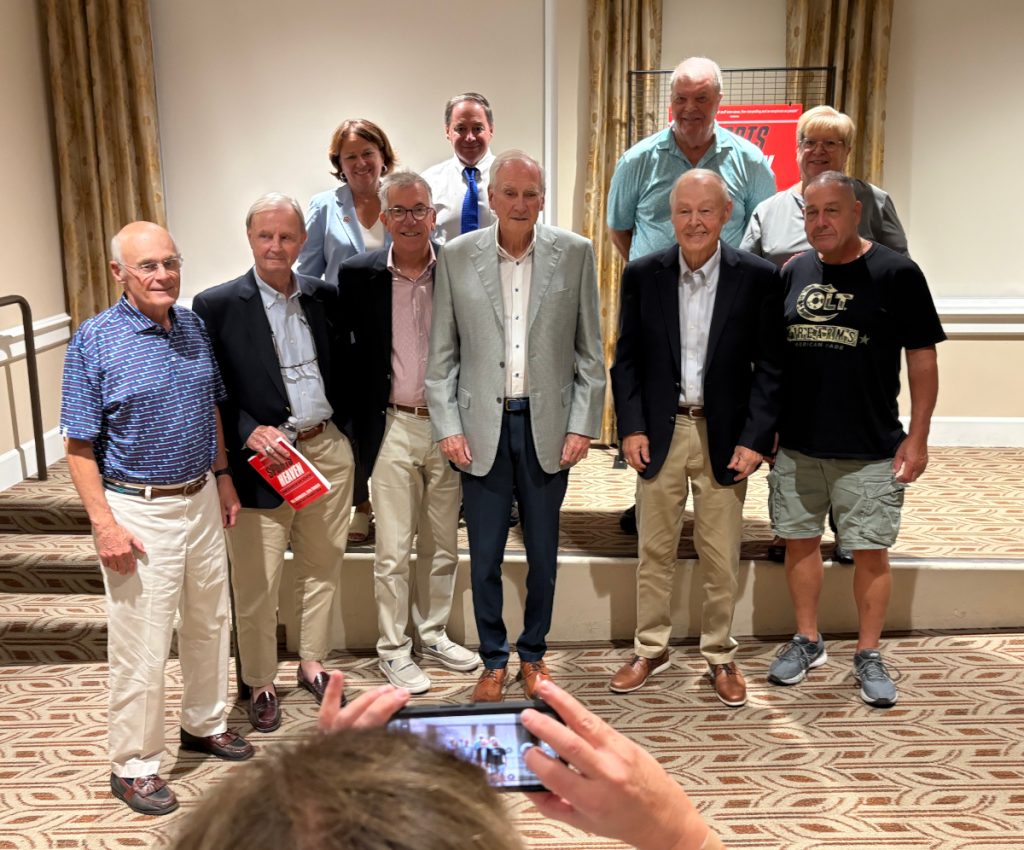
Post-discussion photo with discussion members and people, including family members of those integral to ESPN’s locating in Bristol. Front row, from left, attorney Steve Allaire, architect Geoff Bray, ESPN historian Mike Soltys, former Redevelopment Authority member Tom O’Brien, former Mayor John Leone and son of former Redevelopment director Sam Kasparian, Kerry Kasparian. Back row, Mayor Ellen Zoppo-Sassu, son of Redevelopment Authority chair, Jim Murphy., former Mayor Mike Werner, Kerry Kasparian’s wife, Kim Tabacco Kasparian. | David Fortier
Over the period of the ‘70s, ‘70 to ‘79, into the early ‘80s, we lost half. Half those jobs were gone. All the big companies shut down, Bussman, New Departure, obviously downsized big time.
We, and the guys sitting around the table here, we’re all working on a way to sort of replace it. And that’s where the technology park came. That’s when Mike’s idea to go and take the land from Tomasso came in.
I had a better experience (with Tomasso) because I came after…
He came over and we had dinner and lunch. I said, look, here’s what I’ll do. There’s like 60 or 70 acres that they didn’t take on the first taking of the industrial park…and here’s what we can do. Walt Murphy was a genius.
Walt says, ee’ll put the roads in and you can sell the land. We’ll get it on the tax base and we’ll get more jobs. And that’s exactly what he did. And Angelo Tomasso helped me after that because they put a free industrial park in for him, which was really not paid by Bristol.
It was paid by the federal and state government because Walt Murphy was smart enough to go get the money to do this. And those are the kind of things that happened. But Bristol, you know, Bristol had a mixed reaction.
I think, you said, the satellite dish won’t work. Everybody had antennas on. Back in the day, you went home and you turned the rotor around and you got four channels. And if you did it right, you got five or six, if you got lucky, you got the Giant games on Sunday. If you did it right. And I did it right. But ultimately, that’s how it worked back in the day. So Bristol wasn’t jumping up and down, but they weren’t totally critical of it.
Werner: But I would just say that anybody that knew Bill Rasmussen, he was such a positive guy. And you could tell he’s a visionary. I mean, he knew what he wanted to do, he knew how he wanted to do it, and he was so confident that it was going to work. It was infectious.
I mean, how would you not believe this guy? And I mean, he spent every dime he had on this project, and there was no skepticism on our part.
I know there were people who didn’t (believe him), who might have thought he was a flighty kind of guy, but he’s a brilliant guy, and besides, I love getting up at 3 a.m. and watching slow pitch softball.
O’Brien: Well, Mike talked about the first acquisition for expansion for ESPN, but we see the campus today. And the Redevelopment Agency had been very proud of the fact that they had all these small industrial buildings right along the street.
Well, now we had to go and take all of them and convince all of these manufacturers who were so proud of their companies: you have to move whether it was across the street or somewhere else in Bristol, hopefully. But there was one homeowner who had a home in the middle of the ESPN campus.
Anyone remember his name?
Soltys: He wouldn’t sell.
O’Brien: He wouldn’t sell forever. I mean, 10 years in, he still was there, adamant. They wouldn’t sell to ESPN.
Soltys: Our shuttle bus on the campus would drive by his house. It was a small piece of property, and he’s out there in a speedo.
O’Brien: Eventually, I think he passed away, and we were able to buy it from the estate. But it was the heirs didn’t want to sell either, just out of spite.
And this case went on for years before it was finally taken by eminent domain.
Werner: Now, when you talk about ESPN expansion, and since the statute of limitations has run out, I can tell you this. I got a call one day from the treasurer of ESPN, and I remember his name because it’s the same as mine.
He called me up and said, look, I got an issue with our taxes. Can I come see you? I said, Sure. So he comes up and brings his posse with him, and we’re sitting around the office.
He said, look, you guys are killing us.
Back then, the state of Connecticut allowed or had cities charge property tax on machinery and equipment. They’ve changed the law somewhat. I don’t think they charge Taxes that are all on it anymore. If they do, it’s a lot less than it was. But anyway, they were getting creamed on their equipment.
I said, so what do you need? What do you need from me?
He says, you got to at least reduce this by 25% or an extra. The oil company Getty is going to kill us.
Getty had them on a pretty short lease. So I’m thinking, state law says, I can’t do this. You have to go to a zoning appeals, a tax appeals board. But I’m thinking, you know, if I send them to the Tax Appeals Board, a) they may not do what I want; b) it’s going to take months, or at least a month, before they even meet; and c) the headline in the Bristol Press is going to be ESPN gets a tax break.
I thought, screw that. So I called our assessor.
I said, come on up here. We’ve got to talk. These guys have all kinds of equipment. You have no idea what this stuff is worth, do you? Now, this is long before Google. He had to use actual paper brochures and stuff to look up prices.
He said, well, we got books. We could look up stuff.
I said, come on. There’s got to be some wiggle room here, isn’t there?
He said, well, I think we’re pretty accurate.
I said, if I ask you to reduce their tax by 30%, can you sleep tonight?
He said, well, Mr. Mayor, I don’t know.
I said, let me ask it another way. If I ask you to reduce their taxes by 30%, can you sleep tonight?
He said, I guess I can. I can take care of it. So then he took care of it.
Right now, other than me and those guys in the room, you’re the only ones who know.
Soltys: About 10 years ago, Steve Collins was a reporter of Bristol Press at the time, there were three people who had either been on the city council in 1979 or on redevelopment who died within a very short period of time.
All of them in their Bristol Press obituary said they cast the deciding vote. That was kind of impressive. So maybe somebody’s going to write your obituary someday, but any of you cast the deciding vote.
This is your chance.
O’Brien: I don’t think there was a second vote. Well, it was a five to four vote, and the chair always votes last, so Jerry Murphy is the person who cast the deciding vote.
Leone: Imagine the thought about a five-to-four vote to bring in the largest taxpayer in the city’s history. And we’re talking about it 40, 50 years later. We almost lost that. Almost went wherever.
Werner: I want to carry what John was saying before about ESPN, because it wasn’t just a one-way street. It wasn’t Bristol just giving them everything. ESPN has given, besides the taxes and the employment, they’ve given it back to Bristol in spades more than we ever gave them.
Back when Scotty O’Connell was president of ESPN. I used to play racquetball with him twice a week at lunchtime up at the racquet club. And I always fancied myself a pretty good racquetball player, but then I found out that Scotty played on his college squash team and he buried me.
But he never left there without a few welts in his back from … my returns. I had to let him know he played just played racquetball with me. But anyway, Scotty made it a point to live in Bristol, to send a message to people that worked for him that we’re committed to Bristol.
And from him all down to today, every do-gooder board in town either has a yes from him, people on their board or volunteers in their agency.
They coach in the little leagues, they coach in the park department. My grandson played for an ESPN guy in his midget football team. So they’re everywhere. And anytime we needed a speaker, they’d bring in athletes, professional athletes, or some of their on air talent, or they’d bring people in from New York that you’d all know.
Anytime we needed anything from them, they were there. And like John said, they did that great marketing video, without which I don’t think the Little League Center would be here.
So it’s been a mutual thing. We helped them as much as we could, but they really gave back to us.
Leone: The other thing I want to mention is there are a lot of Bristol companies that worked for ESPN over the years. Lavero Construction, I think it was in 79, they were putting in the first dish. Those guys put in the first dish, a second dish and the third dish. And then he had Steve Massotti was an electrician, George Carpenter built a building, Eddie D’Amato’s group built a building.
So over and over, they put jobs in the Bristol marketplace. And it’s been great.
One last shot of the good ESPN has done here. Come about four or five years ago, they’re going to think about doing something to the Boys and Girls Club.
Morrie Lavero was sitting at the table and goes, ee got to do something. We got to build a new club. They were on Laurel Street. And the place was kind of not really up to speed. So he said, If we don’t do something right away, this place is going to close. It’s going to be really bad for the kids in Bristol.
Okay, so what are we going to do about it?
We’re going to get together and we’re going to build a Boys and Girls Club.
Yeah, good luck. It’s like $8 million. We haven’t got $30 in the treasury.
How are we going to do it?
Bottom line is, Morrie sets a meeting up on his picnic table. Bob Fiondella. me, and somebody else, and he says, we’ve got to figure out a way to raise $6 million.
Bob Fiondella reaches out to ESPN’s Rosa Gatti. He says, Rosa, could you help us out? And I think the number was $500,000. It could have been more. It could have been $600K. And that was the seed money that started the Boys and Girls Club expansion because basically what they did is they took that $600K to buy the land where the St. Ann’s School was. And that started the ball rooling. And then from there, it went on and on and on. And people came in, the Barnes Group, Webster Bank came around.
The state was very generous, too. State Rep. Betty Boukus was super. So people don’t know. The only thing they think about when they see ESPN is when they go out of town, I don’t care where you go, and they hear, well, where do you live?
I live in Bristol, Conn. And they go, Bristol, Conn? They say, where the heck is Bristol, Conn? You say, ESPN. ESPN? You live in Bristol, Conn. That’s where you live. ESPN, that’s where they are.
That’s what separates us from the rest of the world. And as long as ESPN is happy, it’s going to continue to keep separating us.
Soltys: I’ll let Tom have the last word here. Both Mike and John touched on what would Bristol be like here 47 years later if Bill Rasmussen had made a different decision.
O’Brien: Back then, condos were just coming into style. And the storage bins were the alternative, since the person with that organization was looking to take over that last piece of property. We would have additional storage for condos.
Soltys: Geoff, any thoughts on that? On what Bristol would have happened with Bristol with no ESPN. How would it be different to that?
Bray: Well, I live in New Britain, and New Britain was also an industrial center like Bristol. We’ve lost most of the large manufacturing companies as in Bristol.
We have many smaller companies now, but none of them have the same presence that the big ones once did. And I’m glad to see that ESPN has that presence here for Bristol.
It is the notoriety. And I’d just like to say one thing about Bill Rasmussen, all he really had to do was just smile at you, and whatever he was looking for, you just tended to say yes. He was a really great guy for ESPN.
He got pushed out way too early, unfortunately. But he was a great gentleman. And we lost somebody just recently that the world will miss.
Zoppo-Sassu:
Thank you, everyone. I thank all of you for being a part of that and I’m going to ask our panelists tonight as well as the Kasparians and Jim Murphy and Steve Allaire and anyone else who was there in the beginning to meet us in the back corner because we’re going to take a quick photo to commemorate tonight’s event as we get ready for the showing.
Source link