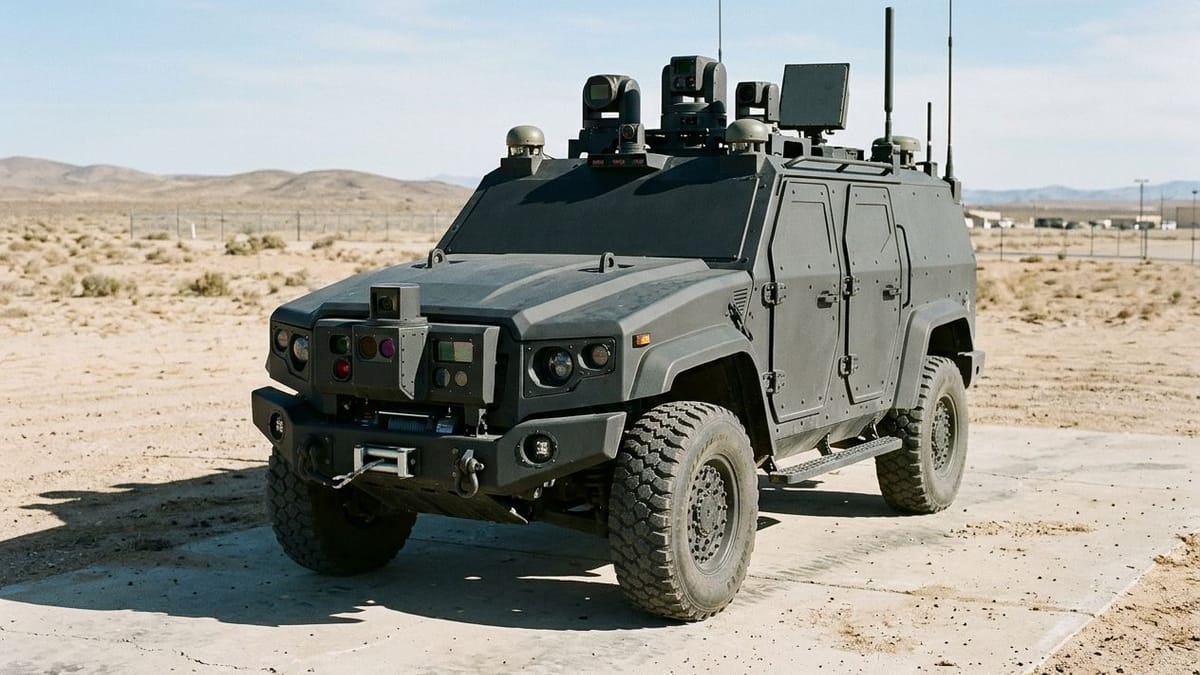
Harbinger just closed a $240 million funding round that pushes the Los Angeles-based autonomous vehicle startup past $650 million in total capital raised. The fresh cash comes as the company shifts gears from commercial electric trucks into military and defense applications, betting that Pentagon contracts will provide the revenue stability that has eluded many autonomous vehicle startups. It’s a strategic pivot that mirrors OpenAI’s recent defense push and signals where smart money sees the autonomous vehicle market headed.
Harbinger is making a calculated bet that the path to profitability in autonomous vehicles runs through the Pentagon, not consumer driveways. The Los Angeles-based startup’s $240 million raise announced today brings its total funding north of $650 million and validates a strategic shift that began quietly earlier this year when the company started developing driverless platforms specifically for military applications.
The timing couldn’t be better. Defense contractors and tech startups alike are racing to capture what industry insiders estimate could be a $50 billion market for autonomous military vehicles over the next decade. Harbinger’s pivot puts it in direct competition with established players like Oshkosh Defense and emerging startups that have already secured initial Pentagon contracts.
What sets Harbinger apart is its three-pronged approach. The company continues developing commercial electric trucks for fleet operators, builds specialized emergency vehicles for first responders, and now engineers autonomous platforms designed to operate in combat zones without human drivers. That diversification strategy addresses the revenue problem that has plagued pure-play autonomous vehicle startups, many of which have burned through billions chasing a consumer market that remains years away from meaningful adoption.
The defense angle isn’t just about new revenue streams. Military contracts typically come with longer development timelines, more patient capital expectations, and customers willing to pay premium prices for cutting-edge technology. It’s a stark contrast to the commercial trucking market, where razor-thin margins and fierce competition from established manufacturers have made profitability elusive for electric vehicle startups.
Harbinger’s approach mirrors moves across the broader tech industry. OpenAI recently hired a former Army Secretary to lead its national security efforts, while Salesforce dropped $375 million on defense AI startup Rune just weeks ago. The message is clear: government contracts, particularly in defense, offer the kind of stable, high-margin revenue that can sustain expensive R&D programs.
The $240 million round itself signals strong investor confidence in this strategy. While the company hasn’t disclosed the round’s lead investor or valuation, the size suggests participation from both traditional venture capital firms and potentially defense-focused investment vehicles. That mix of backers could prove crucial as Harbinger navigates the complex world of military procurement, where relationships and security clearances matter as much as technology.
But the defense pivot comes with risks. Military contracts require navigating byzantine procurement processes, maintaining strict security protocols, and accepting that sales cycles can stretch for years. The company will need to balance the demands of commercial customers expecting rapid iteration with military clients requiring exhaustive testing and certification. Managing that dual-track development could strain resources, even with $650 million in the bank.
The autonomous vehicle market has become a graveyard for overhyped startups. Companies that once commanded multi-billion dollar valuations have scaled back ambitions, merged with competitors, or shut down entirely. Harbinger’s bet is that military applications will provide the proving ground and revenue base needed to perfect the technology before commercial markets fully materialize.
That strategy is already attracting attention from other startups watching funding dry up in traditional autonomous vehicle categories. The shift toward defense applications could accelerate as more companies realize that Pentagon budgets offer a lifeline while consumer adoption remains sluggish. It’s reminiscent of how fusion startups have increasingly traded equity for federal funding as private capital becomes more selective.
Harbinger’s emergency vehicle platform represents another smart hedge. First responder agencies have proven more willing than consumers to adopt new technologies when they offer clear operational advantages. Autonomous fire trucks or ambulances that can navigate through traffic more efficiently could save lives while generating revenue and real-world data to improve the underlying technology.
The company’s $650 million war chest positions it to weather the current funding environment, where rising bond yields have made AI infrastructure buildouts more expensive and investors have grown skeptical of long development timelines. But money alone won’t guarantee success in the defense sector, where winning contracts requires demonstrating not just technical capability but also reliability, security, and the ability to scale production.
What happens next will test whether Harbinger’s multi-market strategy can deliver where pure-play approaches have struggled. The company needs to start converting its technology into actual military contracts while keeping commercial customers engaged and emergency vehicle programs on track. That’s a juggling act that will require exceptional execution and probably more capital down the road.
Harbinger’s $240 million raise and defense expansion represent more than just another funding round in the autonomous vehicle space. It’s a signal that the industry’s most promising path forward may run through military bases rather than suburban garages. Whether that bet pays off depends on the company’s ability to navigate defense procurement while maintaining momentum in commercial markets. For investors who’ve watched billions evaporate in the autonomous vehicle sector, Harbinger’s diversified approach offers a more pragmatic path to profitability. The real test comes when the company needs to prove its technology can handle not just highway driving, but the unpredictable demands of military operations.