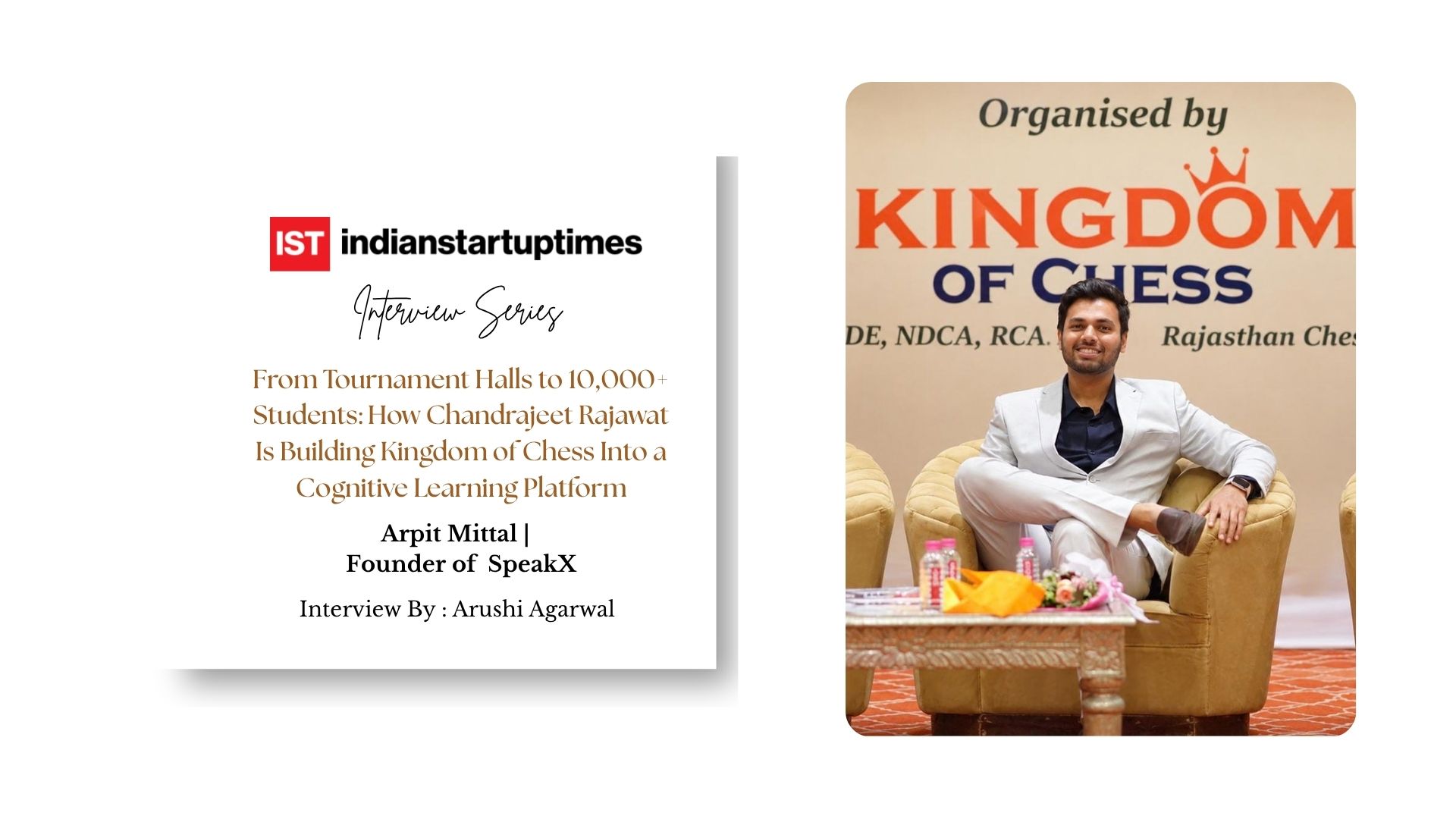
For Chandrajeet Rajawat, founder of chess education startup Kingdom of Chess, the journey from competitive chess to entrepreneurship was shaped by a combination of personal hardship, teaching experience and a desire to create better chess infrastructure for young learners.
What started as an individual pursuit of competitive chess has evolved into an education venture that has trained more than 10,000 students across 30+ countries. Founded in 2018, Kingdom of Chess has expanded from chess coaching into a broader education platform focused on technology, offline centres and cognitive development.
In a recent conversation with Indian Startup Times, Rajawat spoke about his unconventional founder journey, the evolution of Kingdom of Chess, its business model, recent funding and the company’s plans to build technology-led learning products.
From Competitive Chess to Entrepreneurship
Rajawat’s relationship with chess began at home after his father challenged him to play the game. What initially started as an interest developed into a serious pursuit of competitive chess.
His journey, however, was far from conventional. At the age of 17, Rajawat left home with limited financial resources to pursue chess. For a period, he relied on tournament prize money to sustain himself while travelling for competitions, including sleeping at railway stations during difficult phases of his journey.
The experience eventually led him towards teaching.
While pursuing competitive chess in Delhi, Rajawat began coaching students to support himself financially. Teaching gradually became more than a means of income. It gave him an opportunity to understand the gaps young chess players faced in terms of structured learning, mentorship and access to quality training.
That experience later became the foundation for Kingdom of Chess.
Building an Academy Around a Gap in Rajasthan
The idea for Kingdom of Chess emerged from Rajawat’s observation that children in Rajasthan lacked access to the kind of chess infrastructure and mentorship available in larger cities.
Founded in 2018, the company was built around the objective of creating a structured learning environment for aspiring chess players. It was subsequently incorporated as a company in 2023.
Today, Kingdom of Chess says it has trained more than 10,000 students across over 30 countries.
The company is also DPIIT-recognised and was named Best Startup at TiECON Udaipur 2025, adding to its recognition within Rajasthan’s startup and entrepreneurship ecosystem.
From Student Medals to National Recognition
For Rajawat, some of the company’s most important milestones have been directly linked to the achievements of its students.
One such milestone came when the first student trained by the organisation won a national medal. The achievement provided validation for the company’s coaching approach and demonstrated that the academy could help students compete at higher levels.
Rajawat’s own achievements in chess have also contributed to his journey. He is Rajasthan’s first FIDE Arena Grandmaster, a distinction that reflects his competitive background and continued association with the sport.
Another significant moment came when Rajawat was named an ambassador for Zoho, resulting in his appearance on billboards across India.
The company has also focused heavily on retaining students. According to Rajawat, strong student retention has remained an important contributor to the business’s growth, particularly because chess education often requires learners to remain engaged over a longer period to see meaningful improvement.
Chess Beyond Competition
While competitive performance remains an important part of the academy’s offering, Rajawat believes the value of chess extends beyond tournaments and medals.
Kingdom of Chess positions chess as a tool for developing cognitive abilities, including problem-solving, concentration, logical thinking and decision-making.
This approach is also influencing the company’s long-term direction. Rather than limiting itself to producing competitive chess players, the startup aims to use chess as an entry point into a wider cognitive development ecosystem.
Why Tournaments Are Not the Core Business
Kingdom of Chess has also organised large-scale chess tournaments, with cumulative event budgets exceeding ₹2 crore and substantial prize pools.
However, Rajawat does not view tournaments as the company’s primary scalable business model.
Instead, tournaments function as an ancillary component of the broader education ecosystem. They provide students with an opportunity to test their abilities in real competitive environments, understand where they stand against other players and gain experience beyond regular classroom training.
For the company, tournaments therefore serve both an educational and engagement purpose rather than being positioned as the primary revenue engine.
From Bootstrapping to a ₹1.62 Crore Seed Round
Kingdom of Chess operated as a profitable, bootstrapped business before raising its recent funding round.
The company has now raised ₹1.62 crore in a seed round led by BeyondSeed, a venture capital firm, giving it additional capital to accelerate its next phase of expansion.
The funds are being directed towards multiple areas, including technology development, offline learning centres and chess programmes in schools.
The funding also comes at a time when the company is looking to move beyond the limitations of a purely live-coaching model.
Building AI Tutors and Affordable Digital Learning
Technology is expected to become a central pillar of Kingdom of Chess’s next phase.
The company plans to invest in research and development around AI-powered tutors, gamification and standalone digital learning products.
The objective is to create products that can make structured chess education more accessible without requiring students to attend live classes for every stage of their learning journey.
Rajawat believes technology can help the company reach a substantially larger audience while reducing the cost and operational limitations associated with one-to-one or live coaching.
The long-term ambition is to reach one million students through technology-led products and AI-enabled learning tools.
Expanding Offline Through Franchises and Owned Centres
Despite its focus on technology, Kingdom of Chess is not abandoning physical learning.
The company plans to expand its offline presence through a combination of franchise-led centres and company-owned locations.
The strategy is aimed at addressing continued demand from parents and students who prefer in-person coaching while allowing the company to expand its geographical footprint.
School partnerships are also expected to form part of this expansion, enabling chess programmes to reach students within existing educational environments.
From Chess Education to Cognitive Development
Perhaps the most significant part of Rajawat’s long-term vision is the company’s ambition to eventually move beyond chess.
Kingdom of Chess is looking at the larger cognitive development market, with potential offerings around memory, logic, reasoning and mental sharpness.
In this vision, chess becomes more than a standalone subject. It becomes an entry point into a broader platform designed around cognitive learning and development.
This shift could allow the company to address a larger market beyond competitive chess alone.
Preparing for the Next Funding Round
With technology and offline expansion forming the core of its growth strategy, Kingdom of Chess is preparing for another major capital raise.
Rajawat said the company is planning to raise its Series A over the next 12–18 months to accelerate its expansion plans.
The proposed capital would support technology and product development, offline infrastructure, school programmes and the company’s broader ambition to reach millions of learners over time.
From surviving on tournament winnings and teaching chess in Delhi to building an education startup serving students across more than 30 countries, Rajawat’s journey has remained closely connected to the game that shaped his early life.
Now, with Kingdom of Chess, the founder is attempting to take that journey beyond the chessboard by combining education, technology and cognitive development into a larger learning platform.
Interview By: Arushi Agarwal