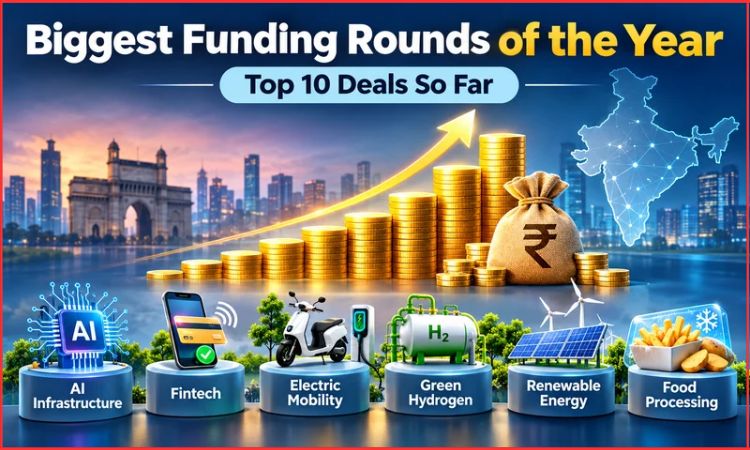
Money is still moving into Indian startups, just more carefully than before. The biggest funding rounds of 2026 show where investors are placing their bets: AI infrastructure, fintech, electric two-wheelers, clean energy and even frozen food. Cheques are getting larger, but they are going to fewer companies.
This list pulls together the largest startup funding rounds 2026 has produced between January and October. It covers who wrote the cheques, what each company plans to do with the money, and what the biggest startup investments say about the direction of Indian startup funding rounds in general. If you want to know which of the highest-funded startups are setting the pace, and why major venture capital deals look different this year, read on.
Founders will find a sense of what investors want to see. Investors and business readers will get a clear picture of where growth capital is heading, and how the top funding deals of 2026 compare with each other.
Top 10 Biggest Startup Funding Deals in India in 2026
The ranking below covers announcements made between January and October 2026. Where possible it counts reported equity or primary investment, not debt or secondary share sales, since those don’t put fresh capital into the company. A few deals are still subject to closing conditions, so figures can change. All amounts are in US dollars.
| Rank | Startup | Funding amount | Sector | Lead or key investors |
|---|---|---|---|---|
| 1 | Neysa | Up to $600 million | AI infrastructure | Blackstone |
| 2 | CRED | $450 million primary | Fintech | Meta |
| 3 | Rapido | $240 million | Mobility | Prosus |
| 4 | Sarvam AI | $234 million first close | Artificial intelligence | HCLTech, Bessemer Venture Partners |
| 5 | KreditBee | $220 million primary | Fintech | Hornbill Capital, Dragon Funds, Motilal Oswal Alternates |
| 6 | Simple Energy | $180 million | Electric mobility | Family office of Dr Arokiaswamy Velumani |
| 7 | Iscon Balaji Foods | $150 million | Food processing | Advent International |
| 8 | Hygenco | $105 million | Green hydrogen | IFC, Fullerton Fund Management, Siemens Financial Services |
| 9 | River | $102 million | Electric mobility | Elev8 Venture Partners, Claypond Capital |
| 10 | Radiance Renewables | About $100 million | Renewable energy | FMO, Impact Fund Denmark |
Source: The Company Check’s 2026 funding ranking, cross-checked against individual deal announcements.
The Top Funding Deals of 2026, Ranked: Deals 1 to 5
1. Neysa: Up to $600 Million
Sector: AI infrastructure
Funding: Up to $600 million in equity
Lead investor: Blackstone
Round: Series B
Neysa sits at the top of the largest startup funding rounds 2026 has seen so far, and the reason is fairly simple. Building AI takes more than clever code. It needs GPUs, data centres and dependable cloud capacity, and that hardware is expensive.
Neysa supplies that computing power to businesses and institutions that want to build and run AI applications. Blackstone is leading the equity commitment, and the company plans to use it to expand its infrastructure as enterprise demand grows. For a country trying to build AI capability at home, this is one of the biggest startup investments to watch.
One caution. The $600 million is the equity commitment only. A separate debt financing package is planned, and it is not part of this number.
2. CRED: $450 Million
Sector: Fintech
Funding: $450 million reported primary investment
Investor: Meta
Round: Series H
CRED landed the year’s largest fintech cheque. Kunal Shah’s company began with credit card bill payments and rewards, then moved into lending, payments and other financial products, all aimed at users with strong credit profiles.
The overall transaction was valued at roughly $900 million, but only $450 million is reported as primary capital. The rest involved existing shareholders selling their stakes, which is why headline numbers in major venture capital deals need a second look. Meta’s involvement is worth noting too, since it shows global technology firms taking Indian financial services seriously.
The fresh money gives CRED room to build out its products, technology and customer engagement.
3. Rapido: $240 Million
Sector: Mobility and transportation
Funding: $240 million
Lead investor: Prosus
Round: Series F
Rapido built its name on cheap, quick rides: bike taxis first, then autos and cabs. Short commutes in jammed cities are exactly where a bike taxi makes sense.
Prosus led this Series F. The business is a tough one, though. Driver supply, pricing, customer acquisition and operating costs all pull on margins, so the new capital will likely go towards expansion, better technology and a stronger network. For investors, Rapido is a direct bet on how urban India chooses to get around.
4. Sarvam AI: $234 Million
Sector: Artificial intelligence
Funding: $234 million first close
Investors: HCLTech and Bessemer Venture Partners
Round: Series B
Sarvam AI, based in Bengaluru, builds AI models with Indian languages, businesses and users in mind. That focus matters. A general-purpose global model often struggles with regional languages, local context and industry-specific needs.
The Series B first close will go towards research talent, computing infrastructure and products for enterprises and consumers. HCLTech’s presence on the cap table is a useful signal because it opens a path to enterprise deployment. Among the highest-funded startups of the year, Sarvam is one of the clearest examples of investors backing foundational AI research and not only applications.
5. KreditBee: $220 Million
Sector: Financial technology
Funding: $220 million primary capital
Investors: Hornbill Capital, Dragon Funds and Motilal Oswal Alternates
Round: Series E
KreditBee is a digital lender offering personal loans through an app-first model. It has grown alongside smartphone adoption and digital payments, and it serves people who want credit without queuing at a branch.
Lending has its own risks: credit quality, regulatory compliance, customer protection and repayment behaviour. Still, three investment firms put in $220 million of primary capital, which says investors continue to see value in fintech platforms that have wide distribution and room to add products. The money is expected to strengthen lending operations, technology and market reach.
Biggest Startup Investments Beyond the Top Five: Deals 6 to 10
6. Simple Energy: $180 Million
Sector: Electric vehicles
Funding: $180 million
Lead investor: Family office of Dr Arokiaswamy Velumani
Round: Series C
Simple Energy, a Bengaluru company, makes electric scooters and related mobility technology. Hardware startups burn cash in ways software firms never do. Factories, battery supply, distribution and after-sales service all have to be funded before a profit shows up.
The company plans to spend this Series C on manufacturing capacity, higher output and a wider sales and service network. Rising fuel costs and government support help the category, but success will hinge on reliability, battery performance and price against established two-wheeler makers.
7. Iscon Balaji Foods: $150 Million
Sector: Food processing
Funding: $150 million
Investor: Advent International
Round: Series A
This one surprises people. Iscon Balaji Foods makes frozen potato products for restaurants and other commercial buyers, and Advent International is putting $150 million behind it.
India’s organised food business is growing on the back of restaurant chains, organised retail and demand for convenient food. The deal proves that Indian startup funding rounds are not reserved for apps and software. Traditional industries with modern manufacturing and distribution can attract serious institutional money, too. The capital will support production, infrastructure and expansion at home and abroad.
8. Hygenco: $105 Million
Sector: Green hydrogen
Funding: $105 million in conditional equity
Investors: IFC, Fullerton Fund Management and Siemens Financial Services
Round: Series C
Green hydrogen is made by splitting water with renewable electricity. It matters most for sectors that can’t easily switch to direct electric power, such as steel, chemicals and fertilisers.
Hygenco’s equity agreement drew international institutions and an industrial finance player. The costs are the obvious hurdle: production, infrastructure, transport and long-term demand all remain open questions. The announced equity is also still subject to closing conditions, so treat the figure as a commitment, not cash in the bank.
9. River: $102 Million
Sector: Electric mobility
Funding: $102 million
Investors: Elev8 Venture Partners and Claypond Capital
Round: Series C
River makes electric scooters designed around practical, everyday use. Its Series C shows investors are willing to back EV makers that target ordinary buyers, not just early adopters.
The scooter market is crowded. Legacy automakers and newer EV brands are all competing on price, range, performance and charging access. River will use the funds to expand manufacturing and retail and to improve product development, but trust, quality and service reach will decide how far it goes.
10. Radiance Renewables: About $100 Million
Sector: Renewable energy
Funding: Approximately $100 million
Investors: FMO and Impact Fund Denmark
Round: Series C
Radiance Renewables closes out the list with roughly $100 million in equity. It supplies solar and other renewable power to commercial and industrial customers, a group that includes manufacturers, logistics firms and retailers trying to cut electricity bills and emissions.
The funding will help build its project pipeline, add capacity and serve more customers. It also reflects a wider shift: investors increasingly treat renewable energy as long-term infrastructure, not an experimental technology.
Startup Funding Trends 2026: What These Deals Reveal
Line the ten deals up side by side and a few patterns jump out. Together they explain where major venture capital deals are heading.
AI is pulling in the biggest cheques
Neysa and Sarvam AI attack different problems. One supplies the computing power, the other builds the models. Both fill gaps in India’s AI build-out. According to Inc42’s Q3 2026 report, AI startups raised $438 million in the quarter, a 265% jump year on year.
Electric mobility keeps attracting capital
Simple Energy and River show investors still want exposure to electric two-wheelers, batteries and manufacturing. Money alone won’t save an EV company, though. Pricing, product quality and a dependable service network decide who survives.
Clean energy is now an investment priority
Hygenco and Radiance Renewables point the same way. Green hydrogen, commercial solar and industrial renewables are drawing funds from investors who want long-horizon assets and who expect corporate demand for cleaner power to grow.
Investors are looking beyond consumer tech
Iscon Balaji Foods is the clearest case. A frozen food maker in the top ten would have been unusual a few years ago. It shows that among the largest startup funding rounds 2026 has produced, traditional sectors with modern operations can compete for institutional capital.
Large rounds are getting more concentrated
This may be the most telling trend in startup funding trends 2026. Inc42 reports that Indian startups raised $2.2 billion across 210 deals in Q3 2026. Total funding rose 5% year on year, yet the number of deals fell 13%. Growth-stage funding climbed 33% to $1.1 billion.
Put simply, more money is going to fewer companies. Investors are being choosy and favouring businesses with proven models and a clear route to expansion.
What the Biggest Startup Investments Mean for Founders and Investors
For founders, the top funding deals of 2026 are a map of where institutional money is going. AI, clean energy, mobility, fintech and manufacturing all have a case to make. But a good sector is not enough. Investors still want to see revenue growth, operational discipline, real demand and a believable path to profit.
For investors, the lesson is to look for companies solving large problems with models that are hard to copy.
Smaller startups can learn from this too. They can study how the highest-funded startups position themselves, spot customer groups that are underserved and build narrow, specialised products.
One more point, and it applies to everyone: a big round is not a scorecard. What counts is how well a company spends the money, earns revenue and builds something that lasts.
Conclusion
The biggest funding rounds of 2026 tell a story that goes beyond consumer apps. AI infrastructure, language models, electric scooters, green hydrogen, solar power and frozen food are all pulling in serious capital. Neysa, CRED, Rapido and Sarvam AI show the scale at the top, while Simple Energy, River and Radiance Renewables show how much weight manufacturing and clean energy now carry.
What happens next depends on execution. Investor confidence opens the door, but each of these companies still has to turn funding into growth, products people trust and, eventually, profit. Founders, investors and business leaders should watch how these top funding deals of 2026 play out over the coming quarters.