
A new investor syndicate, which brings together two of Atlanta’s prominent research institutions, is investing in more local healthcare entrepreneurs.
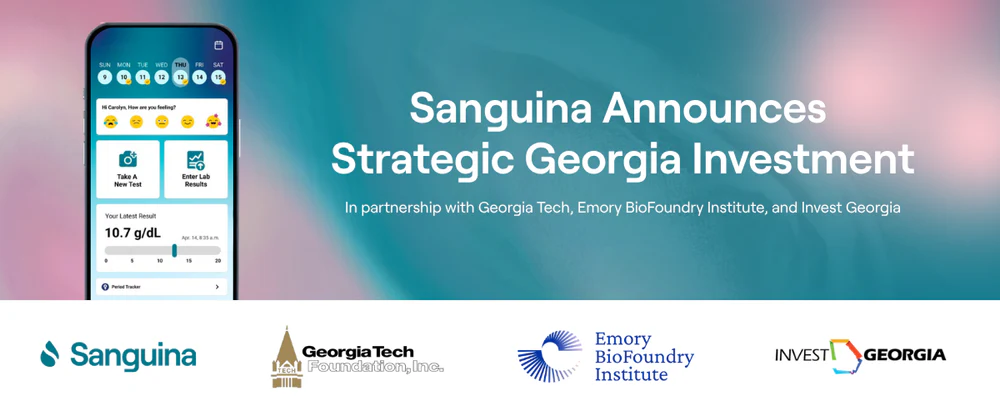
The syndicate, a collaboration between EBFI (the Emory BioFoundry Institute), Invest Georgia, and the Georgia Tech Research Impact Fund, has announced its latest investment into Sanguina, a wellness and diagnostic company offering at-home anemia management tools.
Sanguina’s flagship technology is an AI-powered smartphone application that analyzes a simple fingernail photo to provide insights into blood health and help users monitor indicators associated with iron deficiency and anemia (a problem that impacts close to two billion people worldwide).
“Wellness at your fingertips”
Sanguina was founded on intellectual property developed at both Georgia Tech and Emory University. The startup, which has the motto “wellness at your fingertips,” got off the ground in 2014 and got its app into the app store in 2020.
Co-founders of the company include Erika Tyburski (CEO and Georgia Tech graduate), Wilbur Lam (Vice President of Entrepreneurship at Emory University and the Associate Dean of Innovation at the Emory School of Medicine), and Tom Stribling.
Tyburski said that EBFI connected with her last summer.
“From that meeting, we discovered that our Emory co-founders already had great overlap with the EBFI. We were so fortunate to connect at the time we did as we were fundraising and we could work with the teams locally to integrate them into the Sanguina vision. I’m so proud to have a GA-based funding round and this GA-based network supporting us,” she told Hypepotamus.
The funding will go towards Sanguina’s FDA clearance of its app technology, which “enables our team to focus on generation of recurring revenues and key data set generation,” she added.
Prior to this 2026 investment, Sanguina has raised $5.6 million in outside capital, according to Crunchbase.
Building A Local Investment Model
Knox Massey at Invest Georgia said that the syndicate, made up of Invest Georgia, Emory University’s EBFI, and Georgia Tech’s Research Impact Fund, “represents one of the first collaborative efforts among Georgia-based investment entities to fund and grow a fantastic company such as Sanguina. We look forward to working with EBFI and Georgia Tech over the next several years to find and fund great Georgia-based companies.”
EBFI’s director Michael Tanenbaum told Hypepotamus that the syndicate is “focused on high quality opportunities where our syndicate partners and broader network can uniquely accelerate a company’s path to market. We’re fortunate to have strong syndicate partners and pipeline, and we look forward to building the whole ecosystem with them whenever the right opportunities come through.”
Beyond the investment check, the syndicate provides guidance that helps founders translate science into real-world products.
“We focus on early planning around intellectual property, regulatory pathways, clinical workflow integration, reimbursement strategy, and commercial scalability. We actively open doors to connect startups with strategic partners, advisors, and potential future investors. Our goal is to surround founders with the expert guidance and relationships they need to clear key milestones and scale with confidence,” he added.
The syndicate is looking to address a key problem that Georgia-based biomedical startups face: Access to capital.
While the state is home to some of the top biomedical engineering schools and leading hospital systems in the country, entrepreneurs in the state have historically lagged behind when it comes to access to venture capital. Investing in local companies, like Sanguina, is about “putting the region’s innovation pipeline” on the map of other investors, according to a press release.
Source link