
“Increase the GDP of the internet”, has got to be one of the best corporate mission statements in the world.
It’s
I’m increasingly convinced that the unstated mission statement of foundational-AI platform labs like Anthropic and OpenAI, especially Anthropic’s, is the opposite of Stripe’s.
It is, “to consume the GDP of the internet”.
Up till mid-2025, it seemed like the growth of their valuations was untenable. But increasingly, I’m beginning to see (not agree) their valuations as a bet by investors on being able to capture the internet. That the winning lab captures everything economically valuable that humans currently do online (search, discovery, downloads, learning, professional work, marketing, transactions, running a business, making payments).
This column had earlier framed AI labs as merely enabling tools, and that the closest analogy was that they were “selling shovels” in a massive AI “
But that’s no longer accurate because both Anthropic and OpenAI (playing catch-up now) are now visibly building planet-scale loops to consume economic value from every adjacent surface back into themselves.
They’re launching vertical, industry-focused apps like
They’re creating private equity-backed services arms like Anthropic’s $1.5 billion
They’re creating retail and SMB (small and medium-sized business) apps like
Buried within these higher-order strategies lie integrations via connectors (MCP), plugins, and skills.
There’s frankly no precedent for all of this happening all at once. We’ve had powerful tech platforms in the past, but they’ve usually picked and stayed on one side of the retail-wholesale boundary. In SaaS, for instance, platforms from SAP to Salesforce broadly played wholesale and let ecosystems play retail.
Similarly, in mobile, Apple and Google played retail and let SaaS play wholesale.
What we’re seeing right now is not just a collapse of the retail-wholesale boundary but also their ingestion at the same time.
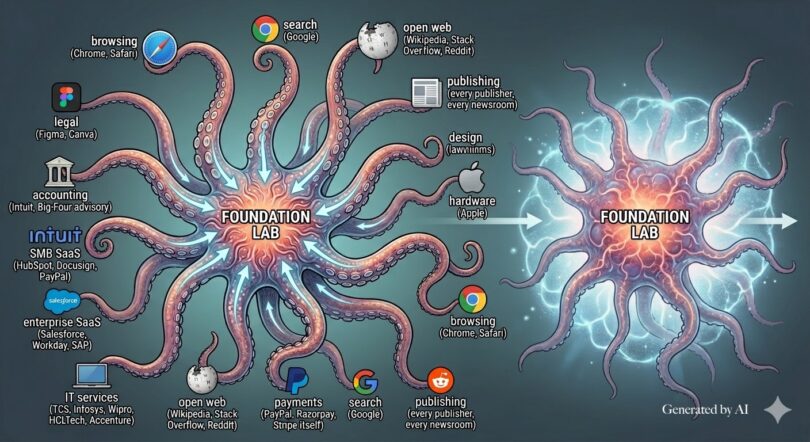
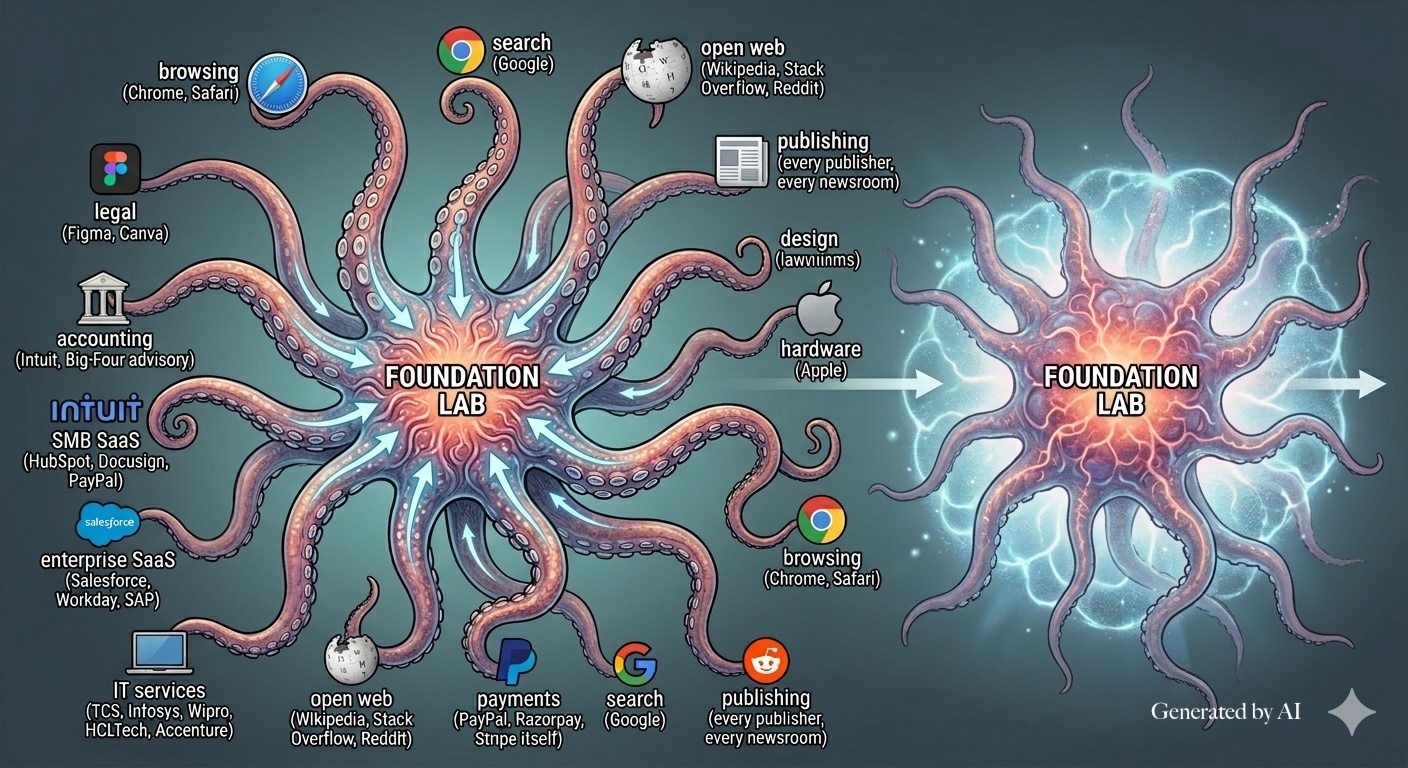
If I had to imagine it visually, it’d be the foundational lab as a single organism with tentacles and suckers. Each tentacle attaches to an existing app, profession, or industry. Each sucker pulls knowledge, data, and revenue back into the central body. Over time, the tentacles thicken, the suckers grow more efficient, and the body itself extends past the need for the tentacle altogether.
Obviously, I had to use AI to depict this.
It moves and grows through successive steps:
- Ingest: “Attach” to a new industry vertical via MCPs, connectors, plugins, and integrations. These allow knowledge and workflow data to flow in. The public framing of this stage is usually as a partnership with quoted partner praise on the launch page. For instance, Anthropic’s Claude for Small Business names Intuit Quickbooks, Paypal, Hubspot, Canva, Docusign, Google Workspace, and Microsoft 365 as connectors, with formal partner quotes from Intuit’s Joe Preston, Hubspot’s Angela DeFranco, and Canva’s Anwar Haneef.
- Codify: Once enough context and knowledge have been ingested, package it as skills, agentic workflows, or vertical bundles. The work that used to be done inside the tool is now done by the agent on top of the tool. Anthropic’s SMB launch ships 15 “ready-to-run” agentic workflows and 15 skills built on “the repeatable tasks owners told us slow them down most”. The tools recede further into the background as the agents become prominent.
- Sever: The tools that started as connectors can be substituted by a new or rival connector, or completely eliminated. The pre-AI platform precedent for this is Apple’s “
SherlockingNPRApple just made your app obsolete? You’ve been ‘Sherlocked’ ”. Karelia Software’s Watson became Sherlock, f.lux became Night Shift, Pocket became Reading List, Tile became Airtag, 1Password became Passwords.
Except, now we’re not about to see merely OS-level, but internet-level Sherlocking.
Unlike prior platforms like, say, Microsoft Windows or Apple iOS, Anthropic is agnostic to which side of any disintermediation wins, because it collects from both.
Let’s take the legal space. Earlier this week, Praveen and I spoke with Shashank Bijapur, the co-founder and CEO of Spotdraft, for an upcoming episode of the Zero Shot podcast. We discussed how in-house legal teams use Claude to take work back from law firms even as law firms use Claude to do more with fewer associates. Both are paying Anthropic, which wins regardless of which side “wins”.
It’s the same logic for marketing (in-house vs agencies), research (in-house vs analysts), content (in-house vs studios), or support (in-house vs BPOs). In every category with an intermediary, the lab is the only stable beneficiary.
Closer home, in India, IT-services firms get hit by the ambitious PE-backed wholesale JV moves from Anthropic and OpenAI. The JVs do what TCS, Infosys, Wipro, HCLTech, Capgemini, and Cognizant have been selling.
“That strikes at the core economic engine of traditional services firms: large labour pyramids monetising implementation, maintenance, and process management. The first thing services firms need to stop doing is pretending AI is an efficiency overlay on the existing model,”
Individually, each of these moves reflects moves we’ve seen earlier.
Microsoft during the
Collectively, we’ve never seen all of these playing out all at once from the same companies.
I’m worried for Stripe and its mission.
This week on the Zero Shot podcast
Hi! This is Vidhatri, the producer of Zero Shot.
Take a look at this comment posted on Hacker News 38 days ago:
“They (OpenAI) had the best tech, the largest installed base, the best brand recognition. Somehow, instead of pressing their lead in all areas, they became hubristic and sloppy. They failed to iterate on the core product and responded too slowly when Anthropic showed that coding agents are the flywheel that accelerates the entire company. It’s like they thought they had an unassailable monopoly and speedran to the lazy incumbent position, all in a matter of months.”
I had a similar conversation with a bunch of friends over dinner the other day. We were all talking about how Anthropic seems to be ahead in the AI race, launching plugins and agents for industry after industry and shaking up markets in the process. All non-techies, mind you.
Among the recent launches (it’s hard to keep track) are their agents for financial services. They dropped on 5 May and generated a lot of conversation.
Typical of anything Anthropic does. We wanted to step back a little and understand what these tools were capable of and how they change workflows in finance—an industry that has traditionally been tech-forward.
And that’s what we did in the latest episode of Zero Shot.
Here’s a great summary of Anthropic’s moves by our host Praveen Gopal Krishnan: “Anthropic is picking its battles very carefully. They are going towards specialisation and verticalisation. Last year, they launched Claude for Financial Services. And now for agents, it’s financial services again.”
Tune in to listen to the episode on Spotify, Apple Podcasts, Youtube, or The Ken app.
Source link