Lehi, Utah — May 27, 2026
When Ashish Fernando packed his life into his car in the spring of 2020 and drove west from Boston to escape the claustrophobia of the pandemic, the plan was to reach the West Coast. But Fernando, an avid skier, made a fateful pit stop in Utah to sample the powder.
He never made it to California.
Captivated by the towering peaks of the Wasatch Front and the proximity of world-class resorts like Alta and Snowbird, he bought a house in Draper. What began as a temporary detour to “The Greatest Snow on Earth” has quietly evolved into one of the most compelling tech stories in the Silicon Slopes. Fernando didn’t just bring his skis; he brought a burgeoning artificial intelligence startup.
Today, Fernando and his co-founder, Vaibhav Gupta (VG), are the architects of Edmo, an enterprise AI operating system that is actively untangling the massive administrative bottlenecks of some of the largest universities in the United States. Operating out of the Kiln Lehi, with a global team of over 120 people, Edmo is an ed-tech powerhouse hiding in plain sight.
This isn’t just a story about a COVID-era geographic relocation. It’s a masterclass in startup agility, detailing how two founders built advanced AI years before ChatGPT made it a buzzword, survived a pandemic pivot that saved their company, and are now fundamentally rewiring the back end of higher education.
And for Fernando, it’s a story of finding a home in Utah—and using his technology to protect the very mountains that drew him here.
Act I: Turning Down Yale and Building AI Before It Was Cool
To understand Edmo’s current dominance in the enterprise ed-tech space, you have to go back to 2013, to a high-school student in Pune, India, trying to navigate his way to an American university.
Like millions of international students, Fernando was forced to rely on the “master-agent” model—a notoriously flawed system where local recruiters often push students toward universities that pay the highest commissions, rather than the schools that fit the student best.
Despite the friction, Fernando possessed a stellar academic profile. He applied to several top-tier institutions independently and was accepted into both Yale and Columbia. But in a move that his mother still playfully resents today, he turned down the Ivy League. Instead, he chose Bentley University in Massachusetts, purely because they offered him a full-ride scholarship.
That experience planted a seed. After graduating and becoming an early employee at the Boston-based startup Quantiphi Analytics, Fernando couldn’t shake the frustration of his own admissions journey. He knew international students were being misguided and misrepresented. He wanted to fix it, and he believed the newly emerging field of artificial intelligence was the key.
Partnering with VG, Fernando launched iSchoolConnect in 2018. Looking back, their technological foresight was staggering.
“At that point in time, an online AI platform for international admissions was unheard of,” VG explains. “We were perhaps one of the first companies using AI to help students with admissions. This was in 2018 and 2019, long before generative AI was sexy.”
While the rest of the tech world was still grappling with basic algorithmic functions, Fernando and VG were building advanced chatbots. They engineered an AI tool that provided qualitative, real-time feedback on student application essays—analyzing not just grammar, but a student’s motivations and career plans. They even built an AI-driven interview practice tool that analyzed a student’s body language, facial movements, and speech patterns to help them prepare for rigorous admissions and visa interviews.
The market responded. By early 2020, iSchoolConnect had grown into one of the top five online student platforms in the world, catering to roughly a million students every month.
Then, the world shut down.
Act II: The Pivot and the “Undiluted Series A”
The COVID-19 pandemic decimated the international student market overnight. Borders closed, university campuses shuttered, and iSchoolConnect’s direct-to-consumer user base evaporated. For many startups, this would have been an extinction-level event. For Fernando and VG, it was an opportunity for one of the most brilliant pivots in recent ed-tech history.
With international travel at a standstill, higher education institutions were suddenly faced with a massive, unprecedented challenge: how to securely test and proctor millions of students who were now locked down at home.
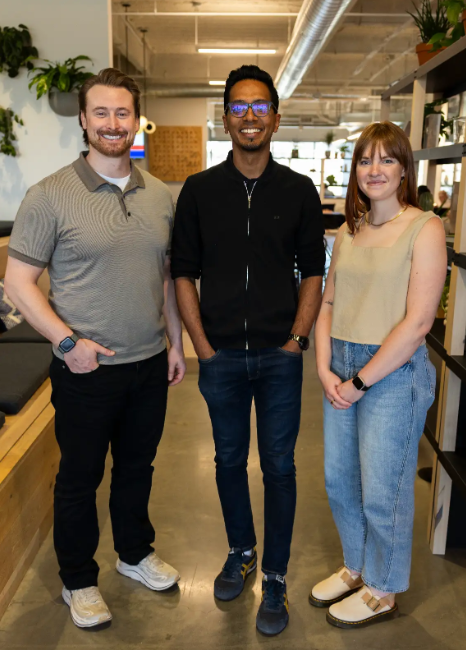
The Edmo team realized they had the exact technology the market needed—it was just facing the wrong direction.
“We retrofitted our interview practice tool to make a proctoring solution,” VG recalls. The facial recognition, movement tracking, and speech analysis software that was originally designed to help a student practice for a visa interview was incredibly effective at ensuring a student wasn’t cheating on a remote biology final.
They quickly partnered with ExamSoft and Turnitin, giants in the educational software space. Between 2021 and 2022, their retrofitted AI proctored roughly six million exams. The tool was so effective that it was ultimately acquired by ExamSoft and Turnitin.
For the company, this acquisition was a lifeline. “At a time when others were struggling, our proctoring business was booming,” VG says. The sale of the proctoring technology provided an injection of capital that the founders fondly refer to as their “undiluted Series A.” It kept the lights on, funded their operations, and most importantly, revealed their true product-market fit.
The pandemic had proven that direct-to-consumer ed-tech was highly volatile, susceptible to government restrictions, and difficult to scale. But the tools they had built—the essay graders, the interview analyzers, the document processors—were desperately needed by the universities themselves.
They stopped focusing on the students and started focusing on the institutions. iSchoolConnect faded into the background, and Edmo, the enterprise AI operating system, was born.
Act III: The AI Operating System for Higher Education
Today, Edmo is a sprawling, sophisticated platform that acts as the central nervous system for university admissions and student success departments. It is designed to solve the agonizing administrative bottlenecks that plague higher education.
“Think of Edmo as an AI operating system specifically built for powering higher ed institutions,” VG explains. The platform is built on three foundational layers: Document Intelligence, Conversation Intelligence, and System Intelligence.
The Document Intelligence layer is arguably the most disruptive. Universities receive mountains of diverse, unstructured data: domestic transcripts, international transcripts with wildly varying GPA scales, personal essays, and IDs. Traditionally, human admissions counselors have to manually verify, convert, and grade these documents.
Edmo’s AI ingests this unstructured data and standardizes it instantly. It features automated GPA conversion that can translate any international grading scale into a standard U.S. metric. But its crown jewel is credit transfer evaluation. For decades, transfer students have been forced to wait weeks to find out which of their past college credits will apply to their new degree. Edmo’s AI can accurately process and evaluate a student’s credit transfer in under four minutes.
The Conversation Intelligence layer features omnichannel AI copilots. For students, these bots deflect repetitive queries and offer 24/7 counseling. For academic advisors, the copilot sits directly inside their CRM, drafting communications, querying student data, and prioritizing leads, effectively turning a single human advisor into a highly efficient team.
Finally, the System Intelligence layer ensures that Edmo isn’t just another disjointed software tool. It integrates natively into the platforms universities already use, acting as a seamless plug-and-play solution for Slate, Salesforce, Ellucian, Workday, and OnBase.
This enterprise focus has allowed Edmo to secure massive clients. They currently work with five of the top ten online universities in the country, including National University and CSU Global.
But their deepest roots are planted firmly in Utah soil. They have worked extensively with Western Governors University (WGU), the Utah-based giant that stands as the nation’s largest online university. Their advisory board reads like a who’s-who of Utah higher education tech, featuring David Morales, the former CIO of WGU, and Rene Eborn, the renowned higher education tech leader at Weber State University who famously orchestrated a massive, statewide deal for Instructure’s Canvas platform in its early days.
As they expand their U.S. operations out of their Lehi office, they are actively engaging with Utah Valley University’s (UVU) new Applied AI Institute, looking to deepen their partnerships within the local ecosystem.
The Kicker: Protecting the Backcountry
Ashish Fernando may have arrived in Utah by accident, but his integration into the state is profoundly intentional. He is not just a tech founder holed up in a Lehi coworking space; he is deeply embedded in the culture and the community of the Wasatch Front.
When he isn’t securing enterprise software deals with massive universities, Fernando can usually be found in the mountains. He goes hard in the backcountry, prioritizing “untracked lines” over groomed resort runs. He is a certified avalanche rescuer, having completed rigorous AIARE (American Institute for Avalanche Research and Education) Level 1 and 2 training.
The devastating human cost of backcountry avalanches in the American West struck a chord with him. With deaths rising in recent winters, Fernando decided to look at the snowpack not just as a skier, but as a technologist.
He is currently collaborating with the Utah Avalanche Center (UAC), utilizing Edmo’s in-house AI engineering team and interns in India to build predictive models. By feeding decades of historical snow, temperature, and weather data into advanced machine learning algorithms, his team is working to better predict avalanche conditions in the Wasatch Mountains.
“We’re doing things to support the local community,” Fernando notes humbly, brushing off the complexity of tasking a world-class enterprise AI team with saving lives in the snow.
It is a fitting capstone to the Edmo story. From a teenager in New Delhi fighting for a fair shot at an education, to a founder building AI before the rest of the world caught on, to an executive rewiring the infrastructure of American universities.
Fernando followed the snow to Utah to escape a pandemic. In the process, he built a company that is shaping the future of education—and he just might use that same technology to make the mountains that brought him here a little bit safer for everyone.
Learn more about Edmo here and from the summary below:
Share this article