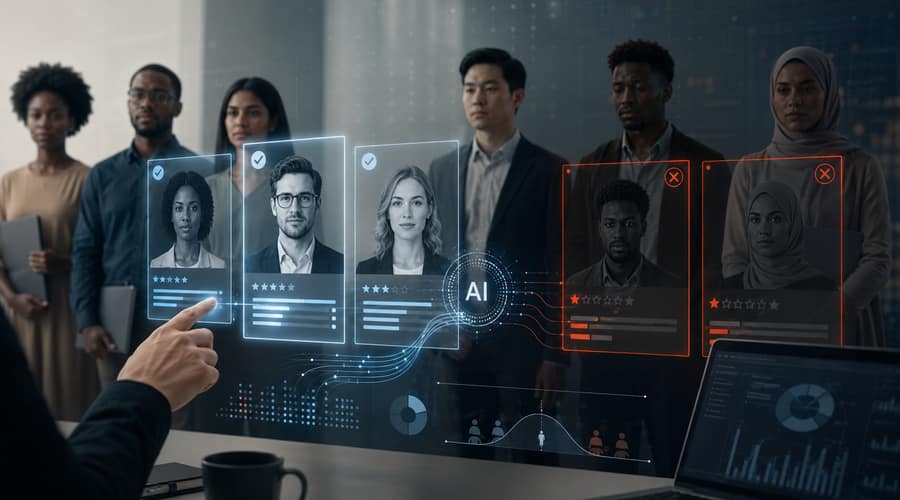
A new Stanford-led study says AI screening systems are rejecting Black and Asian applicants at higher rates, turning a long-running bias concern into a real compliance problem for hiring software vendors and the employers that use them.
The findings matter because this is no longer about one bad model at one company. The research examined 3.4 million people, 4 million applications, 1,700 job postings and 150 employers, and found that 26% of Black applicants and 15% of Asian applicants applied to positions where the AI system discriminated against their racial group, according to Stanford HAI. If AI hiring has become plumbing for mid-sized and large employers, then the bias is not isolated, it is built into the infrastructure.
That is why the study lands with such force. It does not just show that screening tools can be unfair in theory, it shows how the same vendor can influence outcomes across many employers at once. The paper says that when applicants repeatedly submit to roles screened by the same third-party system, they are more likely to be rejected everywhere they apply than they would be if each employer were making decisions independently. In other words, a shared model can create a shared failure mode.
The category drawing the most heat is automated screening, especially systems that rank, recommend or reject candidates before a human recruiter gets deeply involved. Stanford HAI described the hiring pipeline as applications being sent to a vendor, where machine learning models generate labels such as “recommend” or “do not recommend” for employers to use in decisions. That puts resume screening, candidate ranking and early-stage filtering closest to the center of the risk. It also means vendors that sit between employers and applicants face the most exposure, because one model can shape outcomes across an entire customer base.
The study also points to a structural problem that investors and founders should not ignore. Stanford said 90% of U.S. employers use AI screening tools to sort and rank job seekers, and most rely on the same few third-party vendors. That kind of concentration creates what the researchers call algorithmic monocultures, where the same logic gets reused again and again. Once that happens, bias stops looking like a software bug and starts looking like market-wide conduct.
For startups in HR tech, that changes the pitch. Selling speed and efficiency is not enough if customers now have to think about disparate impact, documentation, audits and notice obligations. It also shifts the burden upward into procurement, where legal, HR and compliance teams will want clearer proof that a tool does not disproportionately screen out protected groups. The study’s message is simple: buyers will increasingly ask not just whether the product works, but who it works against.
Regulation is tightening
The legal backdrop is getting stricter at exactly the wrong moment for vendors that have treated bias as a reputational issue. Illinois now requires employers to disclose when AI is used in employment-related decisions, including hiring, and bars the use of AI that has the effect of discriminating against protected classes or uses zip codes as proxies, according to reporting from legal and industry firms tracking the law. The state’s rules took effect on January 1, 2026, which makes this study feel less academic and more operational.
That matters for enterprise buyers as much as for startups. If a company deploys an AI screening tool and cannot explain how it treats race-linked outcomes, it may face not just vendor risk but its own exposure under state and federal employment law. Reuters has already reported on litigation over Workday’s AI hiring software, a sign that courts and regulators are willing to test these systems in public. The new study gives plaintiffs, regulators and employee advocates a stronger factual basis to do that.
There is also a procurement consequence here. Enterprises rarely buy hiring software just for novelty, they buy it to save recruiter time and process more applicants. But once compliance checks become part of the purchase decision, the competitive edge may move toward vendors that can document testing, logging, explainability and human review. That could favor larger platforms with legal and compliance teams over smaller startups that are still racing to ship features.
For founders, the practical lesson is blunt. Algorithmic bias is no longer a theoretical criticism from academics or regulators, it is a buyer objection and a liability question. For investors, that means diligence has to go beyond growth rates and seat expansion. The real question is whether a hiring product can survive when customers, regulators and courts all start asking the same thing: what happens when the model keeps rejecting the same people?
Also read: Carson Block rethinks India fund as AI pressure reaches portfolio construction • Africa’s AI funding is pulling startups back toward local capital • Sam Altman backs away from his AI jobs apocalypse warning