JOHN DOERR: We’ll call it US or Western VCs in China. Is that right? What’s wrong? What’s going on there?
AUDIENCE QUESTION: Yes. Hi, I’m Daniel. I’m studying computer science under policy and politics. Self-driving cars, where you see that going. Yeah, just a bird’s eye view.
JOHN DOERR: Let’s do two more questions and then I’ll try to tackle some of these.
AUDIENCE QUESTION: Hi, my name is Wei and I’m a business major. So I was wondering, what do you think about virtual reality? Where is it going?
JOHN DOERR: Yeah, it’s up here already. So I want to talk about it as one of the next big things. Virtual and augmented reality is the question. Last question, please.
AUDIENCE QUESTION: Hi, my name is Vishal. I’m a CS major and I was wondering what you think the importance of getting an advanced degree is on moving up in business and maybe pursuing a startup?
JOHN DOERR: Yeah. And what kind of advanced degree? Some sort of graduate degree, yeah. Master’s, PhD, MBA. Advanced degree before moving on. So I’m going to pick off a few of these categories, talk about them really briefly. Then I’ve got an overall framework I’d love to share with you. And then we can do some more questions. These are great, by the way.
The Next Big Thing: Green Technology and Climate Change
JOHN DOERR: I’m going to start here with the kind of next big thing. Somebody asked me the question, John, you were a really outspoken proponent of investing in green technologies. In fact, you said something like it’s the largest economic opportunity of the 21st century. Were you wrong? What do you think about this right now?
And my view of this is it remains an enormous opportunity. The planet spends about $6 trillion every year on energy and energy-based systems. And I’m of the conviction that the path we’re on is not sustainable. We cannot continue to put 120 million tons of CO2 in the atmosphere every day like it’s some kind of free, open sewer.
And the consequence of that is exactly what we’re seeing today, which I like to call global weirding. It’s not global warming. It’s global weirding as we have extremes in weather all over our country, all over the world. The people that will pay the highest price for this social ungood are going to be probably Africans, where it’s likely that 100 million of them will starve because they can’t grow crops.
And I think that the engineer in me tells me, not the data, but the engineer says, this is a problem. You know that’s the integral of all the CO2 we put in the atmosphere. And we’re probably well down the path to irreversible and catastrophic climate crisis. That means it affects a whole range of topics that are on this board. Policy, innovation, technology, entrepreneurship. They can all make the difference. And I’m quite taken by the statement of Amory Lovins, who runs the Rocky Mountain Institute.
And my partner Al Gore agrees on this. We have exactly as much time as we need to solve the problem. I find that a very hopeful declaration of what needs to be done there.
In the meantime, I want to confess that I’ve made, and my partners, mistakes in this area of green technology. I think we invested too much, we invested too fast. And arguably there have not been really dramatic innovations to change this carbon equation, to change the carbon equation.
A couple of the best that we’ve backed is a company called Opower. It’s eliminated the energy production of carbon equal to the city of Boston already, just by changing human behavior. Another very successful investment in this field is Nest, with the distributed thermometers. I think you can argue that Tesla is not having any effect on the climate, though it’s at the vanguard of electrification and transportation, which is a very large trend.
Fortunately, that innovation is happening in the area, and I believe the rumors about Apple building a car are in fact true, and reasons we may get into later on in this conversation.
Green Technology: A Spectrum, Not a Sector
So I think this is a very exciting field. It’s capital intensive. It takes longer to bring a product to market. And so I’d be very thoughtful about what part of green you go into if you choose that field. Green is not a sector. It’s a spectrum, and included in that spectrum are some places where entrepreneurs can make a big difference, and some places where entrepreneurs are likely to fail. And if you’re interested in those fields, I’d love to continue a conversation with you on email.
The Game Changer: Better Batteries
I think the totally disruptive technology that’s going to be the game changer in this field will be disruptive, radically better batteries, better batteries. If you look at improvement in energy storage over the last couple of decades, it’s been about 2% per year.
And I’ve had the privilege now of backing four entrepreneurs in four different battery companies, one of which has demonstrated now, and I had in my hand on Friday, a better than lithium ion cell with 250% of the energy density of the best other batteries. Those of you who even have the basic understanding that I do of batteries will know that all batteries cost whatever they weigh. So if we have 250% the energy density, that means it’s going to cost 40% of what it would have otherwise. It can pack 40% more power for a given weight.
And if you apply it to a vehicle like an automobile, that means a Tesla will go 750 miles, or more importantly, the most important part of a Tesla, which is that battery drivetrain, can be dramatically lower in cost. Let me boil it all down to the final benefit. If this innovation works, and it’s a Bay Area innovation, not only will it be possible, but we will build electric vehicles that cost no more than internal combustion vehicles. And when we move the global transportation fleet off fossil fuels to renewables, for example, that’s going to have a huge, rapid, relatively rapid, scalable effect on the carbon emissions.
But I believe it’s the case today, we have all the technology we need to deal with this policy problem.
Digital Health and Augmented Reality
Another question was, so what are other innovative, new areas that you’re excited about? And I’ll tell you, the one that I’m spending the most time right now is on digital health. We’ll hear more about that later.
We back the folks at Magic Leap that are building an amazing augmented reality display system, one that actually understands the physics of how the eye focuses, so that it doesn’t try to project onto an Oculus-like flat screen, a simulation of 3D, which generally will give you a headache and some people think will cause neurological damage. So you want to stay very tuned for the innovation coming from Magic Leap later this year.
The Big Deal: Social, Local, and Mobile Innovation
JOHN DOERR: The big deal right now, what all the venture capitalists are still excited about is Solomo, that’s social, local, and mobile innovations in and around these amazing smartphone devices, which has propelled Apple into being the most valuable company in the world. As an example of that innovation, you have on the local front, a company like Uber, which right now is generating four times the revenues in San Francisco of the entire taxi industry combined. So they’re very clearly changing behavior by providing on-demand transportation.
These local on-demand services, whether it’s an Uber or an Instacart or a Ship, are really profound. Think of this smartphone as your remote controller for the world, your remote controller for the world. And so what it will be able to do for healthcare and for education is, I think, as yet, unappreciated.
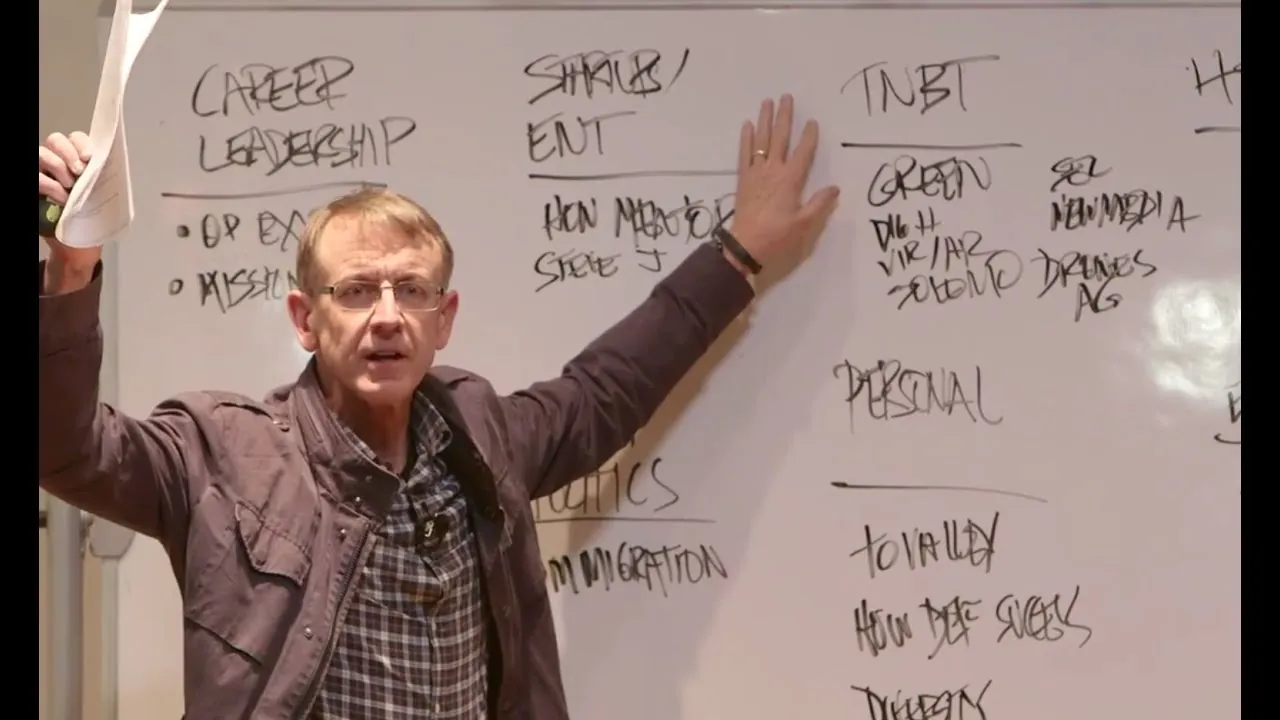
What else did I put up here? New media, drones, precision agriculture. Oh, this is security. I think there’s only two kinds of institutions today. Those that have been hacked and know it and those that have been hacked and don’t. In this arms race, the work that we need to do to protect, defend our increasingly vital infrastructure and systems that depend on the very insecure world wide web is substantial.
Okay, so that’s a quick tour of some, and may I say one more thing? No matter what my views are and my partner’s, we are open for the best ideas every day. We don’t presume to be smarter than entrepreneurs. And I’m delighted and surprised every day when we get new proposals that literally blow our minds.
Five Key Factors That Distinguish Extraordinary Ventures
Why don’t we go over to venture capital for just a moment and tackle some of your questions. How do you tell the difference between an absolutely extraordinary venture and kind of an average one that may do well and may not make it? And we looked back on the investments we’ve made and found there are five key factors that distinguish the Amazons and the Googles from the rest of the pack.
And the first is technical excellence. The second is outstanding founders and management. The third is strategic focus on a large, new market or unserved market. The fourth is execution, that is speed. How fast do you execute? And the fifth and final one is reasonable financings. Reasonable financings.
And for those of you who are taking notes, I think that’s a really smart thing to do, but I’m going to tell you at the end of this talk a way that you can get the notes from this conversation.
So five factors, technical excellence. Why? It’s not for published papers and PhDs. It’s so you can attract the absolutely most amazing talent to your organization, because if you have A technical people, other A technical people want to work with them.
Second, outstanding management and founders. I deeply believe in founder-led companies. The difference between an Amazon or a Google or a TradeSeat, for example, that are run by Jeff Bezos and Larry Page and Tracy DiNunzio is remarkable. And I’m not saying that all founders can always scale with their businesses. The really smart founders, if they know they can’t, will get a COO or even bring in a CEO for a while and then sometimes go back and run their company. But that commitment to have outstanding management is what’s going to allow us to execute.
Because execution at speed is everything. Thomas Edison said, “Innovation without execution is a hallucination.” So your ability to execute matters enormously.
I think large markets and strategic focus on those is pretty obvious. The last thing I’ll say about these factors is I’ve seen ventures raise too much money as well as too little. And when you run out of money, it’s over. So you always want to have maybe a cushion greater than what your plan is. But the way to make a lot of money building a venture, if that’s your number one goal, is not by cutting a tough deal with an investor or a venture capitalist. It’s by being ruthlessly intellectually honest about what the risk is in your venture.
How to Evaluate New Fields
JOHN DOERR: And then, tell you what, let’s get that risk up front and removed. Maybe can you get the product to work. Maybe can you close that strategic partner, that very large entity that’s got all the data you need. But if you focus on that, then clearly after that, your venture’s going to be more valuable. And if you need to, you can raise more money. These, we call, are staged finances.
How do you evaluate new fields, is what it says. I got to tell you, I just try to hang around the smartest people that I can. And so I’ve built a network of advisors, whether it’s Bill Joy in the future of computing, or who would be another good example of that. Larry Page. Younger innovators in their 30s. Dylan Field, who’s a Teal fellow who dropped out.
So I love innovation. I worship at the altar of innovators. I hang around universities. Every Wednesday night I have about eight college students, mostly from Stanford, over to our home for dinner. And then I read like crazy. I subscribe to six, yeah, old-fashioned print newspapers that land on the front door. About 35 magazines. One of my favorites is the MIT Technology Review. Another is The Economist. And then I read stuff on the web like crazy.
One of the important things I do when I’m trying to learn about a new field, and right now I’m really passionate about health and digital health, is I go to entrepreneurs and say, what should I read? What should I watch? And so I try to plow through about a book a week. And then I’ll invite the innovators in a field like that. It’s amazing what people will do if you just call them up on the phone. I ask them if they’re going to be in the Bay Area and then go have breakfast with them or lunch, something of that sort.
I wish I had the time to go back to university to take courses. I’ve kind of grazed on the Coursera courses, some of them anyway. And then I kind of blunder my way through these fields because I don’t really have to be expert in them. I just need to have some sense of taste and rely on the entrepreneurs to be the thought leaders and the innovators.
Qualities That Matter in Entrepreneurs
Okay, what are the qualities that matter in entrepreneurs? This is a pattern-matching thing. It’s like when you meet Jeff Bezos. You just know that you want to be in trouble with them. Jeff was a computer scientist from Princeton, exceedingly bright, and I remember walking into his offices in a very seedy part of Seattle. In fact, the free needle clinic was right across the street from his offices.
Jeff came bounding down from the loft in this place where they were distributing the books with a laugh that only could barely be described as a laugh. It was more like a honk. At that moment, from the intensity in his eyes and the way he talked, I knew there was a kind of personal bond that meant I wouldn’t mind being in trouble with Jeff.
One thing I’m pretty sure about is that any of the entrepreneurs that I get to work with who are going to do something world changing, we are going to get in trouble. The goal then in working with him is to try to make new mistakes, not repeat the same old ones. That was true of Larry Page, that was true of the Sun Founders, it was true of a stealth entrepreneur that I can’t really tell you about right now.
But it’s a great joy. I think the privilege in the work that I do is that I get to be off to the side and support entrepreneurs who are going to change the world big time. So that covers pretty much venture capital and Kleiner Perkins. We’ve got the next big thing started. Startups and entrepreneurs.
How to Mentor Entrepreneurs
How do you mentor entrepreneurs? What kind of mentoring do you provide? I think there’s a whole set of mistakes.
Scar tissue is not really wisdom, but scar tissue from mistakes that others and I have made that we don’t have to repeat. But we’re going to get in trouble. So the goal is to make new mistakes. I try to be online, rapid in response, and then bring some sort of simple scalable systems to companies so they can be even better.
I strongly recommend that entrepreneurs get a coach. I’ll try to fill in and do that job, but there’s also a network of professional coaches that make a big difference.
The Value of a Great Coach
I’m going to tell you a story about a UC Berkeley grad, Eric Schmidt, who we recruited to come work with Larry and Sergey when they were building Google. Not long after Eric arrived, I said, Eric, I think you ought to get a coach. He was really offended by this suggestion. I said, well, I’ve got this coach I want to recommend to you. He’s actually formerly a coach. He’s the football coach at Columbia University, kind of the legendary Bill Campbell.
So Eric said, yeah, yeah, yeah, yeah. He met with Campbell. Years later, he said it was the best piece of advice he’d ever gotten because Coach Campbell, who had been a CEO before and had coached a team before, became his co-pilot in building the Google company with Larry and with Sergey. I think if you spent time with Larry Page today, he would say the same thing about Bill.
What does a great coach do? A great coach gets totally aligned with you. They’ve got your back. They’re working with you to build the company. They might join you in a staff meeting. They’re going to privately give you constructive, critical feedback. That’s one of the rarest things to get in a business setting, is constructive, critical feedback. An extraordinary coach will also work with your teammates.
So I’ve got to tell you, when Bill Campbell walks into a room and he attends all the Monday staff meetings at Google, everybody just lights up. They want to be hugged by this big, burly, foul-mouthed, cussing coach from Columbia University that doesn’t make the decisions, doesn’t run the company, but helps the process.
A Framework for Career Decisions
We’re doing pretty well here. You know what I’d like to do now, if it’s all right with you, is I’d like to share with you a framework for career decisions you might make and a property, a quality I think you really ought to look for when you’re thinking about either starting your own company or the kind of company you might want to join. So without further ado, I’m going to move this away.
I think when you’re selecting what you’re going to do next, your top priority ought to be learning and growing, not making a lot of money, learning and growing. I strongly encourage you to build a strong foundation of experiences. If you’re going to be the CEO and founder of a company, I think you should learn how to sell. You really ought to learn how to get orders. If you don’t find customers and customers are going to pay for what you’re doing, you’re going to fail. You don’t need to learn that in a start-up. You can learn that on somebody else’s nickel.
You also ought to learn something about management, leading a team of at least a dozen or so employees, and then whatever the stage of your development, I think it’s really important to always network, to develop personal and lifelong networks, to have the confidence to cold call anybody that matters to you.
I remember when I was looking for my first job in Silicon Valley, I made a point of interviewing with 35 companies. I didn’t care what my grades were. I wanted to talk to Hewlett Packard and talk to Intel, talk to Fairchild and talk to Oracle and make those networks stay alive. These are not LinkedIn networks, they’re not social networks, they’re personal networks.
If you’re uncomfortable at networking, get outside your comfort zone. Learn how to do that really well. If you’re uncomfortable with public speaking, get really good at public speaking.
Advice for Early Career Decisions
I think people are judged by their ability to think and speak on their feet more than any other skill. I do think it’s a great thing, if you’re lucky enough to find and try to sustain a couple of mentors. Then pick your spot. Try to get in on the ground floor of a company that could be enormous for a couple of reasons. One, those companies tend to attract really good people you’re going to learn more from. Second, when the organization grows really rapidly, you’re going to be pulled right along because the organization trusts you. To get ahead, you don’t have to elbow somebody else out of the way. In 1974, that was Intel. In 2001, it’s Google. We can talk about where that might be next.
I think it’s important to be very choiceful about your field. It’s easier to change where you work, the company, than it is to move out of one field into another. If you’re passionate about health care, great, choose that as a field. If you’re passionate about media, that’s another kind of field. I do think you ought to swing for the fences. Find a startup or start up your own company when the time is right. But I deeply believe you have a lot of time in which to do that. We’re all short of time, but if you can learn a lot about growing companies from Uber or Square, whatever it is, I think you’ll move faster and further.
The Case for Leadership and Mission-Driven Culture
Here’s why. I think your ambition ought to be to be a leader. Why? Because ideas are, relatively speaking, easy. It’s teams that make stuff happen. You want to lead in a culture that’s going to inspire others, that’s going to put the mission ahead of their own personal interests.
Having spent some time in Silicon Valley now, I’ve observed a real range of values in these companies, from the missionaries to the mercenaries. What do I mean by that? My partner, Randy Komisar, wrote a great book. I’m going to suggest you get the book The Monk and the Riddle. It’s the story of Lenny, who’s an entrepreneur. He starts a venture called Funerals.com, where he intends to sell caskets and other paraphernalia associated with a death. The venture doesn’t go very well and the employees aren’t motivated.
He has a mentor. That mentor actually is Randy. Randy advises him to rethink his mission and the values. Instead of selling caskets, what if we focused on building a community of the bereaved and we allowed them to share their experiences. Then if they want these other things at that time, that’s great. So they shifted, they pivoted the company and it actually really worked. It worked very well.
Missionaries vs. Mercenaries
He talks, Randy, about the difference between a missionary and a mercenary. I want to say that you can find missionaries and mercenaries in all the companies that are in Silicon Valley and in all organizations. While I have a preference, I don’t want to be too judgmental here because most realities are somewhere along this continuum.
It was Andy Grove at Intel who coined the phrase everybody heard, “Only the paranoid survive.” I’d love to argue with Andy about this because paranoia is actually a disease state. If instead of being driven by paranoia, you can be drawn into an opportunity by passion. That’s another force and maybe a longer, more durable one.
The mercenaries tend to be more opportunistic and they’re focused on the pitch and the deal, whereas the missionaries are more strategic. They’re interested in the big idea and how you form a partnership. Mercenaries are sprinting for the short run and obsessing on competition. Missionaries understand that their mission is actually a marathon and they’re in it for the long run. They obsess on customers, not on competitors, delighting customers.
In mercenary organizations you may have an aristocracy of founders. If you’re the founder of a company, you ought to pay close attention, be really attuned to how you affect others. Because in an aristocracy you can shut down the best ideas.
Missionary vs. Mercenary Culture
JOHN DOERR: What you want to do is be in a conversation, be in a debate, be in a discussion and get all the best ideas on the table and let the best idea win. Otherwise you’re going to be limited to your own vision and your own thinking.
Mercenary cultures are interested in financial statements, the missionaries in the value statements. In a mercenary culture you’re more of a loner, you’re on your own, there’s not mentoring and coaching. This is important for where you choose to build your career. Are you going to be mentored? Are you going to be coached? Find a culture that emphasizes that.
In a mercenary culture there’s kind of an attitude of entitlement as opposed to a sense that everybody should contribute. And so they’re working on — it’s an insurance term — the deferred life plan. “I’m going to put off living in order to make this business succeed,” as opposed to trying to strike a balance so you can have a whole life, a whole life that really works.
The bottom line of all this is it’s the difference between a lust for just making money or a lust for making meaning and money. When I meet an entrepreneur who tells me they’re not interested in making money, I’m kind of asking myself, are they really telling me the truth? And there are some who are, there are some who are. But I think if you have the privilege of being not just successful but doing work that’s successful and significant, I think that will lead to a good life, a good life well-led.
Ideas Are Easy, Execution Is Everything
Ideas are easy. I worship at the altar of ideas. I love innovation. I bet everybody in the room here does. But I’ve seen so many disruptive ideas where there’s not been execution, the team doesn’t get it done, that it causes me to admire the innovators who can also lead, who can assemble, recruit, hire, and motivate a great team.
So that’s the framework that I’ve found across ventures and I encourage you when you’re interviewing at a company or thinking about what you’re going to do next to look for leaders, look for values, look for culture, find ventures that matter.
Q&A Session
What if we put some more questions up here on the board now?
AUDIENCE QUESTION: Hi, I’m Sandhya. I’m in bioengineering and I wanted to know your take on healthcare and venture capitalists and if they really consider FDA approval as a big hurdle.
JOHN DOERR: This is a great topic I’m really interested in so I’m just going to put it up here in red. Healthcare and VC including but not limited to the FDA. Okay, a couple more.
AUDIENCE QUESTION: My question is that in the past did you miss out on identification of any of these big ideas and did not invest in those big companies that you regret right now?
JOHN DOERR: Oh yeah, there’s two things I could confess to. One is my most famous failures but the biggest problems are the acts of omission, you know, big opportunities we miss. So I’ll try to get to those.
AUDIENCE QUESTION: Getting back to the career aspects that you were talking about, especially early on internships and our first job, is it worth trying to get those big names on our resume to kind of establish ourselves? Because if you go straight into startups I think a lot of times with internships the connotation can be you couldn’t get the big name.
AUDIENCE QUESTION: Okay, how can we get in touch with you?
JOHN DOERR: So my email address is kpcb.com and you can send me mail and if you would like a copy of those slides or a photo of this whiteboard, if you will send me the names of your three favorite books that sort of changed your life or otherwise that you just think I ought to read, then I’ll send you mine. That’s the deal. So that’s how to get ahold of me.
AUDIENCE QUESTION: So you said that it’s important to keep your networks alive and to create a network. Can you explain how you do that? How do you network?
JOHN DOERR: Sure.
AUDIENCE QUESTION: I know you talked about earlier your criteria for what you look for in a successful startup. Can you give us an example or a couple or a pattern where you’ve seen a startup that fits all those criteria perfectly and then for whatever reason down the road fails?
JOHN DOERR: Can I give you an example of that? Thank you. I ought to be able to come up with one. So I’m going to put that under startups that meet the criteria but still fail. Yeah, all right. So I want to do these for a while and then maybe we’ll wrap up and cover some more topics later on.
Education: A Divided Market
With respect to education, I think of the education market globally as being divided into two and I’m informed by the US education system but not confined to that. I think there’s the elementary public education system in the US which has failed. It’s killing our kids. 20% of the kids in American schools don’t learn to read. They don’t learn to manipulate symbols. That’s code word for algebra. They don’t learn how to express themselves. You don’t read. You can’t really write. You can’t program. You can’t create with art. And that’s a national tragedy and it’s intolerable.
I’ve worked in the field of ed reform for a couple of decades making only minimal progress and pretty much gave up on it until I had the extraordinary privilege and luck of through my wife Ann meeting Sal Khan who with Khan Academy and the new technologies finally brought 10 million students a month into a remarkable curriculum and university that basically has a faculty of one. So there’s a certain scale now that’s possible and more important than the scale, you don’t have to work through the system. You don’t have to get approval from a district or a union or even a school administrator to get there.
The other thing that’s happening in education that I think is pretty exciting is these smartphones. While no one was looking, 70% of the teenagers in America walked into the classroom with a device that connects them to the Internet. And so ventures that take advantage of that, whether it’s messaging or content or quizzes like Quizlet, they’re really going through the roof.
Higher Education and MOOCs
Higher education is a great national treasure. The US is leading there despite some of the archaic tenure-based systems and the pressure that there are on these institutions. Globally we know that education, higher education costs too much and it’s not available to enough people. So I had the privilege of backing a Berkeley alum, Andrew Ng. I happened to be taking his machine learning course. 120,000 people signed up for it and suddenly he was a rock star. He’d walked down University Avenue and people would say, “Andrew, how are you?” That’s more people than he’d teach in his lifetime in one course several times over.
So I think these MOOCs are not going to replace the physical universities and indeed if you look at Coursera, two-thirds of their students are outside the US. 60% of them are not enrolled in any kind of formal undergraduate program and they’re just getting started. So I think this whole area is pretty exciting but it’s going to take a long time because fundamentally it’s the second largest most screwed-up part of the American economy. The teachers, the parents, and the students are not linked in any rational economic system.
Health Care: The Most Screwed-Up Part of the American Economy
AUDIENCE QUESTION: Well that begs the question, John, what is the most screwed-up part of the American economy?
JOHN DOERR: Who thinks? Health care. Any other answers? No, it’s health care. Why is that? It’s because the patients, the providers, and the payers are not linked in any rational economic system. Who knows how much it really costs to have their last health care procedure? And independent of what it costs, who knows how much you paid for it? Who knows how to measure whether or not that worked? Health care in the United States is a three trillion dollar industry. I just want to put that in context.
The Scale of US Health Care
You know how excited we are about Facebook and Google and Twitter and all these ad-based online systems? Online advertising globally is about a 250 billion dollar industry. It’s less than one-tenth the size of just health care in the US. If you took US health care and made a country out of it, it’d be the fifth largest country in the world, just our health care. The only bigger countries would be the US itself, of course, Germany, Japan, China, and then there’s US health care, bigger than all of France.
All of the gross domestic product of France of 66 million people is less than three trillion dollars, and we know a third of it’s wasted. A trillion dollars is unnecessary, it’s over-utilization, it’s mistakes and errors. The US doesn’t have demonstrably better health care than other countries.
Innovation and the Future of Health Care
This is a system that’s well-positioned for improvement, and the really exciting thing about where we are right now in time, this moment in time, is the combination of data, big data, innovation, changes that are possible due to the Affordable Care Act, entrepreneurs. There’s an entrepreneur here in the audience who’s launched a stealth company that’s going to, I believe, transform the health care industry.
These forces are coming together in a way that if I was building my career right now, I think I’d major in computer science and big data and go to work for a company in this field, because this is valuable work. When people lose their health care insurance, or people they love, they die, or they go bankrupt, or they get divorced, or it cuts very, very deep. And so health care, health care innovation.
You asked the question about the FDA, and the FDA has improved its act slowly during the Obama administration. But fundamentally they were using procedures to approve clinical trials that didn’t exploit the targeting and the personalization of gene-based therapies. They’re gradually making changes in that part of the system.
How Western Companies Succeed in China
So let’s see, we’ve touched education online, we’ve touched healthcare. Global. How do Western companies succeed in China? I don’t know. There are very few examples of it. There’s a strong commitment on the part of the Chinese government to foster and encourage national winners.
There’s a law that’s been fast-tracked for both the second and third reading next month in the middle of March that would require any provider of innovation or network technologies to host all the data on the Chinese citizens on their ground, to provide a front door, not a back door, of access to those, to provide their source code data. And this has been put forth not by the Ministry of Information, but by the national security agencies. I believe if passed, if fast-tracked, it’ll cause companies like Apple to leave China. And that would be an extraordinary change. This is not in the interest of the Chinese people, but it’s a very difficult place to do business.
I think if you’re going to succeed in China the way LinkedIn has, the way Evernote has, you’re required to partner with local national champions. And of course, pretty famously, Google says, we won’t tolerate their censorship. We won’t be part of it. We’re going to pull out of the country. How many here think that was a good decision? How many think it was a terrible decision? And how many of us don’t really know? We don’t have the data to decide. Tough call. Largest market in the world. Maybe being there will move it towards democracy, but maybe not.
Women in Technology
I haven’t talked about women in technology. I’m the proud father of two adopted daughters, and the tech industry is terrible with respect to women. How, in a time when we can’t get enough technical talent, we haven’t figured out how to address this problem, I don’t know.
I talked to John Hennessey, the president of Stanford, about it. I said, why aren’t there more women who stay the course right through CS? He says, look, they look at the work that’s done in CS, the exercises, the use of talents, and this is crummy. You’re programming in a solitary environment.
JOHN DOERR: You’re not leveraging your leadership or your ability to connect with and motivate others. I think it’s a combination of the curriculum. I think it’s the role models. It’s a lack of mentoring. This is a national waste. The venture capital industry is even worse than the tech industry per se. The average number of females in the venture industry is 4%. What kind of message do you think that sends to female entrepreneurs?
I’m proud my own partnership has 20% of our general partners in investing professionals as female. Therefore, first of all, we make better decisions. Second of all, I think we’re more attractive to female founders, which I want to back. I want to be part of their innovations in changing the world as much as anyone else’s. This is a problem. We’re finally starting to talk about it. I hope we do something about it. I hope we get results fast.
Networking, Resumes, and Staying Connected
The resume question, names, burnishing your resume, internship. I’d go for substance over resume but I wouldn’t neglect the resume either. If you’ve been an intern at Google and somebody looks that you’ve been at Google, that’s going to move you higher up. It’s a great place to network. It’s a well-respected technical company. That applies to a number of other companies as well. It’s just kind of the truth and that’s what I’m sticking with.
How do I keep my networks alive? To network, you’ve got to communicate and you’ve got to be choiceful about who you want to communicate with and be clear about what you want to do and hopefully have some fun while you’re doing it as well. I do like to say there’s always extra points for humor. Communicate like crazy. Use the social networks. Use the professional social networks. Live life to the crazy fullest that you possibly can.
Audience Q&A: Final Questions
I’ll tell you what, I’ve run a little over time now. It’s 6.05. I think what we’re going to do is close with four more questions and if anybody wants to leave right now, you certainly can. Yep, can we get a mic there?
AUDIENCE QUESTION: Can you talk a little bit more about the Australian economy and which companies you think are really hot in the area? Specifically, which stock vertical should we be looking into?
JOHN DOERR: Sharing economy. Love to do that. Let’s get three more questions up here.
AUDIENCE QUESTION: What do you think about social entrepreneurship and this new fascination with impact?
JOHN DOERR: Social entrepreneurs. Love them. Love to talk briefly about them. Okay, two more.
AUDIENCE QUESTION: Hi, I’m Lucas. I’m a mechanical engineering student and I would like to see what you think about companies like SpaceX and space exploration.
JOHN DOERR: Space. Last question.
AUDIENCE QUESTION: Hi, I’m Aisha. I’m a political science student, a senior, and I was wondering, you mentioned that the industry average in VC firms is 4% of women. If you’re a woman and you’re hoping to break into the VC industry, what would you suggest a woman do?
Advice for Women — and Men — Breaking Into Venture Capital
JOHN DOERR: Women in VC. My advice here applies to women and men in VC. You cannot buy the right to be on a board of directors. You do not buy the right to advise entrepreneurs. You’ve got to earn that right. You better earn it by virtue of experience.
Maybe you’ll be extremely lucky, but my advice is go be a successful entrepreneur. Figure out how hard it really is to raise money, to make a payroll, to fire one of your co-founders, to inspire a team, to grow an organization. How about how hard it is to manage through managers and managers when you don’t know the names of everybody that’s in your company? You figure out how to do those things and you will be highly sought after by venture firms because that’s the real deal.
Venture capital is a service industry. My partners and I, while we’ve started companies, we’re not confused about what our role is. We do not run these companies. We’re there to serve the entrepreneurs, to provide them with the best advice that we can when they want it and sometimes when they don’t, and then to back them to help accelerate their vision.
After all, the reason we invested is their vision is much better than ours. I don’t think there’s anything wrong with hanging around venture firms, like getting a summer internship there or getting a sense of it. Go to companies that have been backed by good VC firms, if that matters to you.
For the most part, when I first came to Silicon Valley, I thought I wanted to intern at and work at a venture firm. Why? Because I heard they had something to do with starting companies. The advice I got was, “Doer, forget it.” Actually, no VC firms would hire me. I said, go get a job at a real tech company. There was this little chip company getting started called Intel and that’s what I did. I’m one of the luckiest people in the world. It worked out really well.
Resumes, Internships, Networking, and the Sharing Economy
Resumes, internships, how I network, sharing economy. I just made a commitment to an amazing company. We’re big investors in Uber and that’s looking good so far. I think that’s going to work out. There’s a lot of interest in food right now. How many people use Sprig? Ever? Not so many people. Anybody use Munchery here? More Munchery, about a factor of six to one. I’m going to go see Sprig tonight. Munchery on Thursday this week.
Social Entrepreneurship
Social entrepreneurship. Regardless of the field, here’s the definition of entrepreneurs. Entrepreneurs do more than anyone thinks possible with less than anyone thinks possible. That’s the amazing thing. They do more than anyone thinks possible with less than anyone thinks possible.
That can be in a Silicon Valley VC start-up. That can be in a non-profit like a hospital. That can be Mohammed Yunus in creating microloans. That can be Bono in the Red Organization in raising the Global Fund to bring anti-retrovirals and AZT to largely women in Africa with AIDS.
There’s great work to be done for social entrepreneurs. In a lot of ways that’s harder. It’s hard to recruit great people to entrepreneurial organizations. But both the satisfaction and the impact of the work, the degree to which it changes the world, certainly can be greater than your next incremental photo web sharing site that too many people are pursuing.
Books, Problem Solving, and Ventures That Didn’t Win
You asked about my three favorite books for problem solving. I told you how to find out about those. Send me your three. Then there was a question finally here of how about ventures that kind of met those criteria but in the end didn’t win. Sometimes they were too early. So Friendster and MySpace, they were too early. But other times primarily they don’t execute.
Ideas Are Easy. Execution Is Everything.
Ideas are easy. Execution is everything. It takes a team to win. So to each of you, there’s never been a better time than now to build an entrepreneurial career. There’s never been a better time now to start a venture. I did say go join a big company. But if you’re the next Mark Zuckerberg, I’d like to see you ready after this meeting. Thank you very much.