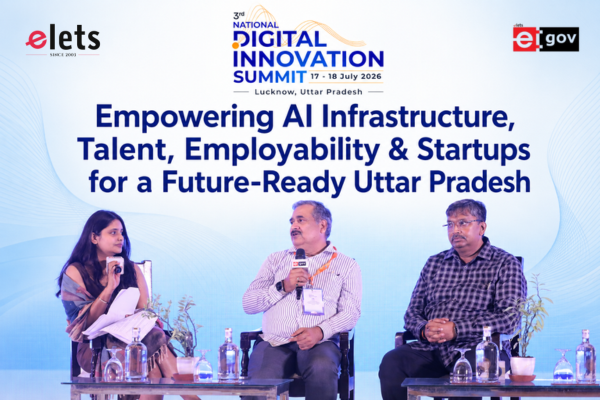



At the 3rd National Digital Innovation Summit 2026, the panel discussion on “Empowering AI Infrastructure, Talent, Employability & Startups for a Future-Ready Uttar Pradesh” explored how the state can prepare its people and institutions for an economy increasingly shaped by artificial intelligence, automation, Industry 4.0 and digital technologies. The conversation examined the role of schools, government programmes, skilling systems and startup ecosystems in ensuring that technological progress translates into meaningful opportunities for young people.
The discussion brought together perspectives from school education and youth development, highlighting the need to build AI capabilities from an early stage while simultaneously creating pathways for innovation, entrepreneurship and employment. From AI-enabled classrooms and personalised learning to startup mentorship and a more supportive environment for experimentation, the panel looked at how Uttar Pradesh can develop a talent ecosystem that evolves alongside its digital infrastructure.
Vishnu Kant Pandey, Additional State Project Director, Department of Secondary Education, Government of Uttar Pradesh
The integration of AI into school education is being approached through two parallel objectives: using technology to improve the learning experience of teachers and students, and preparing students to understand and apply AI in their future careers and everyday lives. In line with the National Education Policy (NEP) 2020, which envisages introducing AI learning from Class VI, Uttar Pradesh is working towards creating an environment where students encounter technology not merely as a separate subject but as part of the broader learning process.
A major component of this transformation is the expansion of ICT laboratories and smart classrooms across government schools. The state is working towards developing AI-enabled ICT infrastructure in schools, while at least one teacher from each school has been trained to use smart-class and ICT facilities. AI can also support multiple aspects of school management and learning, including attendance, assessment, monitoring learning levels, identifying difficulties faced by students and evaluating educational performance. Collaborations with organisations such as Khan Academy, including its AI-powered Khanmigo platform, are providing additional possibilities for personalised learning in subjects such as mathematics and science. The broader objective is to use AI to bridge learning gaps and extend quality educational support to students across the state.
Kumar Vineet, Special Secretary, Youth and Family Welfare Department, Government of Uttar Pradesh
The changing nature of employment requires a shift in how AI and skilling are understood. AI is fundamentally a tool that works through human intelligence, machine learning and increasingly sophisticated language models, meaning that future jobs will not simply disappear but will evolve in terms of the skills and capabilities required from workers. The experience of technological transitions such as Y2K also demonstrates how industries and people can adapt when new technologies fundamentally alter existing processes.
For government, the challenge extends beyond introducing individual AI applications. Effective digital transformation has to translate into better services for citizens and improved institutional performance. Education, affordability and access to information, effective usage of technology, government outreach and ease of interaction with citizens form important components of this transition. Rather than equating AI adoption with chatbots or isolated analytics tools, the focus needs to remain on whether technology is solving real problems and creating measurable value. As society changes, government systems will also need to continuously adapt, with infrastructure and governance mechanisms evolving at a comparable pace.
Also Read: Japanese team to visit Uttar Pradesh to explore semiconductor cooperation, giving fresh impetus to new technology partnership
Key Takeaways
- AI education needs to begin early, with schools becoming the foundation for developing future AI talent.
- ICT labs and smart classrooms can expand access to technology-enabled learning across government schools.
- AI can support personalised learning, assessment, attendance, and identification of learning gaps.
- Future skilling programmes must focus on adaptability and evolving job roles, rather than only training for existing occupations.
- A strong startup ecosystem requires mentorship, trust, access to networks and tolerance for failure, alongside financial support.
- The government’s role is increasingly that of a facilitator and enabler, creating the infrastructure and policy environment for innovation.
- Uttar Pradesh’s ambition to become an AI talent capital will depend on connecting education, skilling, infrastructure, industry, and entrepreneurship.
Conclusion: Building the Human Foundation for an AI-Ready UP
The panel made it clear that building an AI-ready Uttar Pradesh is not simply a question of deploying advanced technology. It requires a strong human foundation, beginning with digitally equipped schools and extending through higher education, skilling, employment and entrepreneurship.
As AI continues to reshape industries and occupations, the states that succeed will be those that can develop talent alongside technology. For Uttar Pradesh, the opportunity lies in connecting its large young population with AI education, industry-aligned skills, innovation opportunities and a supportive startup ecosystem. With early AI literacy, stronger digital infrastructure and a culture that encourages experimentation, the state can build the capabilities required to become a significant contributor to India’s emerging AI and digital economy.
Source link