
The College of Law may be just a few years old, but this new school on the block is already establishing
itself as a force in Florida’s legal education landscape. Since opening its doors
in August 2022, it has quickly earned a reputation as one of the state’s most promising
and dynamic law schools.
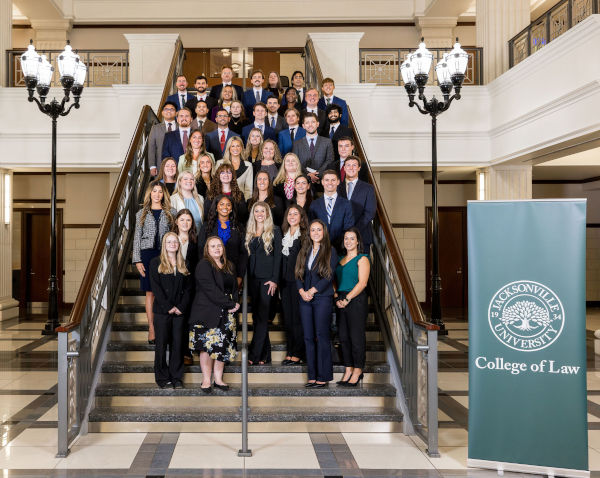
Last spring, the College graduated its inaugural class, which achieved the second-highest bar exam pass rate among all Florida law schools
— an impressive 91.7%. As of February 2026, including states outside of Florida, the
inaugural class had achieved an ultimate bar pass rate of 92.3%. It’s a remarkable
accomplishment for a first showing at the bar. Yet this rapid ascent hasn’t occurred
despite the school’s newness; rather, it’s happened because of it.
While other well-established institutions have decades-long histories behind them,
Randall C. Berg Jr., Founding Dean, Nicholas Allard believes the school’s blank slate
allows it to be at the cutting edge of legal education. “Things that law schools have
never really focused on, we’re focusing on them,” he said. Having identified seven
key priorities to guide the future of the school, Dean Allard is intent on weaving
each into the fabric of the overall educational experience, where real, practical
learning extends far beyond theory. “In the world where the only constant, paradoxically,
is accelerating change, we don’t want this new school to ever become old school,”
he said.
When it launched in 2022, the College of Law became the first new law school in Florida
in more than 20 years. With Jacksonville experiencing rapid growth and now ranking
as the 10th most populous city in the USS., it was an opportune moment for the university
to invest in a law school that could meet the region’s burgeoning demand for legal
talent and resources.
Dean Allard likens the way the school was built—is being built—to that of a startup.
He credits the momentum to the energy of the students, staff and faculty who chose
JU precisely because they wanted to embrace the challenge. He shares that they were
“test pilots” collectively helping to build the plane mid-flight. “I think we’re all
very aware of how special it is that we’re kind of creating the culture and what it
means to be a JU law student,” said third-year law student Marissa Abry van der Zee.
“I think we all take that really seriously in terms of the way that we interact with
each other and with people in the community.”
In August 2024, the school moved into its new home inside the historic former Atlantic
National Bank building in downtown Jacksonville, right in the heart of the city’s
bustling legal district. The College of Law is the result of a strategic partnership
with the City of Jacksonville, which supplied $11.5 million in support. The eight-month
renovation project by Auld & White Constructors, TTV Architects and Workscapes revitalized
50,000 square feet
of underutilized office space across four floors, transforming the 117-year-old building
into a modern law school.
Auld & White took great care to thoughtfully preserve historic features such as the
first-floor stairwell and second-floor reception room, complete with original parquet
floors and ceiling trim, while blending them seamlessly with modern design elements
like a three-story atrium that floods the common areas with natural light. This intentional
approach earned the College of Law an Excellence in Construction award in the Historical
Restoration/Renovation category at the 2025 Associated Builders & Contractors’ Florida
First Coast Chapter’s annual awards, beating out 55 other entries.
Just blocks away from state and federal courthouses, law firms, and government 22
buildings, the school’s location offers students unparalleled access to real-world
legal experiences—one of Dean Allard’s seven priorities. The green lanyards students
wear when entering these spaces have become a quiet symbol of the bright future of
Jacksonville’s legal community. Judges and attorneys often go out of their way to
connect with students, sparking serendipitous learning and opening doors of opportunity.
“An explosive upside has been the support from the bench and the bar inside Northeast
Florida,’ said Jacksonville University President Tim Cost. “Attorneys, corporations,
consultants, elected officials—they all want to see these graduates succeed. They
want to help at the college itself; they want to be involved. There’s been a tremendous
outpouring of support.”
The community partnership goes both ways. In September, the school was recognized
for its strong service culture—another of the seven priorities—when it received the
Kathy Para Outstanding Pro Bono Service Award from Jacksonville Area Legal Aid. The
award, typically given to an individual or organization for a single case or project,
was instead presented to the College in recognition of the hundreds of pro bono hours
volunteered by students. “I was very proud,” said Dean Allard. “It’s gratifying and
reminds students why they’re doing all this stuff, why they’re breaking their backs
studying to be lawyers.”
Last fall, the school welcomed its largest incoming class yet—70 students—more than
doubling the student body to 135. While enrollment is growing, there are no plans
to lose the intimacy and personalized approach that are hallmarks of the Jacksonville
experience. That personal touch extends all the way to the top: over the summer, Dean
Allard personally called each new student to congratulate them on their admission.
Among them was first-year student Brandon Fason, who said the accessibility of faculty
and staff has been what impresses him most. “It’s not really positions at JU, it’s
people. We know the people because they walk the halls with us. They say, ‘hi’. They
call us by name. Dean Allard has his door open pretty much any day, any time that
he’s there. I don’t think I’ve ever walked by his office and not seen him with his
door open and given him a wave, said ‘hi’.
Dean Allard has said time and again that there is no tool in the world as powerful
as a legally trained mind. While he, staff, and the faculty work to equip the next
generation of lawyers with that tool, they’re doing so with what he calls “Jacksonville
Pollock creativity,’ embracing innovation every step of the way. Put all of these
elements together, and you have a recipe for success. And the proof, as they say,
is in the pudding. “You don’t have to leave Jacksonville to get an outstanding, top-line,
second-to-none education,” says Dean Allard. “If you want a great law school education,
come to JU. You’ll get it here.”