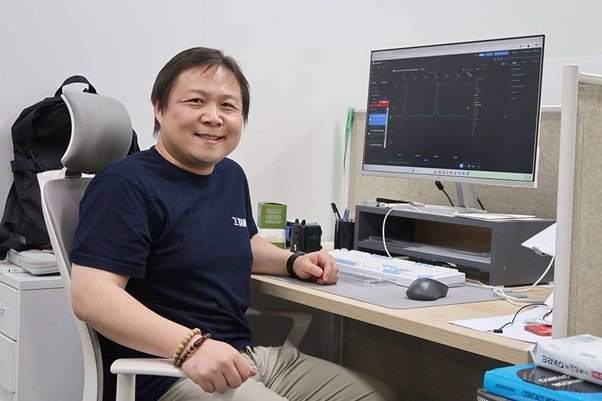
– Principal Engineer Keunsu Kim leads sensor data analysis by integrating physical laws into machine learning models, maximizing the utility of tire data to ensure critical on-road safety and autonomous vehicle reliability.
– Supported by collaborative internal programs like random lunches and bi-weekly seminars, BANF aims to establish its technology as the definitive global standard for vehicle safety and tire intelligence.
This article sets out to share the stories of individuals working within rapidly evolving and fast-growing startups. To be precise, it aims to answer the lingering question: “What exactly do they do?” While major IT companies compete fiercely to recruit top talent, it is natural to wonder what those talented individuals actually do once they are inside the organization. For instance, do a Google employee and a Facebook employee with the exact same department and title perform identical work?
Enter Keunsu Kim, a Principal Engineer on the AI team at BANF. BANF is a deep-tech startup possessing advanced tire data analysis technology, responsible for developing the “Tire Profile Solution.” Using sensors attached to automobile tires, it collects and analyzes driving data in real time to derive information not only on tire wear, vehicle load, wheel alignment, and detachment status, but also on road surface conditions like black ice and potholes. Leveraging this technological prowess, BANF is collaborating with industry giants like Hyundai Motor, Volvo, and DHL to expand its business into the autonomous driving and commercial vehicle sectors.
Keunsu Kim joined BANF last August and is tasked with extracting insights related to automobiles, tires, and roads through sensor data analysis. He is exploring ways to maximize the utility of tire data by analyzing it through the lens of an artificial intelligence (AI) that understands the laws of physics—namely, physics-informed AI.
We sat down with Keunsu Kim to discuss what led him to BANF, his current responsibilities, and the corporate culture at the company. He holds bachelor’s, master’s, and doctoral degrees from the Department of Mechanical and Aerospace Engineering at Seoul National University. His primary research focus is on diagnosing the condition of mechanical systems and predicting their behavior through the convergence of physics and data. After graduating, he joined LG Energy Solution in 2023. Over roughly three years, he developed and implemented AI-based solutions—from initial algorithm development to mass production field applications—optimizing processes and maximizing the efficiency of new material development. He officially joined BANF in August.
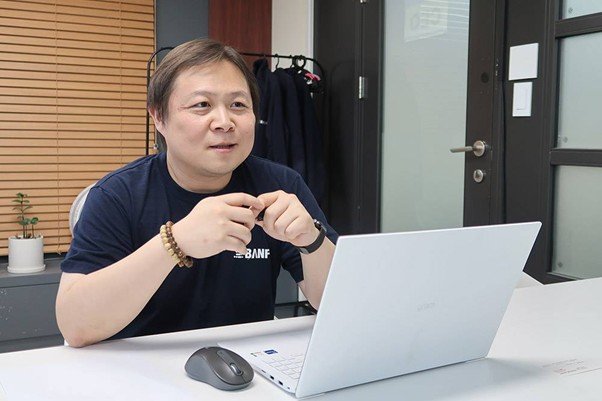
Keunsu Kim, Principal Engineer at BANF/source=IT DongA
Joining BANF After a Three-Year Wait
How did you first find out about BANF?
I first discovered BANF in 2023. At the time, I was preparing for the job market and exploring various companies when I came across them. I felt that my past research aligned perfectly with BANF’s business model and technological direction. During my graduate studies, I researched Prognostics and Health Management (PHM), diagnosing and predicting the condition of bearings using acceleration signals. Because bearings and tires share remarkably similar mechanisms, and since BANF also utilizes acceleration data, it felt like a natural extension of my ongoing research. Above all, the prospect of pioneering an untrodden path was incredibly appealing.
I applied to BANF and had an interview with Adam Sunghan You, the CEO. We spoke for two to three hours, and we met three or four more times after that. Through those conversations, I deeply resonated with the vision and corporate philosophy that Adam Sunghan You presented. However, at that time, my desire to experience how a large corporate system operates was slightly stronger. Therefore, I opted for a large conglomerate, promising Adam Sunghan You that I would reapply after gaining at least three years of experience. True to my word, exactly three years later, last August, I joined BANF.
What was the reason you applied to BANF again?
Even during my three years at the large conglomerate, I consistently kept a close eye on BANF’s technology and business trajectory. They were executing their business exactly in the direction Adam Sunghan You had initially laid out. Watching this, I became absolutely convinced of their authenticity and commitment. Truthfully, as I entered my third year at the conglomerate, I had a variety of options on the table. However, driven by a desire to immerse myself more deeply in the work I truly wanted to do—and to work somewhere I could directly contribute to the company and its technology—I knocked on BANF’s door once again.
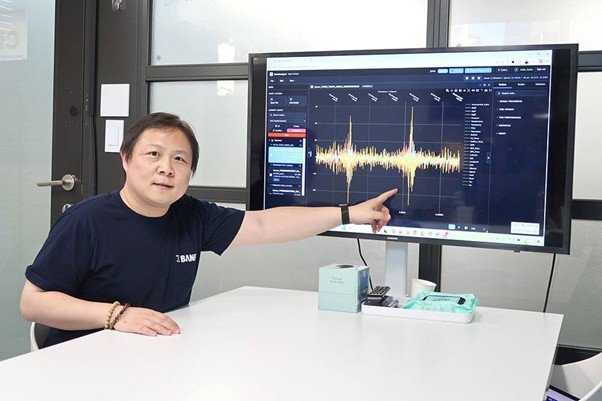
Keunsu Kim explaining tire data analysis/source=IT DongA
What kind of company is BANF, based on your experience since joining?
I believe it is a company with the potential to succeed on the global stage thanks to its unrivaled technological prowess, combined with the execution capability to rapidly deploy advanced technologies that ensure real on-road safety. In a word, it is a “company striving to benefit the world through technology.”
What are your current responsibilities at BANF?
Currently at BANF, I am focused on extracting actionable insights by analyzing sensor data, backed by specialized knowledge of the physical principles governing how tires move.
BANF extracts data by attaching sensors to tires, using this to derive key metrics such as tire wear, vehicle load, wheel alignment status, and detachment warnings. Furthermore, we can determine the vehicle’s payload status as well as information about the road surface the tire comes into contact with, such as black ice or potholes. BANF believes that an even greater depth of insights and information can be extracted beyond this. Achieving this requires a proper understanding of the core principles behind how the data was generated, which is precisely where physics-informed AI comes into play. Physics-informed AI refers to an AI that inherently understands the laws of physics; it involves researching exactly which physical laws are embedded within the AI algorithms. Equipped with domain knowledge and physics-informed AI, one can extract a diverse array of insights based on generalized principles, even if the overall data volume is small.
Physics-informed AI is an area I have consistently researched with deep interest. Leveraging this, I am constantly exploring what additional information can be extracted from tire data, and what tangible value these analytical results can deliver to our actual customers. Although it has been less than two months since I joined, I am swiftly spearheading the structuring of data and the advancement of our technical development strategies, grounded in a profound understanding of vehicle and tire dynamics based on mechanical engineering. Through these efforts, I expect to contribute to refining BANF’s existing technological capabilities while reinforcing its overall expertise.
Solidifying the ‘BANFer’ Culture Through Random Lunches and Town Halls
Could you introduce BANF’s work environment and corporate culture?
Unlike most companies that fixate solely on results, BANF places a heavier emphasis on how those results were achieved—namely, the core principles and the essence of the work. Because the overarching atmosphere actively supports the pursuit of foundational truths, you can immerse yourself fully in these principles and conduct research to your heart’s content. My own job satisfaction has improved drastically because I am empowered to constantly ask “why” one more time, feeling a genuine sense of accomplishment as I unravel complex problems. The team members here also harbor a deep affection for their work. Even though I haven’t been interacting with them for very long, I can strongly feel everyone’s shared ambition to produce the absolute best results in their respective domains. I fully expect this dynamic to generate even greater synergy moving forward.
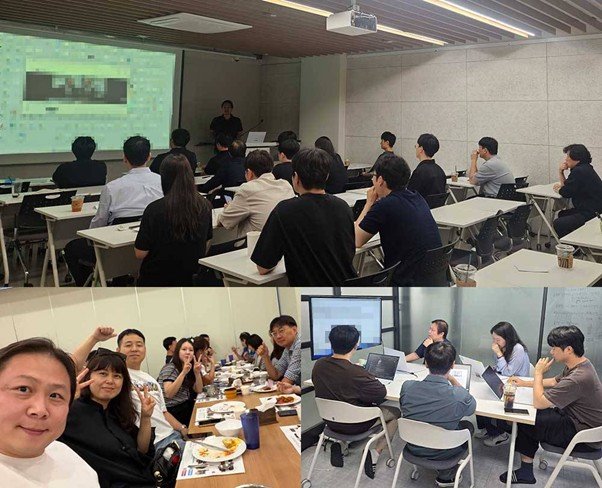
BANF’s Town Hall Meeting (Top), Random Lunch (Bottom Left), Internal Seminar/source=BANF
Is there an organizational culture unique to BANF?
We host a “Random Lunch” event every other Friday. When the HR team randomly forms groups of four to five people—regardless of department or rank—and announces them at 11 AM on Friday, the assigned team members coordinate and eat lunch together. Randomly mingling and dining with colleagues you rarely interact with due to differing workloads naturally fosters camaraderie, and it effectively bridges communication gaps that can sometimes arise from differences in age or job function. Thanks to this initiative, I was able to familiarize myself with the faces of colleagues in other departments and adapt to the company very quickly. Close communication is essential for internal collaboration, and to achieve that, it is highly advantageous to first know who your team members are on a personal level. In that regard, I believe the Random Lunch is an incredibly useful system.
We also hold a town hall meeting once a quarter. During these town halls, we invite external speakers to conduct capability-building training for our employees, while CEO Adam Sunghan You shares the quarterly performance, achievements, and future roadmap. The town hall meeting seamlessly transitions into a company-wide dinner, serving as an excellent opportunity to communicate comfortably and strengthen friendships.
Bi-weekly internal seminars are also held, where team members step up as presenters to share insights, achievements, or study results they have gained through their work, followed by a Q&A and open discussion session. In early September, I personally took the stage to present on work-related insights I had gathered while studying the field shortly after joining. Programs like this serve as a fantastic catalyst for enhancing mutual understanding of each other’s roles across the company.
Keunsu Kim, Principal Engineer at BANF/source=IT DongA
What is the ultimate goal you want to achieve through BANF?
Features like collision detection, front and rear cameras, and autonomous driving—which were once considered premium options—are now widely distributed as standard specifications. However, technology directly related to tires is still lingering in the past. AI, too, has already deeply permeated our lives, yet its tangible reality often feels somewhat ambiguous to the average person. Given this landscape, by intricately linking the physical data of tires with advanced algorithms, I want to become a reliable conduit that helps AI seamlessly intersect with the physical world and tangibly contribute to actual on-road safety. I want to see firsthand how BANF’s technology is utilized in the real world, and witness how everyday life genuinely improves because of it. I eagerly look forward to the day I can point and say, “That vehicle is equipped with BANF’s solution, and I personally contributed to building it.” Ultimately, I hope BANF’s solutions will firmly establish themselves as the definitive global standard in the realms of vehicle safety and tire technology. And I deeply hope to contribute to that remarkable journey.
By Man-hyuk Han ([email protected])
Source link