Good People is a bi-weekly article series highlighting McGill students doing community-oriented work on and around campus — because it’ s important to celebrate good people doing good things.
It happens to the best of us: a neglected sleep schedule, long hours at the library, or too many house parties can quickly turn a stubborn cold into a serious health risk. In the face of a medical scare, it can be challenging to know where or how to access care, especially for international or out-of- province students.
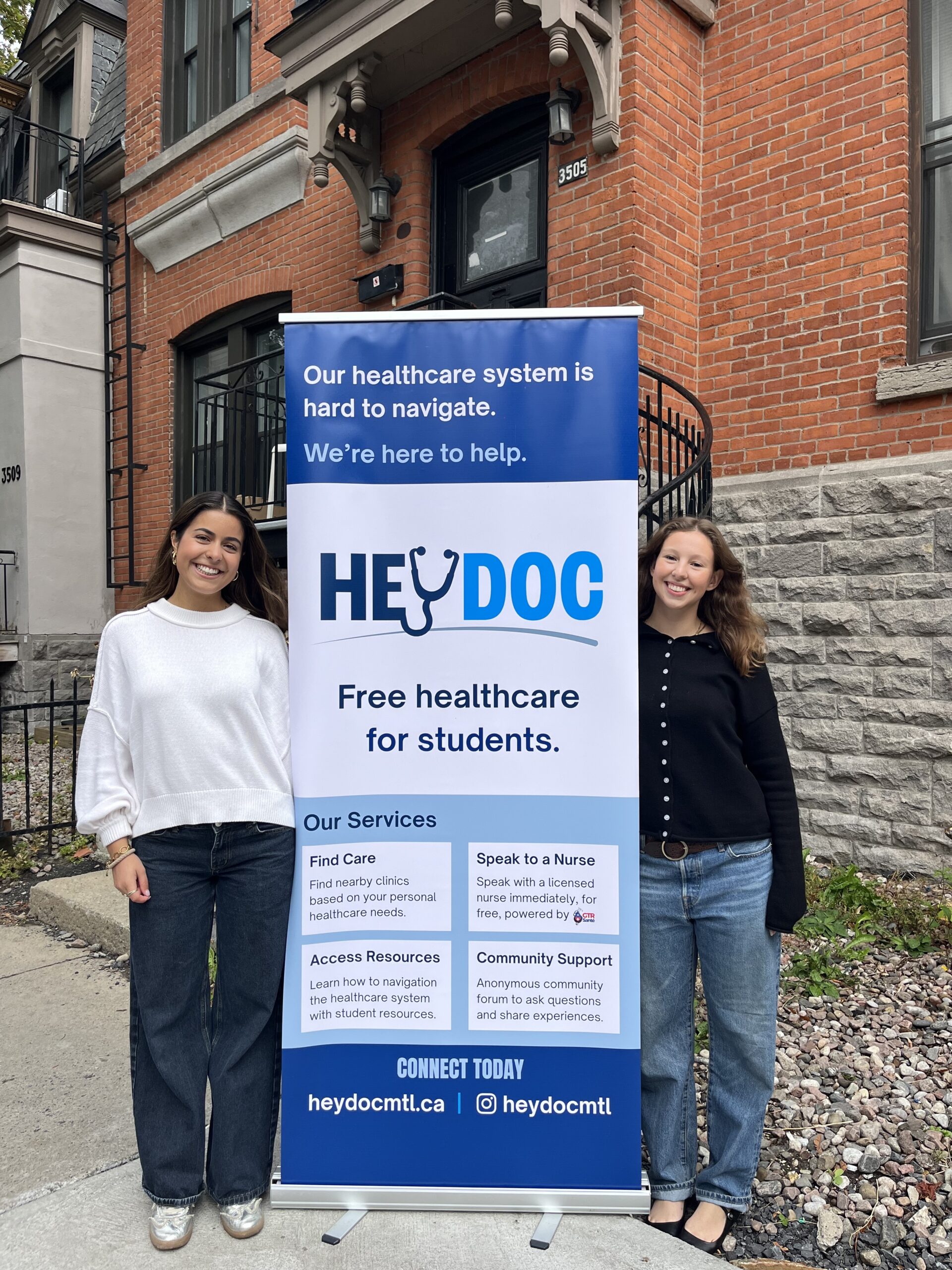
That’s where HeyDoc comes in. Launched on July 31, 2026, HeyDoc is a free online resource built to guide students through Montreal’s healthcare system. In partnership with GTR Santé, a Quebec-based private healthcare network, HeyDoc’s “speak-with-a-practitioner” function allows students to text or call nurses in real time.
The Daily spoke with co-founders Ella Durno and Shoshana Iny, fourth-year McGill students studying General Management and International Development respectively. We talked about the sources of strain on Quebec’s healthcare system, the importance of accessible and affordable care, and how empathy can change people’s lives for the better.
This interview has been edited for clarity and conciseness.
Enid Kohler for The McGill Daily (MD): I want to start with the basics. Imagine you’re at a house party and a student asks you about HeyDoc. How would you describe it to them?
Shoshana Iny (SI): We’re a startup to help students access care as easily as possible, especially for out- of-province or international students. We both have recognized the difficulties trying to access free, same- day healthcare in Quebec. That’s our goal — just to help as many students as possible.
Ella Durno (ED): I would paraphrase it as their Montreal healthcare concierge. It’s a healthcare … one-stop shop to help navigate the system, no matter their background, their language, their insurance coverage, their age, or gender identity. On top of that, we have an opportunity for them to speak with nurses directly, because sometimes it’s a lot easier and more comfortable to speak to a real human.
MD: Why did you start HeyDoc? What prompted the idea?
SI: We initially became friends through the Integrated Management Student Fellowship (IMSF), which is a year-long program through the Desautels Faculty of Management that brings together students from a variety of faculties who are broadly interested in social impact and positive change-making.
As a part of the fellowship, you have to create a sustainable startup related to one of the UN Sustainable Development Goals. We came up with the idea of wanting to be aligned to SDG 3, which is good health and well-being.
Ella and I built on that vision. We reflected on our own experiences as out-of- province students who have really struggled when … [accessing] different kinds of healthcare in Quebec. And we realized that there would be a real opportunity to help students in Quebec access healthcare more easily. That was when HeyDoc was born.
ED: Coming to a new city and a new province, it can be so overwhelming for so many reasons. When it comes to healthcare, that’s just another thing that you don’t know how to navigate.
MD: You already touched on this a bit, but can you describe your observations about challenges when it comes to access to healthcare among McGill students more broadly?
SI: Looking more broadly at the system, some of the current pain points that we identified during our research is a huge lack of family doctors in Quebec. International student population aside, even people that are already living here are struggling to access family doctors, which is burdening the system. There are huge strains on ERs as a result of that. Because of the family doctor shortage, coupled with the fact that walk-in clinics aren’t really common here, that creates this pervasive issue where there are not a lot of accessible, free same-day health care options.
MD: In the process of launching HeyDoc, were there any challenges that you encountered?
ED: We launched this summer, when we were both working full-time jobs, which was one of the biggest challenges. Initially, it was also a challenge that neither of us had any technical experience in web development.
SI: I think the other part that we both struggled with was just navigating creating a real business, especially as undergraduate students. I’m not in Management; I felt as though I didn’t have any substantial background on the start-up scene or in entrepreneurship. It can be a bit daunting launching this new venture, putting yourself out there, especially on social media, without knowing how people will react.
But it’s been amazing to see the overwhelming support from both friends and family, and also people that we don’t know who come up to us, saying that they wish they’d had this in their first year. That’s really given us the encouragement to keep going forward and trying to grow the platform.
ED: Adding onto that, just the uncertainty of pouring everything we have into an idea that we believed in and not being sure how the community would react was stressful. But since launching, it’s [been] nice to see that there is a big demand for it.
MD: Looking five or ten years down the line, what is your vision for the future of HeyDoc?
ED: I would love for HeyDoc to be known as the go-to resource for students, maybe [students from] other universities as well, trying to navigate the healthcare system in Montreal.
SI: Right now, our focus is as much growth as possible, because that’s how we can positively impact as many students as possible.
MD: The tagline for this column is “good people doing good things.” In the context of your work with HeyDoc, what does being a “good person” mean to you?
SI: I think just leading with empathy and having that guide both your personal values and your professional aspirations. That’s always been really integral to my life and what I see for myself in the future. I’m really grateful to have the opportunity with HeyDoc to be putting that into real-world practice.
ED: I was going to say something very similar about being very intentional about your values and how you choose to follow them on a day-to-day basis. That looks different for everyone, but I think if you have strong values and stay true to them, you can make a positive impact.
You can learn more about HeyDoc via email at [email protected], their Instagram page @heydocmtl, or their website, heydocmtl.ca, to make a free account and use HeyDoc’s services.
If you know good people doing good things who you would like to see featured in this column, email [email protected].