Another month, another training update from SBJ Tech colleague Rob Schaefer on his TCS New York City Marathon journey. If you’re just joining us, Rob is running his first marathon Nov. 1 and piloting select performance tech as he prepares. We introduced this series in August and checked in with him in September.
Over the past two months, Shadan Al-Saket, an applied sport biomechanist with insole sensor company Plantiga, has become a fixture in my work email inbox. Al-Saket dutifully sends me weekly reports on data collected through the sensor-embedded insoles with which I’ve tracked all of my training runs — usually on Monday evenings, and usually with only a succinct message attached: Attached is your weekly report for XX-XX, everything looks good to me!
So, when I opened my inbox Sept. 21 to a full paragraph, I figured something might be up.
Earlier that day, I had cycled through a series of baseline jumping and sprinting workouts that Plantiga recommends conducting biweekly to track movement performance. Al-Saket had noticed something fishy from mine that day. Specifically, she wrote: “Your impact asymmetries on the ‘consecutive countermovement jump,’ ‘cyclic jump’ and ‘single leg jump for height’ are quite high, which could indicate a stiffer landing strategy to protect an injured or weaker side.”
She was right.
The previous week, I’d begun experiencing significant stiffness and discomfort in my inner left quad, which had bubbled up during an interval training session and exacerbated during an ensuing long run.
Luckily, I was able to remedy the injury with a freshly acquired foam roller and proper stretching before and after workouts. But the anecdote illustrated how even an amateur athlete can benefit from technology designed for the elite. I knew I was experiencing discomfort, but the measurable decline flagged that it required real attention. A pro athlete flanked by a staff of physiotherapists and trainers might have come to that conclusion sooner. I needed the sensors.
The episode has heightened my focus on my baseline tests and how my motion patterns hold up as I progress to longer runs. Last Saturday, I hit my longest yet — an 18-miler that crossed three New York City boroughs (Brooklyn, Queens, Manhattan) and three bridges (Pulaski, Queensboro, Brooklyn) — and came out of it feeling good mentally and physically. My Plantiga report confirmed the latter, despite some fluctuation in the ground impact made by each foot.
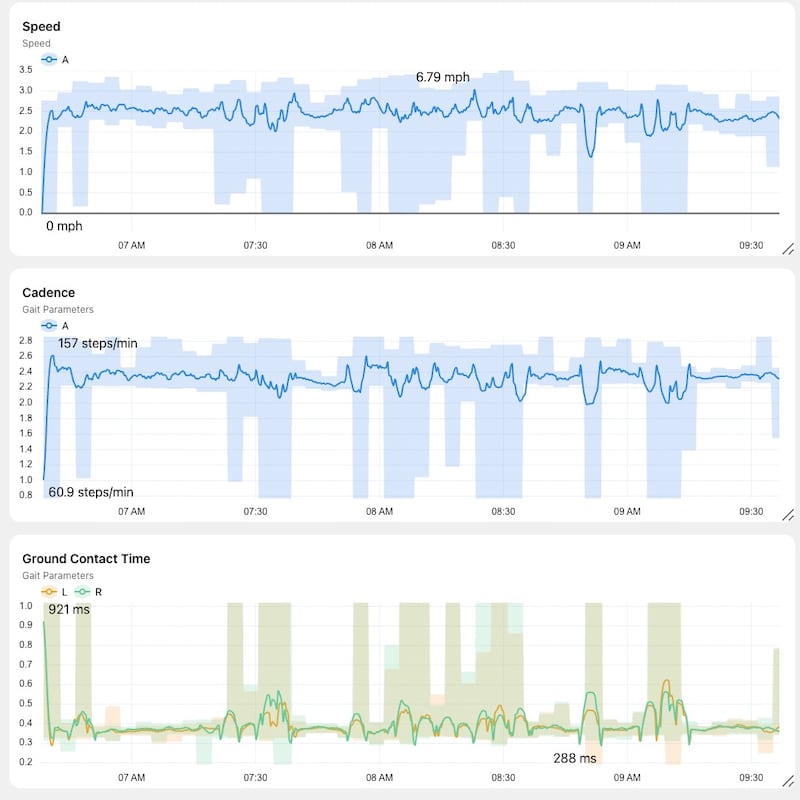
I also ran my latest baseline tests earlier this week, and thankfully, I “leveled out” back toward the results of my first two tests, Al-Saket said.
A couple more updates:
On my gait analyses: A change in my Ochy score! After ramping up the app’s recommended exercises to near-daily (either after runs or strength training sessions), my overall score rose from 57% to 63% and my arm position (the No. 1 priority segment to work on from my last scan) jumped from a “bad” 32% to “good” 66%. In fact, virtually all of my metrics improved or stayed level. (These percentages are a measure of how close I am to the ideal biomechanical range for someone my height, weight and speed, based on research conducted by Ochy.)
- Foot landing: Up from 40% to 53%. It’s still a “moderate overstride”
- Back position: Increase to 66% — from “not sufficiently forward leaning” at 50% to “ideal”
- Front knee angle: Decreased from 78% (ideal) to 51%; this is now my No. 2 priority segment to work on
- Back knee angle: 98% to 96%
- Head position: Still 33%, with a slightly too skyward gaze
Though I can’t confidently say the results on my pace or efficiency have been significant — candidly, it’s just hard to tell — the 11-minute daily routines generated by the Ochy app are clearly having some impact. Hopefully that continues.
Training plan: Loyal readers will remember that I fully migrated my training to the Strava-owned “Runna” app after my last update. This is my peak week — topping out around 40 miles, with a 20-mile “race practice” Saturday morning — and with a steady diet of challenging interval sessions it has me feeling prepared. I must report, though, that the “Runna AI” feature I was interested to dive into has proven to be more summary than insight.