In the past decade, starting a new business, especially an ambitious one, was often synonymous with starting an online business or similar digital-focused venture. These new companies have been the driving force of productivity gains and economic growth in the same period.
At the same time, the emergence of AI is radically reforging how work is done, what skill sets are in demand, and which sectors of the economy will thrive and which will be replaced by automation.
As such, it is interesting to understand how AI is shaping attitudes toward entrepreneurship and business creation. A recent study by researchers at the National Economics University (Vietnam) investigated which digital technologies boost or weaken “digital entrepreneurial self-efficacy”, or the confidence in performing broader digital venture creation tasks.
They found that AI skills are tightly linked to entrepreneurial self-efficacy, which will modulate an individual’s motivation and confidence in launching a new business activity.
They published their results in Social Sciences & Humanities Open1, under the title “AI capacities and digital entrepreneurship: The moderating role of Fintech entrepreneurial ecosystems and university infrastructure”.
Explaining Entrepreneurial Self-Efficacy
The Psychology Of Entrepreneurship
The researchers used the Social Cognitive Career Theory (SCCT), which aims to understand the cognitive and contextual factors influencing career development. In it, they have positioned AICs as learning experiences and cognitive resources.
Central to this theory is the concept of self-efficacy, which refers to an individual’s belief in their capability to perform actions required to attain specific goals successfully. It is shaped by learning experiences and social environments.
This then guides individuals toward specific outcomes such as forming entrepreneurial intentions, especially as these are impacted by uncertainty and risk, and demand strong self-efficacy beliefs.
In that context, digital technology can help greatly, at least in theory:
- The FinTech ecosystem provides essential financial tools that may reinforce entrepreneurial intention.
- AI may strengthen students’ cognitive readiness and entrepreneurial intention, but it may depend on supportive financial and university infrastructures.
AI can help potential entrepreneurs with entrepreneurial tasks such as opportunity recognition, customer analysis, digital planning, decision support, and strategic problem-solving
In the context of this study, AI capacity does not refer to technical AI development capabilities, such as programming or algorithm design, but to a “perceived technological resource”.
Besides AI, the study also analyses the effect on entrepreneurial intention of fintech, crowdfunding, mobile payments, and blockchain, as well as the role of universities.

Building The Dataset
The researchers focused on university students, as a population at a critical stage in their career decision-making, where aspirations and the perceived feasibility of entrepreneurial activities significantly influence their future choices. It is also a cohort with relatively similar prior business exposure.
Besides the location of the researchers, Vietnam was chosen because its economic transformation into a pro-entrepreneurial ecosystem has cultivated a dynamic and innovation-driven academic environment, including in AI technology.
“A vast majority—approximately nine out of ten—university students now engage with generative AI platforms (e.g., ChatGPT, BingAI, Grammarly, and DeepSeek) to support their learning activities.”
A survey was sent to undergraduates in 224 tertiary institutions (123 located in the north and 101 in the south of the country) and produced 1061 responses for analysis. It was roughly balanced by gender and split between business and engineering majors.
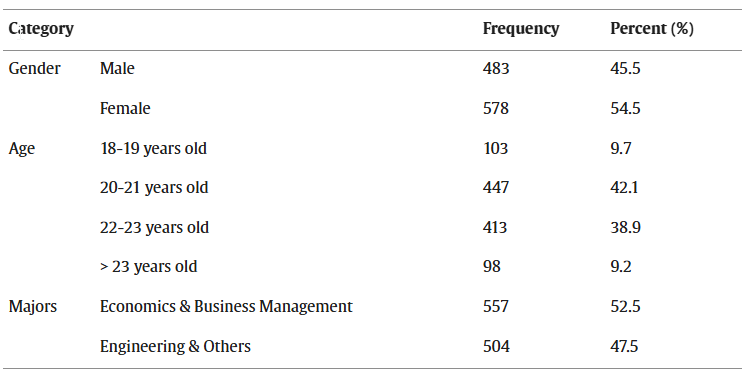
The results were analyzed with tools such as IBM SPSS Statistics, PROCESS Model 4, and AMOS.
AI & Entrepreneurship
The study found that perceived AI capacities are associated with stronger digital entrepreneurial self-efficacy, which is subsequently associated with stronger digital entrepreneurial intention.
“Individuals who perceive AI as a valuable tool for business development are more confident in their ability to leverage digital technologies in entrepreneurial activities.”
Besides self-efficacy, other psychological mechanisms such as outcome expectations may also play a role.
Regarding the effect of FinTech entrepreneurial ecosystems, it appears to depend on whether students perceive each tool as strategically relevant to early-stage venture creation.
Crowdfunding in particular strengthens this connection, suggesting that access to alternative funding sources reinforces individuals’ confidence in leveraging AI for business activities. In this case, it connects AI-supported opportunity evaluation with tangible resources, market validation, and early stakeholder feedback.
However, mobile payments had a tendency in the initial analysis to reduce the positive attitude toward entrepreneurship stemming from AI.
“While mobile payment systems are widely adopted for daily transactions, they may not be perceived as directly enhancing strategic AI-driven business capabilities.”
The explanation is that they are perceived as ordinary digital infrastructure and are not perceived as strategically relevant.
Meanwhile, blockchain technology did not impact in any way the connection between AI and entrepreneurial intent. Despite moderate familiarity with blockchain, the students mostly do not see it as part of their entrepreneurial tool set.
“Blockchain may not yet function as a psychologically actionable resource for undergraduate students at the pre-venture stage. Familiarity alone may not be sufficient; perceived applicability to immediate entrepreneurial tasks may be more critical in shaping self-efficacy and intention.”
Lastly, when it comes to university infrastructure, students exposed to a supportive entrepreneurial culture are more likely to perceive AI as a useful tool and to act on their entrepreneurial intentions. This illustrates how the role of universities is not just education, but also nurturing the right social and psychological environment for their students.
“The presence of mentorship, networking opportunities, and institutional support likely reinforces the belief that AI can be successfully integrated into business ventures, which can increase the likelihood of entrepreneurial engagement.”
Investors Takeaways
This study illustrates how the connection between AI and other digital technologies’ usefulness in theory, and their application by potential entrepreneurs in practice, is strongly influenced by psychological factors.
For example, fintech is only boosting entrepreneurial intent when it is seen as helping secure funding, while payment systems are not seen as especially useful, or are even judged a potential bureaucratic barrier to company creation.
Similarly, some technologies might be seen as potentially interesting, but too remote from an immediate use case for a new startup to be considered relevant, like in the case of blockchain.
Meanwhile, the role of universities in a digital future should not be underestimated, at least when they also provide non-technical “services” like mentorship, entrepreneurial advice, and networking.
As such, investors in AI and digital technologies, especially those with a market focus on entrepreneurs and SMEs, should question how much it is actually perceived as solving entrepreneurs’ problems. Or risk falling into the well-known trap of “a solution looking for a problem”.
Still, they should also remember not to over-interpret the results of this study, as it measured entrepreneurial intention among undergraduate students rather than actual venture creation and perception of existing entrepreneurs.
Investing In Digital Startups
Shopify
Shopify was founded in 2004 as a tool to build e-commerce websites. To fuel growth, Shopify (SHOP ) launched its application programming interface (API) platform in 2009, allowing for the creation of applications.
These applications added vital features such as website themes and streamlined refund processes, making Shopify one of the most customizable e-commerce platforms in the world. The company grew rapidly over the next several years before eventually going public in 2016 and becoming a giant of commerce around the world.
“Entrepreneurs on Shopify generated $1.2+ trillion in global economic activity. Thatʼs larger than the annual GDP of most countries, as high as the GP of Mexico or Switzerland.”
The company is continuing its tendency to move ahead of e-commerce trends thanks to its Universal Commerce Protocol, launched together with Google. With it, Shopify aims to become an infrastructure layer for commerce using AI agents. This combines with its Sidekick assistant and other AI tools to help merchants build, manage, and grow stores.
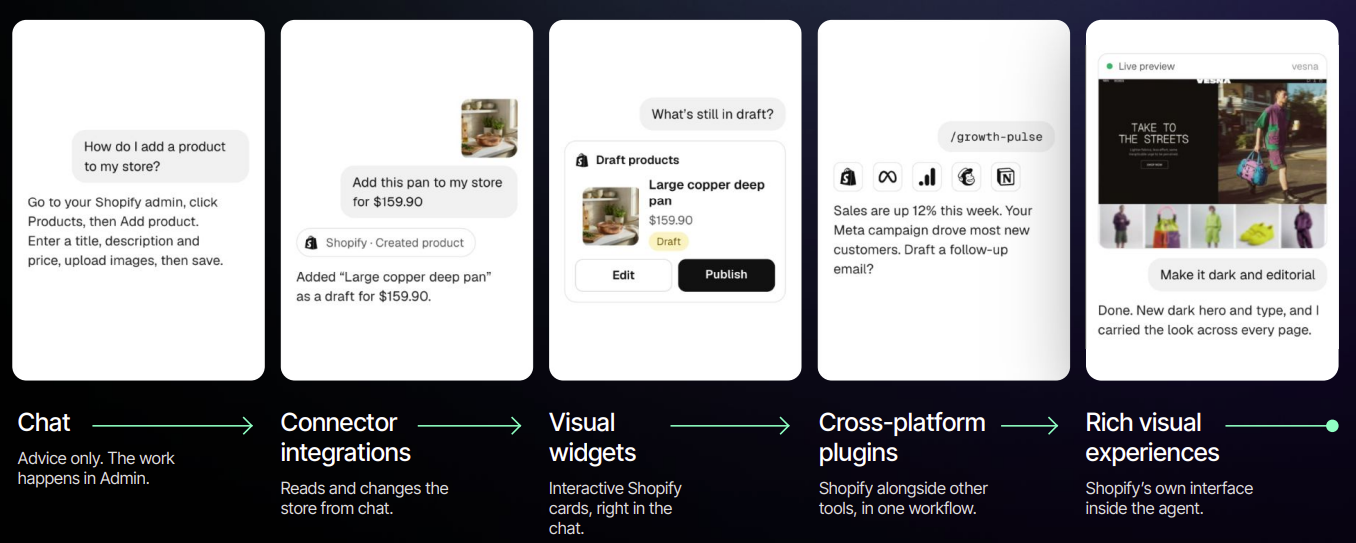
Source: Shopify
UCP was co-developed by Google and Shopify with support from major commerce and marketplace players, including Etsy, Wayfair, Target, Walmart, and others.
It is designed to make it fast for agents built within Google AI Mode, Gemini, Microsoft Copilot, ChatGPT, and others to handle the messy reality of commerce: discounts, loyalty programs, subscriptions, pre-orders, and edge cases in checkout.
The company is moving fast to expand into this new field, notably by opening its Shopify Catalog, a normalized, enriched catalog of billions of products, to brands that do not run their online store on Shopify.
It also launched a new Agentic plan for these brands to sell through AI channels, the Shop app, and future partners without migrating their storefront.
A key idea behind UCP is neutrality. The protocol is vendor-agnostic and not limited to Google or Shopify products, making it possible to support agentic commerce on virtually any platform.
UCP will directly compete with OpenAI’s Agentic Commerce Protocol, developed with Stripe and also released as open source. UCP aims to focus mostly on a standardized, end-to-end commerce layer that can operate at marketplace scale instead of agent behavior.
Besides AI efforts to move ahead of the AI agent revolutionizing e-commerce, Shopify is still growing quickly, with, for example, in Q3 2026, GMV up 30%, revenue up 32%, gross profit up 28%.
As such, no matter the speed of adoption of AI agents, it is likely that Shopify will stay at the forefront of e-commerce, as both the main alternative to listing products on e-commerce platforms and the key partner of these platforms to adapt to agentic AI.
Overall, despite the radical evolution of e-commerce in the past few years, Shopify stays the leading platform for standalone web shops, greatly benefiting potential digital entrepreneurs. It might benefit from an era of agentic e-commerce that challenges the traditional dominance of large marketplaces.
Latest Shopify (SHOP) Stock News and Developments
Study Referenced
1. Thanh Tung Dao, et al. AI capacities and digital entrepreneurship: The moderating role of Fintech entrepreneurial ecosystems and university infrastructure. Social Sciences & Humanities Open. December 2026. Article: 104005. Volume 14. 10.1016/j.ssaho.2026.104005