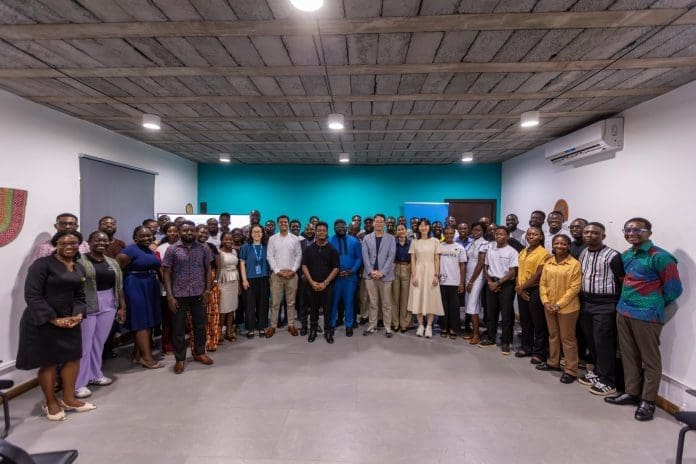
Twenty (20) growth-stage, tech-enabled social impact startups have been admitted into the sixth cohort of the UNICEF StartUp Lab accelerator programme.
These ventures are developing innovative solutions to address critical challenges facing children and adolescents in education, health, nutrition, climate action, and financial inclusion.
Established in 2019, the UNICEF Start-up Lab is supported by the Government of the Republic of Korea through the Korea International Cooperation Agency (KOICA) and implemented by MEST Africa.
This year’s cohort reflects the increasing maturity of Ghana’s entrepreneurial ecosystem in delivering scalable, locally driven development. Over the next six months, the startups will undergo a rigorous venture-building curriculum.
They will work alongside UNICEF programme specialists and industry experts to refine their products, strengthen business models, and build pathways toward international investment, including the UNICEF Innovation Fund and the Digital Public Goods ecosystem.
“We are proud to welcome this new cohort of innovators,” said Christin Lucille McConnell, Chief of Education, UNICEF Ghana. “These startups demonstrate the creativity and commitment needed to tackle some of the most pressing challenges facing children today. We will work closely with them to connect them to technical experts and investors so they can scale their impact for children in Ghana and beyond.”
Since its inception, the programme has supported over 100 startups, collectively reaching more than 250,000 children and young people. For this cohort, participating startups will receive equity-free prototype grants of GHS 65,000, with an additional GHS 165,000 awarded to three standout ventures via the Scale-up Fund.
Representing the Government of the Republic of Korea, Shinyoung Pyeon, KOICA Deputy Country Director, noted: “KOICA is proud to have invested 2.2 million dollars over the past five years to support this initiative. This programme reflects Korea’s belief that innovation and local entrepreneurship are among the most powerful drivers of sustainable development.”
The 2026 cohort shows a strong focus on EdTech (40%), alongside ventures in FinTech, Agriculture, and Climate Action. Geographically, while 50% are based in Greater Accra, the cohort features representation from the Western, Northern, and Upper East regions, among others.