

Healthcare startups continue pushing diagnostics closer to patients through point-of-care systems, at-home testing, and AI-assisted biosensors. Yet many technologies that perform impressively in controlled laboratory settings still struggle once they enter real clinical and consumer environments. The gap is becoming one of the most important execution challenges in healthcare deep-tech commercialization, especially as diagnostic systems increasingly move outside centralized laboratories and into uncontrolled real-world conditions.
The Real Failure Often Begins After Leaving the Lab
The global diagnostics industry has spent years pursuing faster, cheaper, and more accessible testing systems.
During the COVID-19 pandemic, public familiarity with rapid testing accelerated dramatically, while regulators including the U.S. Food and Drug Administration (FDA) expanded support for point-of-care and at-home diagnostic models.
The FDA stated that in vitro diagnostic tests traditionally performed inside laboratories are increasingly moving into non-laboratory environments, including homes and decentralized care settings. At the same time, regulators acknowledged that evaluating real-world performance outside controlled clinical environments remains a growing challenge.
For Hyou-Arm Joung, CTO and Co-Founder of Kompass Diagnostics and a diagnostics developer with experience spanning Korea and the United States, this transition exposes a major misconception inside healthcare innovation.
“In my experience, the first point of failure after a diagnostic product leaves the controlled laboratory environment is usually the loss of environmental and process control,”
Joung told KoreaTechDesk.
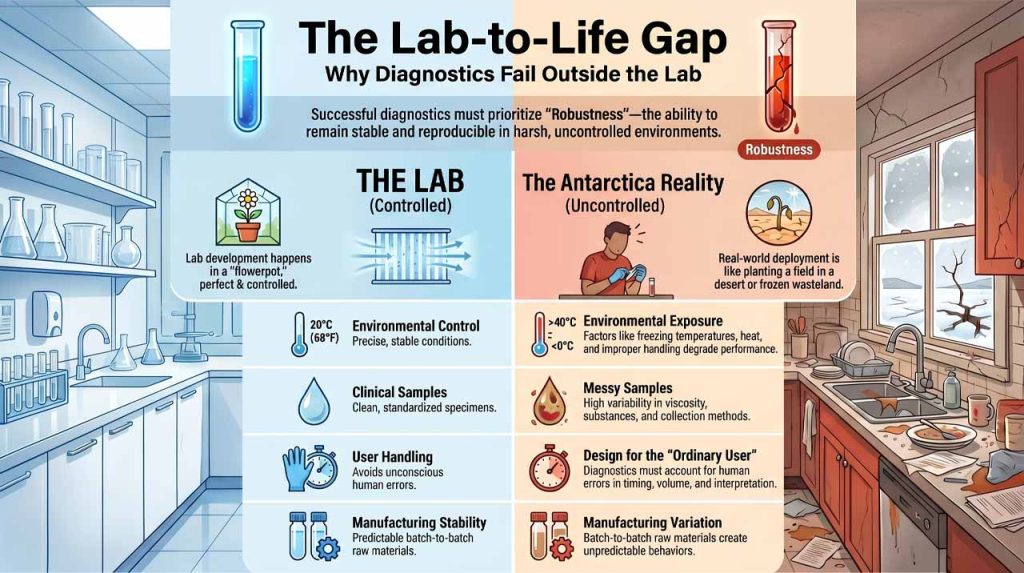
He explained that many diagnostic systems appear stable during research because laboratory development occurs under highly controlled conditions.
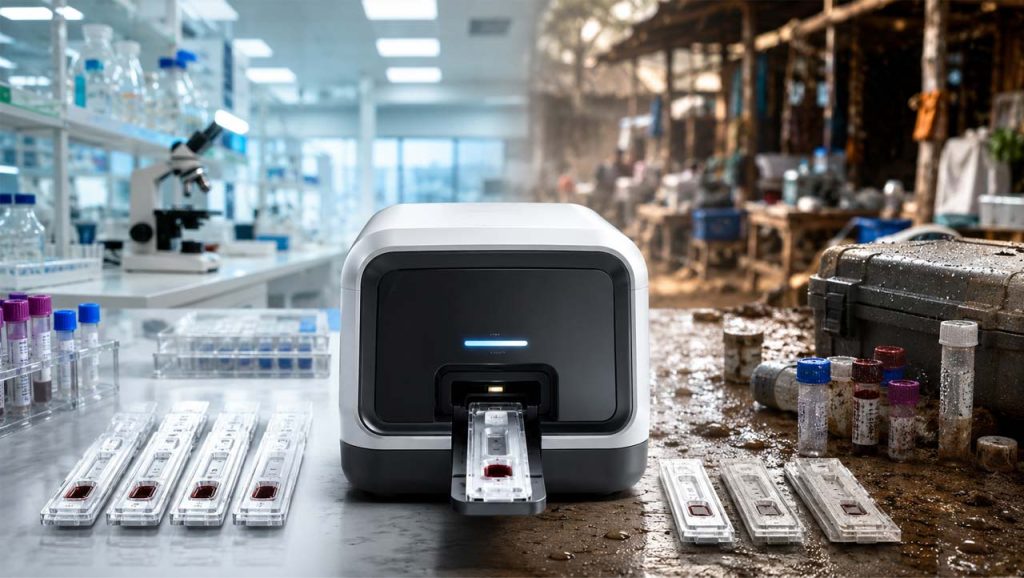
Meanwhile, commercial deployment introduces far more variables simultaneously, including raw-material variation, manufacturing instability, user handling differences, environmental exposure, and unpredictable clinical samples.
“One of the biggest challenges is batch-to-batch variation in raw materials.
As these materials interact, they generate new parameters and behaviors that are often not visible during early laboratory-stage development.”
Why High Accuracy Alone Does Not Guarantee Real-World Reliability
Diagnostic startups often emphasize sensitivity, specificity, and AI model performance when presenting technologies to investors and healthcare partners. However, Joung argues that these metrics alone can create a misleading picture of commercial readiness.
According to Korea’s Ministry of Food and Drug Safety (MFDS), even tests with strong sensitivity and specificity can still produce very different real-world predictive outcomes depending on prevalence rates and actual user conditions. Real-world reliability depends not only on analytical accuracy but also on how systems perform under uncontrolled operational environments.
Joung believes one of the most underestimated factors is the complexity of crude clinical samples themselves.
“Diagnostic sensors do not measure clean, idealized samples,”
he said.
“They measure highly complex biological specimens, where variability in sample matrix, viscosity, interfering substances, collection methods, storage conditions, and user handling can dramatically affect performance.”
He said many teams mistakenly assume these problems can be solved later through optimization.
“I often compare it to the difference between growing a single flower in a flowerpot at home and trying to create a massive flower field in the middle of Antarctica or a desert,”
Joung explained.
“In a controlled indoor environment, almost anything can appear stable and beautiful. But scaling that system into an uncontrolled, harsh environment is an entirely different challenge.”
The distinction matters because many diagnostic failures emerge not from the sensing mechanism itself, but from everything surrounding the measurement process.
Research published in Scientific Reports this year noted that pre-analytical stages such as specimen collection, handling, transportation, and preparation remain one of the largest sources of laboratory testing errors globally.
Similar concerns have also been highlighted by the U.S. Centers for Disease Control and Prevention (CDC), which warned that even CLIA-waived and home-use tests are not error-proof when operated incorrectly or under unsuitable conditions.
Point-of-Care Testing Pushes Diagnostics into Uncontrolled Environments
The expansion of decentralized healthcare testing is reshaping how diagnostic systems are designed.
At-home and point-of-care diagnostics reduce dependence on centralized laboratories and improve accessibility. However, these advantages also remove many layers of environmental and procedural control that previously protected testing consistency.
According to the FDA, environmental conditions such as freezing temperatures, heat exposure, and improper handling can directly affect test performance in home-use systems.
Joung believes usability becomes one of the hidden technical barriers once diagnostic products reach ordinary users.
“Laboratory users can unconsciously compensate for many variables during testing, but general users cannot.
The most common usability-driven failures are inconsistent sample handling, incorrect sample volume, timing errors, environmental exposure, and misinterpretation of results.”
He explained that improving usability often requires integrating more automated sample-processing functions directly into cartridge systems. Yet doing so also increases manufacturing complexity and production cost.
“So in reality, usability, robustness, performance, and cost are always trade-offs.”
Robustness May Become the Most Important Metric in Diagnostics
The diagnostics sector increasingly promotes AI integration, smart healthcare infrastructure, and decentralized testing accessibility. Yet Joung believes the industry still faces a more fundamental challenge.
“A successful diagnostic system must not only perform well under ideal conditions, but remain stable, reproducible, and controllable under the harsh realities of real-world use and mass production.”
That requirement is becoming more important as healthcare systems seek to expand rapid diagnostics beyond hospitals and specialized laboratories.
Academic researchers have also increasingly warned that many biosensor platforms demonstrate promising laboratory sensitivity while still lacking sufficient robustness, reproducibility, validation maturity, and manufacturing readiness for large-scale clinical deployment.
Joung believes the gap between technical feasibility and industrial reliability remains one of the least appreciated realities in healthcare deep-tech commercialization.
“Real-world conditions must be understood from the earliest stages of development.”
The Industry’s Next Challenge May Not Be Invention
Now, diagnostic innovation is definitely not slowing down. Companies continue developing AI-assisted biosensors, decentralized healthcare systems, multiplex diagnostics, and at-home testing platforms designed to reduce friction in clinical access.
Yet the next competitive advantage may depend less on inventing new sensing technologies and more on building systems capable of surviving uncontrolled real-world environments consistently over time.
That challenge extends beyond technical performance alone. It includes manufacturing controllability, supply-chain stability, usability, environmental resilience, and long-term reproducibility under large-scale deployment conditions.
As diagnostic systems continue moving closer to patients, the healthcare industry may increasingly discover that proving a concept inside a laboratory is only the beginning of commercialization.
Key Takeaways
- Strong laboratory accuracy does not guarantee reliable real-world diagnostic performance.
- According to Hyou-Arm Joung, the first major failure after commercialization is often the loss of environmental and process control.
- Real-world deployment introduces variables including sample variability, environmental stress, manufacturing inconsistency, and user handling differences.
- FDA and CDC guidance increasingly highlights the operational challenges associated with point-of-care and at-home diagnostic systems.
- Diagnostic commercialization depends heavily on robustness, reproducibility, controllability, and long-term operational stability, not only sensitivity or specificity.
- Joung argues that real-world conditions must be considered from the earliest stages of diagnostic development, not after laboratory validation is complete.
🤝 Looking to connect with verified Korean companies building globally?
Explore curated company profiles and request direct introductions through beSUCCESS Connect.
– Stay Ahead in Korea’s Startup Scene –
Get real-time insights, funding updates, and policy shifts shaping Korea’s innovation ecosystem.
➡️ Follow KoreaTechDesk on LinkedIn, X (Twitter), Threads, Bluesky, Telegram, Facebook, and WhatsApp Channel.
Source link