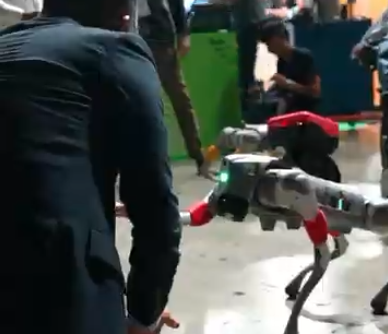
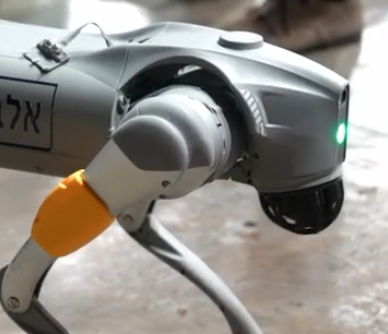


Israel has earned a global reputation for developing technologies that solve some of the world’s most complex challenges. From cybersecurity and healthcare to climate innovation and artificial intelligence, Israeli entrepreneurs continue to push the boundaries of what technology can achieve. In a recent episode of What’s Next in Israel Tech, a weekly video series highlighting cutting-edge Israeli innovation, viewers are introduced to S.Tech, a startup whose Claw4See robot is redefining mobility for people who are blind or visually impaired.
At first glance, Claw4See looks like a sophisticated four-legged robot. But its real innovation lies beneath the surface. Combining advanced robotics, artificial intelligence, real-time mapping, and accessibility-focused design, the system enables users to navigate complex urban environments independently and confidently.
AI-powered robots replace seeing-eye dogs
(What’s Next in Israel Tech)
Rather than relying on traditional guide dogs, users guided by the robotic dog receive guidance through a simple earbud interface. They tell the robotic dog where they want to go, and Claw4See calculates the route, detects obstacles in real time, and guides them safely to their destination. Throughout the journey, Claw4See communicates with its handler about the environment and upcoming hazards, answering questions posed by the handler.
Gerson Panitch, speaks with Shalom Cohen, CEO of S.Tech, and Mikael Bouzaglo, CTO and Co-Founder of S.Tech. Together, they provide an inside look at the technology behind Claw4See, explaining how the AI-assisted robotics creates a new level of independence for people who are blind or visually impaired.
The company’s lean team combines elite expertise in robotics, artificial intelligence, computer vision, and real-time navigation systems. Their goal is not merely to build another robot, but to create technology that enhances quality of life and expands opportunities for people who have historically faced significant barriers to independent movement.
Dr. Sharon Eytan, a visually impaired user, is one of the early adopters of the technology and shared her overwhelmingly positive experience, “I had tried a real dog, but I typically walk with a cane or with someone guiding me. But when I tried Claud4C, it was amazing, it was like a dream come true.”
Rather than relying on traditional guide dogs, users guided by the robotic dog receive guidance through a simple earbud interface
(Photo: Screenshot)
The cost difference between a live dog and Claw4C is striking. A trained guide dog typically costs on the order of $80,000 when the full lifecycle expenses are accounted for, including selective breeding programs, veterinary care, and more than a year of intensive, specialized training for both the dog and its eventual handler. In addition, ongoing support services, follow-up training, and the relatively limited working lifespan of the animal further contribute to the overall cost.
By contrast, S.Tech’s Claw4See robotic solution is designed to deliver even better mobility assistance at a fraction of the price, with an expected cost of roughly $15,000, leveraging scalable manufacturing, software-driven navigation, and minimal ongoing upkeep. This dramatic cost differential has the potential to expand access to mobility assistance for a much broader population of blind and visually impaired individuals.
A significant percentage of guide dog placements ultimately do not succeed, with many programs reporting that roughly 20–40% of matches fail due to temperament mismatches, handler compatibility issues, or changing needs over time. Even well-trained dogs can have personalities, stress responses, or working styles that do not align with a particular owner, leading to reassignment or early retirement. By contrast, a robotic system like Claw4See eliminates these variables entirely: it delivers consistent, programmable behavior without the unpredictability or emotional dynamics inherent in a live animal, removing the risk of incompatibility and ensuring a uniform experience for every user.
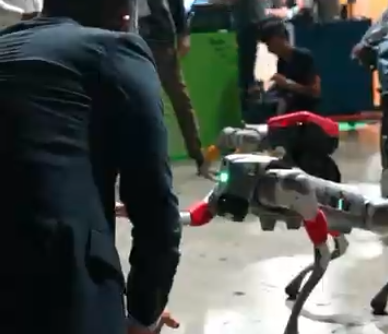
Claw4See’s AI enables real-time, natural-language interaction between the handler and the robot
(Photo: Screenshot)
Moreover, Claw4See’s AI enables real-time, natural-language interaction between the handler and the robot — capabilities that are simply not possible with a live animal.
For users, the impact goes far beyond convenience. Greater mobility can mean improved access to education, employment, social activities, and everyday experiences that many people take for granted. By removing obstacles — both physical and psychological — technologies like Claw4See have the potential to transform daily life.
While many robotics companies focus on industrial automation, logistics, or defense applications, S.Tech has chosen to tackle one of the most personal and meaningful challenges imaginable—independent mobility for the sight impaired. The project reflects a broader trend that has become a hallmark of the Israeli technology ecosystem: applying cutting-edge innovation to solve real human challenges.
What’s Next in Israel Tech, hosted by Gerson Panitch, is a post–October 7 initiative of Finnegan aimed at showcasing the life-changing technologies emerging from Israel and encouraging investment in the country’s most exciting startups.
Source link