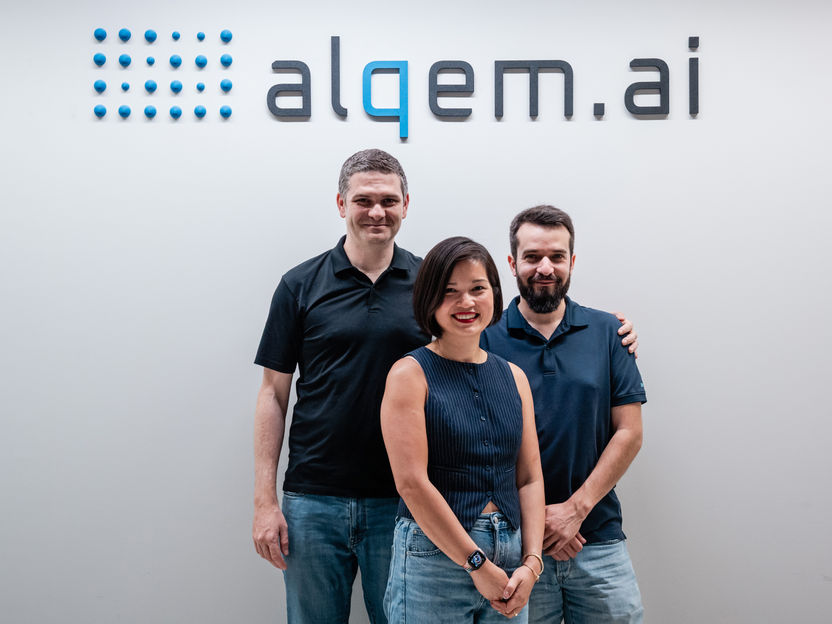
alqem, a deep tech startup developing an AI platform for the discovery and commercialization of novel materials, has closed a pre-seed funding round of 8 million euros. The round was co-led by UVC Partners and Union Square Ventures. The company was founded by the team behind Alexandria—the world’s leading open materials database, which is used by numerous universities and companies in AI-driven materials research.
At the core of the AI platform are two proprietary data foundations: a database of predicted materials on an unprecedented scale, as well as high-quality training data for material properties that did not previously exist in this form. In-house laboratory capabilities for synthesis ensure that digital predictions are turned into real materials.
Undiscovered Materials for the Next Technological Era
Bronze, iron, steel, silicon: Every major technological era has been shaped by new materials. However, only a fraction of the theoretically possible crystalline compounds have ever been synthesized. Hundreds of millions of possibilities remain undiscovered. At the same time, the supply of critical raw materials is increasingly falling into the hands of just a few countries.
High-performance permanent magnets—indispensable for electric vehicles, wind turbines, robotics, and defense systems—are produced in China at a rate of about 90 percent. Recent export restrictions have made the supply of these materials a key geopolitical issue.
“For the first time, we have a map of the material universe. Hundreds of millions of possibilities—far more than the few compounds known to date—that we can now systematically explore. Materials that could make electric vehicles more efficient, wind turbines more powerful, and critical supply chains independent of production in a single country,” says Dr. Hanh Nguyen, CEO of alqem.
The last breakthrough in permanent magnets was more than 40 years ago
The search for new materials is no longer an odyssey. It is a targeted journey. alqem’s mission is to shorten the path from scientific prediction to industrial application—from decades to years—or even months. The AI platform has already developed a pipeline of promising candidates
for rare-earth-free magnets, whose predicted performance has been validated using experimental data. By narrowing down hundreds of millions of possibilities to a manageable selection and automating experimental analysis—which typically takes hours—the AI platform becomes more precise with each iteration
.
“We’re starting where the need is greatest: with rare-earth-free magnets—a product the world urgently needs, since rare earths have remained irreplaceable for decades. But the AI platform we’re building isn’t limited to a single class of materials,” says Dr. Nguyen.
In addition to the AI platform, alqem is working to establish a European supply chain for critical materials. This work supports the creation of DeepTech, research, engineering, and manufacturing jobs at the Munich and Coimbra locations.
From Alexandria to alqem: Scientific Excellence and Technology
Three technical foundations underpin the AI platform. The first is al-mine: a proprietary database of predicted stable crystalline compounds specifically focused on non-toxic, cost-effective elements. The second is al-oracle: a set of high-quality, domain-specific training data for material properties that the team has built up over the years. Both build on Alexandria, the open materials database jointly developed by alqem co-founder Dr. Tiago Cerqueira (CTO) and scientific advisor Prof. Miguel Marques—proof that this team set the scientific
standard in this field long before alqem existed. The third pillar is the team’s in-house synthesis and characterization capabilities, anchored by co-founder Prof. Milan Allan, who holds the Chair of Experimental Physics at LMU Munich.
Collaborations and Supporters
alqem’s work is supported by close collaboration with the Max Planck Institute for Chemical Physics of Solid States in Dresden in the field of next-generation magnetic materials. The collaboration is led by Prof. Claudia Felser, Director of the Institute and Vice President of the Max Planck Society. She serves as a scientific advisor to alqem, as do Prof. Miguel Marques (Ruhr University Bochum) and Michael Viertler, former Senior Partner and Managing Partner in Munich at
McKinsey. Research partners include LMU Munich, TU Munich, Técnico de Lisboa, the University of Porto, and the University of Coimbra.
“alqem is a startup that translates world-class science into a company tackling one of Europe’s most strategically important industrial challenges. Advanced materials are at the heart of the technologies that will shape the coming decades—from clean energy to mobility to defense. “alqem has the unique scientific foundation and entrepreneurial drive to become a defining player in this field,” says Amanda Birkenholz, Principal at UVC Partners.
“Discovering a truly new permanent magnet is one of the most difficult problems in materials science. The last real breakthrough was over forty years ago. What sets alqem’s approach apart is that it doesn’t stop at prediction. In our collaboration, we’re putting precisely those rare-earth-free candidates through experimental testing that researchers have long been waiting for. And it is the combination of large-scale computer-aided screening and systematic synthesis that convinces me this can work,” says Prof. Claudia Felser, Director of the Max Planck Institute for Chemical Physics of Solids and Vice President of the Max Planck Society.