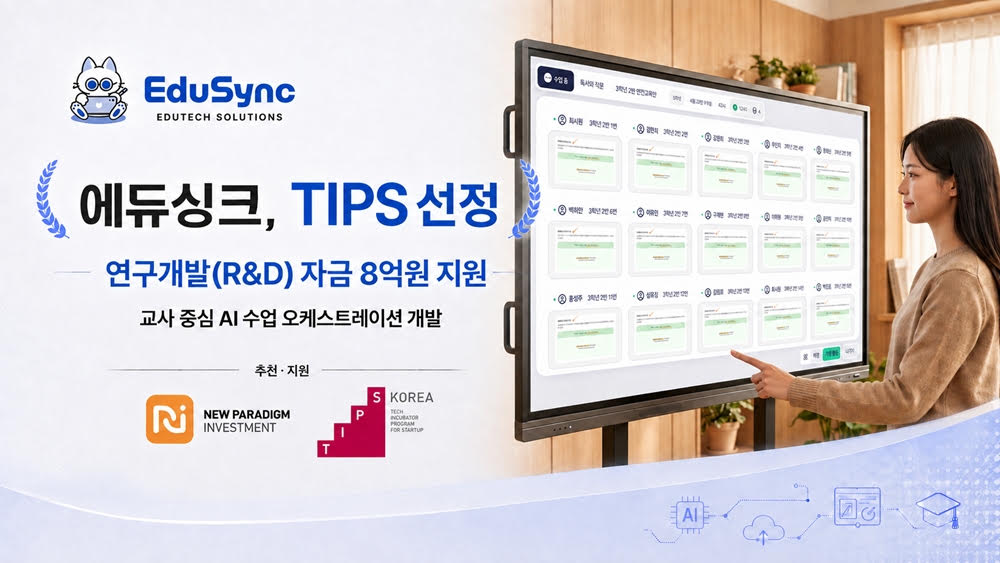
The scope of AI utilization in the educational field is expanding from problem generation and content recommendation to actual class management. In a classroom, blackboard writing, teacher explanations, learning materials, and student questions occur simultaneously, but because they remain in distinct forms, it is difficult to reconstruct the overall context of the lesson. By connecting this data to the same timeline, AI can analyze the stages of the lesson and student responses together. EduSync, an AI education infrastructure startup, is embarking on the development of technology to support the entire lesson process for teachers, based on accumulated class data from 7,000 sessions.
EduSync was finally selected for the Ministry of SMEs and Startups’ ‘TIPS General Track’ upon recommendation from New Paradigm Investment, a TIPS operator. Over the next two years, the company will receive up to 800 million won in government R&D funding to advance its ‘AI Class Orchestration’ technology, which connects classroom data.
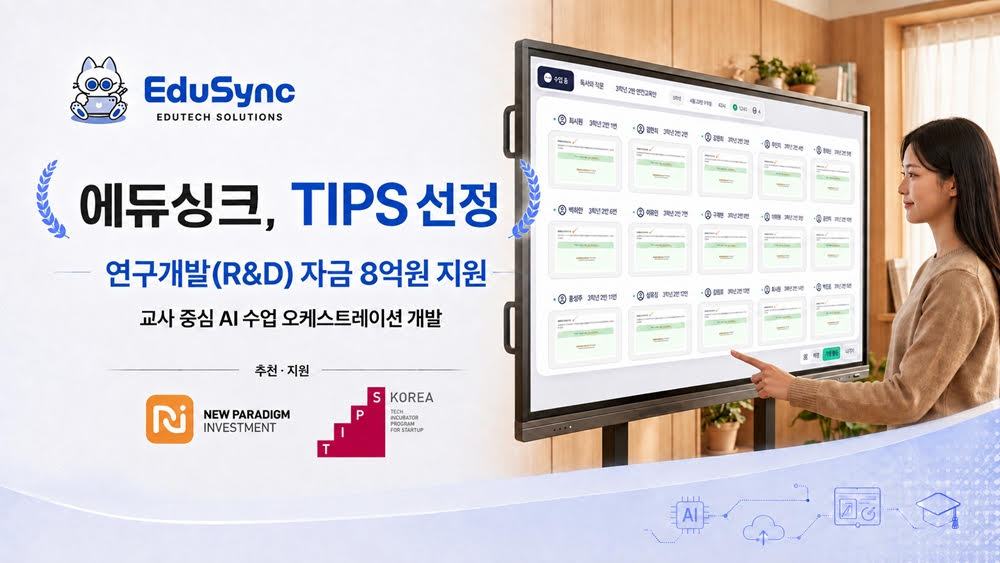
EduSync previously secured seed investment from New Paradigm Investment. Through this TIPS project, it combines multimodal AI with its existing electronic whiteboard-based class solution and expands into a platform that connects everything from class preparation to real-time operation and post-class analysis.
The key lies in structuring data generated in various forms within the classroom into a single lesson context. The design places the teacher’s writing and speech, learning materials displayed on the electronic whiteboard, and student questions and participation records on the same timeline, enabling AI to analyze the relationship between specific explanations and student responses.
For example, it is possible to check, in chronological order, what questions were asked immediately after the teacher explained a concept, or how student participation changed when specific materials were presented. It is a structure that analyzes the interactions that occurred during the lesson, rather than simply summarizing the results after the class ends.
Connecting from the pre-lesson knowledge graph to the design of the next session
Before the lesson, create a ‘Lesson Knowledge Graph (LKG).’ Organize the key concepts to be covered in the session, the relationships between them, and anticipated misconceptions that students may encounter, enabling the teacher to utilize this information in designing the lesson flow.
Data generated during class is converted into a ‘Structured Lesson Stream (SLS).’ AI connects whiteboard writing, speech, screen materials, and student responses in real time to analyze the stage of the lesson and suggests points for the teacher to check or areas requiring intervention.
After the class ends, identified misconceptions and supplementary content for each student are summarized, and a plan for the next session is provided. This method creates a cyclical structure in which the understanding and responses observed in the previous session are reflected in the structure of the next lesson by connecting pre-class preparation materials, actual progress records, and post-class analysis results.
The technology development utilizes accumulated class data from approximately 7,000 sessions secured by EduSync from school sites. The company is operating a demonstration network centered around Yangmyeong High School, Pyeongtaek Seongdong Elementary School, and Ansan International Business High School.
EduSync has set a goal to demonstrate its technology in more than 30 schools by the end of research and development and to convert more than 60% of the participating institutions into paying customers. The plan is to supply the technology to electronic whiteboard and education platform operators in Southeast Asia and North America via bundling and API after confirming its usability and purchasing demand in the school and academy markets.
“The development direction is to support teachers in making better decisions by having AI organize information scattered within the classroom,” said Kwon Ga-won, CEO of EduSync. “We will create an educational infrastructure where the quality of educational content and lesson design improves as class data is repeated.”
The success of this project depends not on the quantity of class data secured, but on how accurately data from different classrooms is connected and how the analysis results are transformed into suggestions that teachers can actually utilize. It is also necessary to have a personal information protection system in place while handling records of student speech and participation, as well as the capability to stably process differences in classroom environments across schools. The pilot program involving 30 schools and the paid conversion rate of over 60% presented by EduSync are expected to serve as indicators confirming not only the accuracy of the technology but also the educational field’s intention to continue using it.
Related