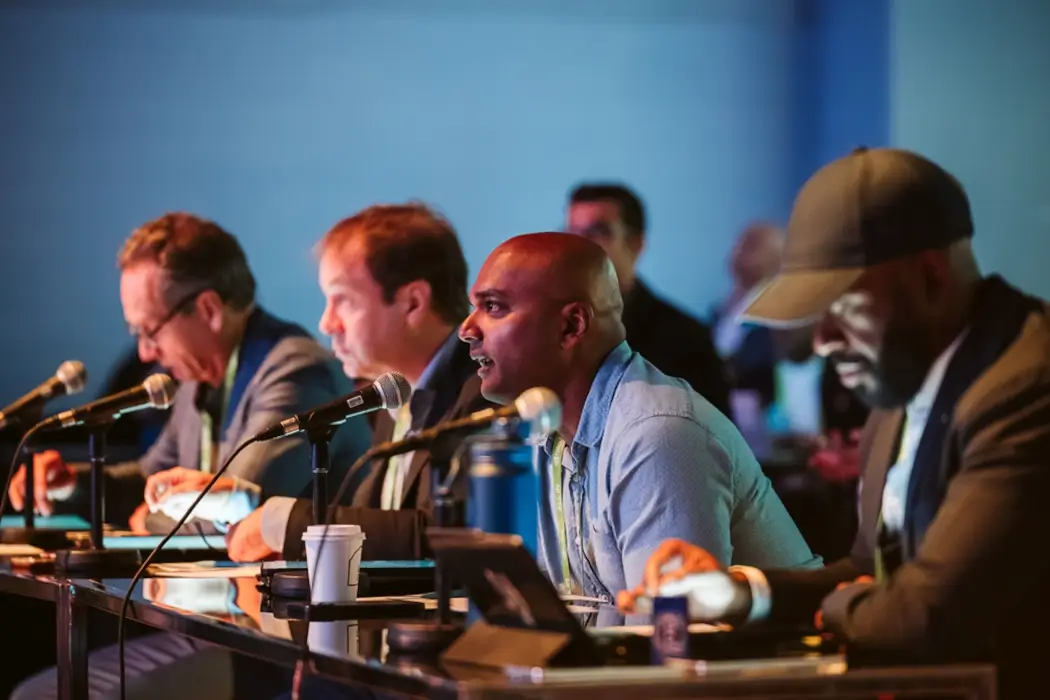


Smart Cities AI Challenge is one of three reverse pitch competitions at Canada’s largest AI and tech event.
As discussions around making governments more efficient flourish, the City of Toronto is betting on Canadian AI solutions and the problems that technology companies want to solve. But turning that interest into an actual municipal deployment is much harder.
That is the premise behind the Smart Cities AI Challenge, run in collaboration with the City of Toronto and taking place at Canada’s largest AI and technology gathering, ALL IN 2026, in Montréal on September 16-17. The competition showcases challenges faced by cities and communities, then asks tech companies to bring forward AI-powered solutions that could address them.
Isabelle Turcotte,
“Building a globally competitive Canadian AI industry starts with creating opportunities to deploy our technology here at home.”
ALL IN
The challenge comes as municipalities across Canada are examining how AI can be used to improve municipal operations, infrastructure, and residents’ quality of life. The City of Toronto is also bringing a 40-strong delegation to ALL IN.
The Smart Cities AI Challenge is one of three AI competitions at this year’s event, up from just one in 2025. The expansion is part of ALL IN’s effort to accelerate the adoption of Canadian AI and tech, and to highlight what can happen for governments when AI technology is used to solve real and specific operational problems.
“Our AI Challenges are about connecting real-world needs with Canadian AI solutions,” said Isabelle Turcotte, Co-Founder and CEO of ALL IN. “For these companies, the opportunity to demonstrate their technology, and potentially secure a first public-sector client, can make a significant difference in their growth trajectory.”
Starting with the problem
For many startups, the public sector can be a tough market to crack. Cities have sprawling infrastructure, complex service demands, and no shortage of operational challenges. They also have procurement systems that can be both rigorous and time-intensive.
“Canadian cities have an important role to play in building a strong AI industry. By adopting Canadian AI solutions to address real operational challenges, municipalities can improve the services they deliver to citizens while also giving Canadian companies the opportunity to prove their technologies, secure important first customers, and scale. Building a globally competitive Canadian AI industry starts with creating opportunities to deploy our technology here at home,” Turcotte said.
The format of the Smart Cities AI Challenge forces competitors to connect their solution to an identifiable use case, such as urban mobility, infrastructure coordination, public safety, social services, or sustainability.
The Smart Cities Challenge has a short list of six companies working across construction, cleantech, education, business intelligence, and cybersecurity, among others.
One of the companies is Kingston-based Lawtonica, which helps city planners, designers, and building professionals research codes, check zoning, and organize project findings with AI-assisted workflows. Another finalist is Montréal-based cybersecurity company Cyberdefence AI, an AI-native cybersecurity lab that focuses on preemptive defence against cyber threats.
The other shortlisted firms include air and odour sampling tech firm Scentroid, Vancouver-based critical operations software firm Industrio AI, Toronto-based edtech platform Readocracy, and Montréal-based asset management firm Tbmaestro.
The selected companies for the Smart Cities AI Challenge will present their solutions on stage at ALL IN 2026 for a shot at potential collaboration opportunities with cities, public organizations, and innovation partners.
“Narrowing down applicants to these six finalists was no easy task. What stood out was the quality of the Canadian solutions ready to address real challenges facing our cities today. The next step is getting those solutions deployed. We need to move beyond experimentation and create more opportunities for Canadian AI companies to prove their value, deliver measurable results, and scale their solutions across cities and communities throughout the country,” said Turcotte.
Three challenges, 180 applications
Toronto is one of three governments participating in AI challenges at ALL IN this year. The City of Montréal is partnering with the Reinventing the Citizen Experience AI Challenge, which focuses on how residents can report issues requiring city intervention.
“There’s something exciting about seeing these companies take the stage, defend their ideas, and show what Canadian AI can do.”
The challenge asks companies to develop a system that can process reports involving potholes, graffiti, cleanliness concerns, or damaged infrastructure from a photo, potentially accompanied by a voice message or written description. The city is seeking AI solutions that can automate routine tasks involved in this process, while accelerating request processing and supporting better decision-making at the municipal level.
The AI for Real Impact Challenge is being run in partnership with Germany’s Federal Ministry for Digital Transformation and Government Modernisation and German digital network de:hub. Germany is also ALL IN’s 2026 country of honour.
AI for Real Impact is looking for AI systems already producing measurable economic, social, environmental, security, or operational outcomes. Its scope stretches across many areas, including manufacturing, public services, healthcare, sustainability, security, and business operations.
Scaling the model
ALL IN conducted AI challenges last year through its AgriTech AI Challenge. Sollum Technologies and Miraterra won the competition after presenting AI-driven technologies addressing agricultural problems, including soil and crop management, productivity, and supply-chain efficiency.
The two companies subsequently presented their technology at the World Food Forum at the headquarters of the United Nations Food and Agriculture Organization in Rome.
For the 2026 edition, ALL IN is scaling the format of its past experiments considerably. The organization expects over 7,500 business leaders from more than 40 countries at the Montréal event, where the three competitions will sit alongside the broader conference program, which includes talks from LawZero’s Yoshua Bengio, Scale AI’s Julien Billot, Cohere’s Aidan Gomez and Joelle Pineau, among many others.
“Anyone who has participated in previous years can testify to how exciting and unique this format is,” Turcotte said. “The strength of these reverse pitch competitions is that it starts with a real problem that needs to be solved. There’s something exciting about seeing these companies take the stage, defend their ideas, and show what Canadian AI can do. I can’t wait to see what this year’s finalists bring to Montréal.”
PRESENTED BY
Catch the AI Challenge track at ALL IN 2026 in Montréal on September 16 and 17. Explore the full ALL IN 2026 program and registration details.
Feature image courtsy ALL IN.
Source link