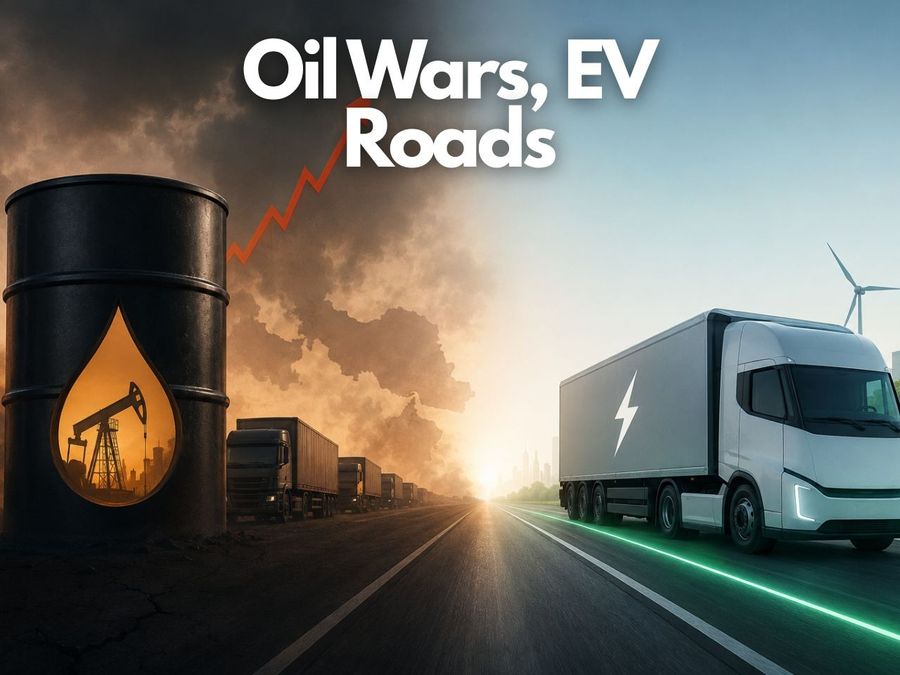
The Iran war is now travelling through India’s economy — not through missiles or military deployments, but through diesel tanks, freight bills and the rising cost of moving goods across the country.
Within a week, India raised petrol and diesel prices twice after global crude oil prices surged amid escalating tensions in the Middle East and fears of disruption around the Strait of Hormuz, one of the world’s most critical oil transit routes. The latest increase followed an earlier ₹3-per-litre hike last week, marking the sharpest retail fuel revision in nearly four years. (reuters.com)
For consumers, the impact is immediate. Fuel becomes expensive, transport costs rise and household budgets tighten.
But somewhere deeper inside the economy, another pressure point is beginning to crack — logistics.
Because India does not merely consume diesel. Its economy moves on diesel.
Every night, millions of trucks carry vegetables to mandis, medicines to pharmacies, steel to factories, cement to infrastructure projects and ecommerce deliveries to homes. More than 70% of India’s freight movement depends on road transport powered overwhelmingly by diesel. Which means every geopolitical tremor in West Asia eventually reaches Indian highways.
This time, it may end up accelerating one of India’s most overlooked startup opportunities: electric freight mobility.
India’s EV Revolution Ignored Its Biggest Fuel Consumer
For years, India’s EV narrative revolved largely around consumers. The conversation focused on electric scooters, passenger cars and charging stations in urban neighborhoods. Venture capital chased mobility apps while policymakers pushed adoption targets for personal transportation.
Meanwhile, the country’s largest fuel-consuming mobility segment — heavy trucking — remained relatively outside the spotlight.
That blind spot is now disappearing because freight economics are changing faster than climate politics.
Fleet operators do not make decisions based on environmental slogans. They make decisions based on margins. And when diesel prices become volatile, the economics of logistics starts changing rapidly.
Every fuel hike creates a cascading effect across the economy. Freight costs rise, ecommerce delivery becomes expensive, manufacturing margins shrink, MSMEs face pressure and food inflation slowly spreads through supply chains.
India imports nearly 85% of its crude oil requirements, making the economy deeply vulnerable to geopolitical disruptions. The Iran conflict has simply exposed a structural reality policymakers already understood but perhaps underestimated: India’s growth story remains deeply tied to imported fuel.
That realization is quietly changing the EV truck conversation.
What was once viewed primarily as a climate experiment is increasingly being seen as strategic economic infrastructure.
The Startups Quietly Rebuilding India’s Freight Economy
Across industrial corridors, warehouses and logistics parks, a new generation of Indian startups is already preparing for that shift.
At the center of this emerging ecosystem is Blue Energy Motors, backed by the Essar Group, which is building around the idea that the future of freight will require more than just electric vehicles. The company recently launched what it described as India’s first heavy-duty electric truck with battery-swapping capability, while simultaneously building an ecosystem around LNG-powered trucks, green logistics infrastructure and energy systems designed for commercial fleets.
Other startups are approaching the opportunity from different angles. Delhi-based Euler Motors is betting on urban cargo electrification as ecommerce and hyperlocal delivery networks expand rapidly across Indian cities. Bengaluru-based Altigreen is focusing on intra-city logistics fleets where fuel savings can immediately improve operating economics. Omega Seiki Mobility is targeting commercial cargo transportation across Tier-2 and Tier-3 India, while Montra Electric is pushing into industrial freight mobility where diesel volatility can significantly impact fleet profitability.
Even companies like Flytta, which are experimenting with retrofitted heavy electric trucks, are drawing attention because they offer a possible transition path for fleet operators unwilling to immediately abandon existing diesel assets.
Together, these startups are not simply manufacturing vehicles. They are attempting to redesign freight economics for a future where fuel volatility may become the new normal.
And the timing may not be accidental.
Around the world, oil volatility is accelerating freight electrification faster than policymakers expected. China, already the world’s largest EV market, is witnessing rising adoption of heavy electric trucks as fuel prices surge amid Middle East instability.
India may now be entering a similar transition phase.
Why EV Trucks May Soon Become Strategic Infrastructure
India’s large automotive companies have already sensed the shift. Tata Motors, Ashok Leyland, Mahindra and Eicher are all expanding aggressively into electric commercial mobility. Tata Motors, in particular, has emerged as one of India’s strongest electric cargo vehicle players while warning investors that geopolitical instability and commodity volatility are impacting transportation economics globally.
But the larger story extends beyond automobiles.
Heavy EV trucking is not merely a mobility challenge. It is becoming an infrastructure challenge tied directly to energy security, inflation management, industrial competitiveness and supply-chain resilience.
India’s logistics costs remain around 13–14% of GDP, significantly higher than manufacturing economies like China and the United States. If India wants to emerge as a serious manufacturing and supply-chain alternative under the China+1 strategy, reducing freight volatility becomes critical.
That is why electric freight may eventually move beyond climate policy and enter the category of strategic national infrastructure alongside highways, railways, ports and power grids.
India’s next EV revolution may not begin in showrooms. It may begin in warehouses, freight corridors and industrial highways.
Every major oil crisis in modern history has accelerated technological transformation. The oil shocks of the 1970s reshaped automotive engineering. The Gulf Wars transformed global energy security strategies. The Ukraine conflict accelerated Europe’s renewable transition.
Now, the Iran conflict may end up accelerating India’s electric freight revolution.
Because in the coming decade, India’s battle for manufacturing competitiveness may depend as much on electric freight corridors as on factories themselves.