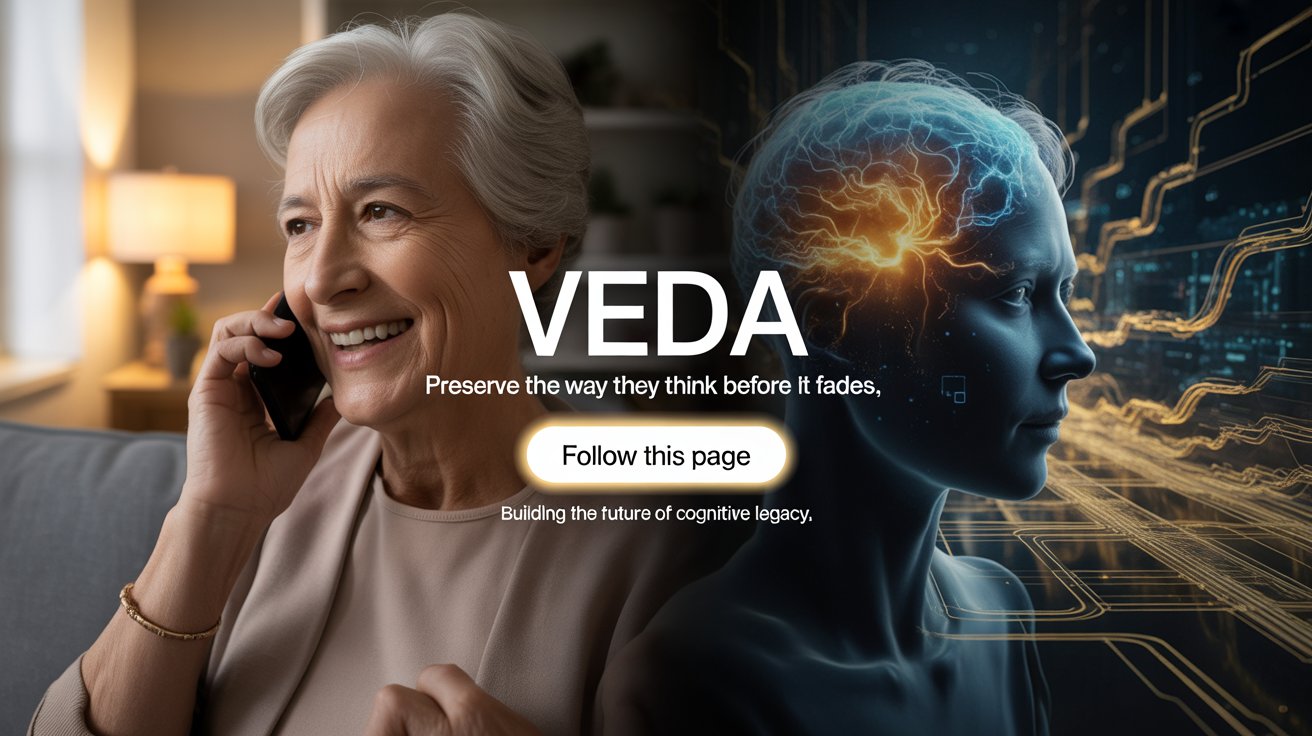
Nigerian startup Veda Legacy is using AI to preserve how dementia sufferers think before the condition takes it permanently.
“When someone develops dementia, the first thing that goes is not their name or their face. It is the way they reason. The decision logic they built over forty years of running a business. The values that held a family together across generations. The judgment that no one else in the room has, because it took a lifetime to develop,” Adeyemi Olaoye, Veda Legacy founder and CEO told Disrupt Africa.
“By the time a family realises what is happening, that cognitive architecture is already eroding. And once the window closes, there is no getting it back.”
Veda Legacy exists to pre-empt that situation, and is building a voice-first AI cognitive continuity platform that preserves how people think before dementia takes it away.
“We built a platform that meets families in that window. A subject dials a Veda Legacy phone number, has a structured voice conversation with our AI system, and over multiple sessions their reasoning patterns, decision frameworks, and values get captured, structured, and modelled into a private consultable AI representation,” Olaoye said.
“A daughter can open Veda three years after her father’s diagnosis and ask what he would have decided about a succession dispute. She gets a response grounded in his documented reasoning, in his voice, shaped by everything he shared while he was still fully himself.”
The entire experience happens over a standard phone call.
“No smartphone. No app. No internet connection. That was a deliberate architectural decision. The people most at risk of cognitive decline in Africa are not always the most digitally connected. A phone call is the most accessible communication technology on the continent. We designed the product around that reality from day one,” said Olaoye.
The company, which is 18 months into active product development, is filling a specific and surprisingly unaddressed gap, given the scale of the problem.
“Every existing tool in the digital legacy and memory preservation space was built for what comes after,” Olaoye said.
“After death, after the window has closed. StoryFile and HereAfterAI create interactive post-mortem video archives. Replika builds AI companionship. DeepBrain AI produces video avatars. MindBank AI builds personal AI models through conversation. None of them were designed for families navigating cognitive decline in a living person. None of them were built for the African context. And none of them were built specifically to capture how someone thinks rather than what they remember.”
That distinction matters enormously in practice, he said.
“A transcript of what your father said on a Tuesday afternoon is not the same as a model of how he makes decisions under pressure. Families going through succession disputes or financial decisions after a patriarch’s diagnosis do not need a recording. They need to understand how he would have reasoned through it. Those are different products,” said Olaoye.
Veda Legacy is still in private beta, with its call infrastructure live and operational in Nigeria.
“Subjects can dial a Veda Legacy number, complete a structured voice session, and have their responses captured. The founding customer pipeline is active, with families engaged in direct conversations and early sessions underway,” Olaoye said.
“The reasoning engine, the component that transforms captured sessions into the full consultable AI output, is the product milestone that completes the core value proposition. Until that exists, I am not trying to acquire customers at scale. The current phase is about proving the end-to-end product works with real users in real conditions before we open the gates.”
Fully founder-funded to date, Veda Legacy was recently named AI Startup of the Year Nigeria 2026 by the Corporate Innovation and Excellence Awards UK. It has been accepted into the STATION F Fighters Programme in Paris for the Spring 2026 batch, as well as the 1752VC Launchpad in the US, Founder Institute Abuja 2026, and UPG Biashara in Switzerland.
“The recognition has come faster than the capital, which is an honest description of where we are. The product story is strong. The revenue story is still being written,” Olaoye said.
The “revenue story” will be written by annual family subscriptions at three tiers, as well as institutional licensing to hospitals, memory clinics, and dementia NGOs that integrate Veda into their clinical care pathways. For now, the startup is Nigeria-focused, but Olaoye said it has wider plans.
“The secondary market we are building toward is the UK, specifically the Nigerian and broader African diaspora community, which represents a population that is geographically distant from their elderly family members in Nigeria and often the most motivated to act on preservation before the window closes. The diaspora angle is also financially significant: these are families with the resources to pay for the Heritage and Sovereign subscription tiers and the emotional proximity to a problem they cannot solve with a WhatsApp call,” he said.
“UK company registration is planned, contingent on incoming funding, to access Innovate UK grants, SEIS and EIS investor incentives, and UK government-backed funding programmes. The longer expansion roadmap runs through Sub-Saharan Africa broadly, then into the Middle East where multigenerational family office structures create a natural market for the Sovereign tier, then into the US African diaspora. But I am not building for all of those markets right now. Nigeria first. Prove it here. Then move.”