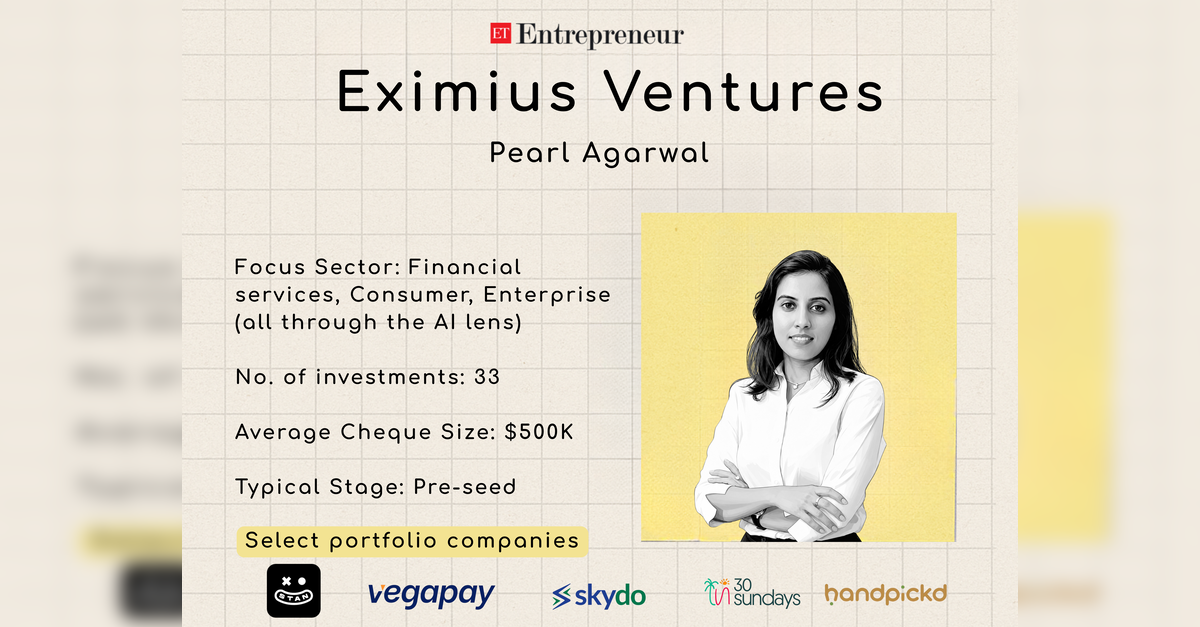
As a student, Pearl Agarwal found herself drawn to microfinance, convinced that access to capital could transform lives in ways that charity alone could not. She spent her early college years studying the subject, imagining a future where she would work in Africa, helping small communities build livelihoods and financial independence. Startup investing wasn’t part of that vision.That future changed almost by accident.
Still an undergraduate, Agarwal walked into the School of Investment Banking, one of the few places willing to take a chance on her. “They were the only ones who said, ‘We won’t pay you. You can come work here for free, but we don’t need you to have a graduate degree,'” she recalled. “That door sort of unlocked the entire finance world for me.”
The internship opened doors to a career that spanned investment banking at Merrill Lynch, infrastructure investing at Global Infrastructure Partners and institutional investing at the University of Texas Investment Management Company.
She even built a fintech startup in Austin, wanting to understand entrepreneurship from the founder’s side before returning to investing. On paper, her career appeared to be moving steadily away from the idealism that had first drawn her towards microfinance.
In reality, she insists, it wasn’t.
“The only thing that changed,” she said, “is that instead of trying to do it in a more social way, I realized that through venture capital, one is able to do it much faster and at a much bigger scale.”
That belief had taken shape much earlier, growing up in Barbil, a mining town in Odisha. Around her, entrepreneurs represented livelihoods and the possibility of changing the fortunes of an entire community.
“People around me valued entrepreneurs a lot because that was their hope of change,” she said. “That was their hope to see an impact.”
Years later, after working across global financial institutions and returning to India, that idea would evolve into Eximius Ventures. The fund was born from a conviction that India’s startup ecosystem had built an abundance of capital for companies that had already found their footing, but too little institutional support for founders taking their very first steps.
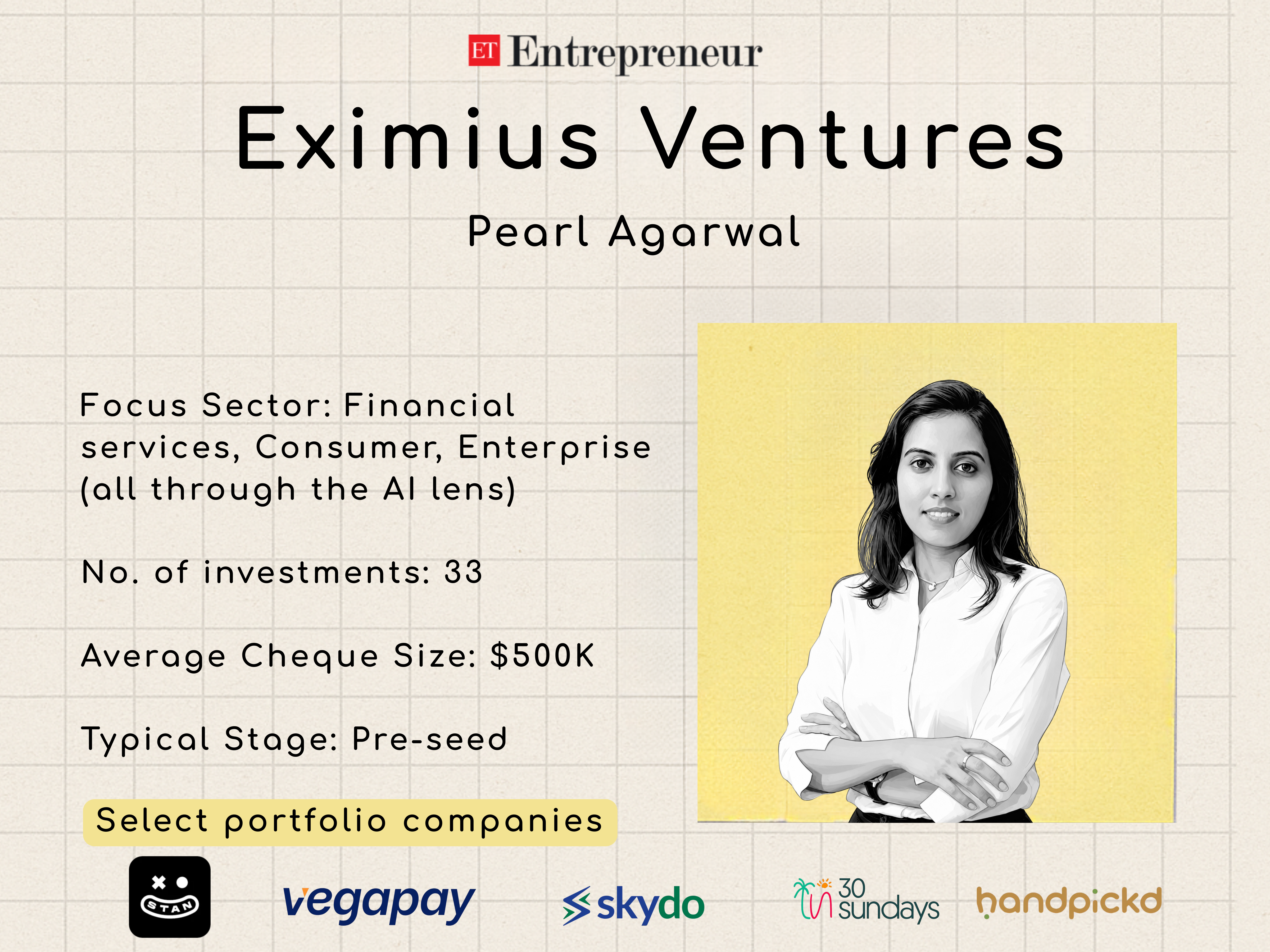
Launched in 2021 with a $10 million debut fund, Eximius has since backed startups such as Handpickd, Jar and Stan, writing some of the earliest institutional cheques into founders building across fintech, enterprise software and AI. Last year, the firm launched its second fund with a target corpus of $30 million.
First steps
For all the years she spent in global finance, Agarwal knew she wanted to return to India.
The question was never whether she would come back. It was what she would build when she did.
The answer emerged gradually during a six-month stint in Mumbai around 2017-18, while working with Global Infrastructure Partners on a potential acquisition involving IDFC. India’s startup ecosystem was already attracting unprecedented pools of capital and yet something felt incomplete.
“I realized that while a lot of capital had come into the Indian ecosystem, at the core, the pre-seed and the zero-to-one journey was broken,” she said.
Soon after returning, Agarwal built DotReview, a platform that reviewed more than 2,000 founders to understand the earliest challenges they faced. The results surprised even her. Nearly 70 per cent of founders said they didn’t know where to raise their first institutional cheque from. Another 15 per cent said they struggled to find investors who could provide the right guidance beyond capital.
In the US, firms such as HF0 and Union Square Ventures had built reputations around backing founders at the very beginning of their journeys. India, she felt, still relied largely on angel investors and syndicates for that stage of company building. Institutional pre-seed investing, with the rigour and conviction to lead a company’s first round, remained underdeveloped.
Eximius Ventures’ investment philosophy, therefore, is simple: become the first institutional believer in a founder, often before a product exists, before customers arrive and, in some cases, before the company itself has been formally incorporated.
Beyond pattern recognition
Venture capital often gravitates towards familiar signals be it in the form of elite universities, past successful exits and so on.
Agarwal said she has learnt to ignore many of them.
“When we started, we said we don’t care if you’re IIT or non-IIT,” she said. “That is not even a question today. I don’t even write it anywhere in our memo.”
The same evolution has played out with serial entrepreneurs. Early on, prior startup experience appeared to be a reassuring signal. Over time, she found little evidence that it consistently predicted outcomes.
“Whether you’re a first-time or second-time founder, or whether you come from a premium institution, has not directly correlated with how you perform,” she said.
Instead, she has become increasingly obsessed with something far harder to quantify: customers.
Across Eximius’ portfolio, Agarwal said the founders who have consistently outperformed are the ones who display an almost irrational curiosity about the people they are building for. Before they think about fundraising, they spend time validating assumptions, speaking to users, refining products and testing whether a problem is worth solving in the first place.
“What actually directly correlates is their obsession with the customer,” she said.
She recounts one founder whose company was still awaiting an investment committee decision. Instead of waiting for outside capital, the entrepreneur spent ₹20,000 of his own money validating the idea, eventually reaching nearly ₹4 lakh in monthly revenue before raising institutional funding.
To Agarwal, the behavior mattered more than the revenue itself.
“He was too curious to validate to himself that this actually works,” she said. “He kept executing, kept refining.”
That quality, she believes, cannot be manufactured.
In recent years, founders have become significantly better prepared. There are accelerator playbooks, fundraising coaches, AI tools capable of polishing pitch decks and a growing ecosystem eager to explain how successful startups should sound.
However, she argues that genuine conviction still reveals itself surprisingly quickly.
“We get anywhere between 1,100 and 1,200 startups every month. We pick one,” she said. “It is very easy to see that rawness in the right kind of founder because they will speak from their experience.”
The founders she worries about are what she calls ‘desktop founders’ or entrepreneurs who build elaborate investment theses without ever leaving their desks to test them in the real world.
“They try to figure out what gets funded without ever stepping into the market,” she said. “Those are things you can sniff from the very first conversation.”
The earliest stage of venture investing, she suggests, is all about people restless enough to keep asking questions long after everyone else believes they already know the answers.
A changing ecosystem
If Eximius was born from a conviction that India’s earliest founders deserved stronger institutional backing, its second fund reflects another belief: that the country’s startup ecosystem has quietly entered a different phase of its evolution.
When Agarwal began raising her first fund in 2021, India’s venture landscape was still finding its rhythm. Public listings of technology companies were rare, secondary markets were shallow and experienced startup operators remained relatively scarce. Five years later, she sees a fundamentally different ecosystem.
“You have multiple companies that have listed. You have very active secondary markets. As a result, you have solid second-time founders and seasoned operators coming out that can execute much faster,” she said.
The pace of company building, she argued, has accelerated just as dramatically.
“When I started in India, getting two million users in a month was unheard of,” she said. “Today, you actually see founders delivering two million users, a million in revenue within six months.”
Larger pre-seed rounds now enable companies to move fast enough to match the opportunities in front of them. Eximius’ second fund, accordingly, writes significantly larger first cheques than its predecessor primarily because of how fast the market has changed.
Nowhere is that shift more apparent than in artificial intelligence.
Like many venture investors, Agarwal believes AI represents a platform shift.
“We are very, very gung-ho on consumer AI,” she said. “After 1999 (the dawn of the internet era), this is the chance to revolutionise everything B2C again.”
For decades, digital products largely assumed users knew what they wanted and how to find it. AI, she believes, changes that equation by acting less like a search engine and more like a trusted guide.
“It is not me doing and collecting information,” she said. “I have a trusted friend or an advisor that guides me through the entire process.”
That distinction, she believes, matters especially for India’s vast population beyond the country’s biggest cities. “This is what India B and India C were actually waiting for,” she said.
Rather than treating AI simply as a cheaper way to build software or automate work, Agarwal sees it as a technology capable of widening participation.
It is also consistent with the thread that has quietly run through her career: how can capital and technology lower the barriers that keep more people from participating in opportunity?
Market makers
For a fund that prides itself on writing the first institutional cheque, success is rarely immediate. Pre-seed funds often invest in markets that don’t yet exist.
Asked what she hopes people will say about Eximius five years from now, Agarwal doesn’t mention returns or unicorns.
Instead, she talks about markets.
“We want to bet on ideas that seemed impossible or very difficult to build during that time,” she said. Looking back at Eximius’ first fund, she believes many of its portfolio companies weren’t necessarily introducing breakthrough technologies. They were entering spaces that had yet to be fully defined. “A lot of them have created the market or were creating the market in which they existed.”
If Eximius succeeds, she hopes its legacy won’t simply be a portfolio of successful startups.
“Five years from now, we would want to say that Eximius has aided in market creation in certain areas and has generated category-defining companies in those markets.”