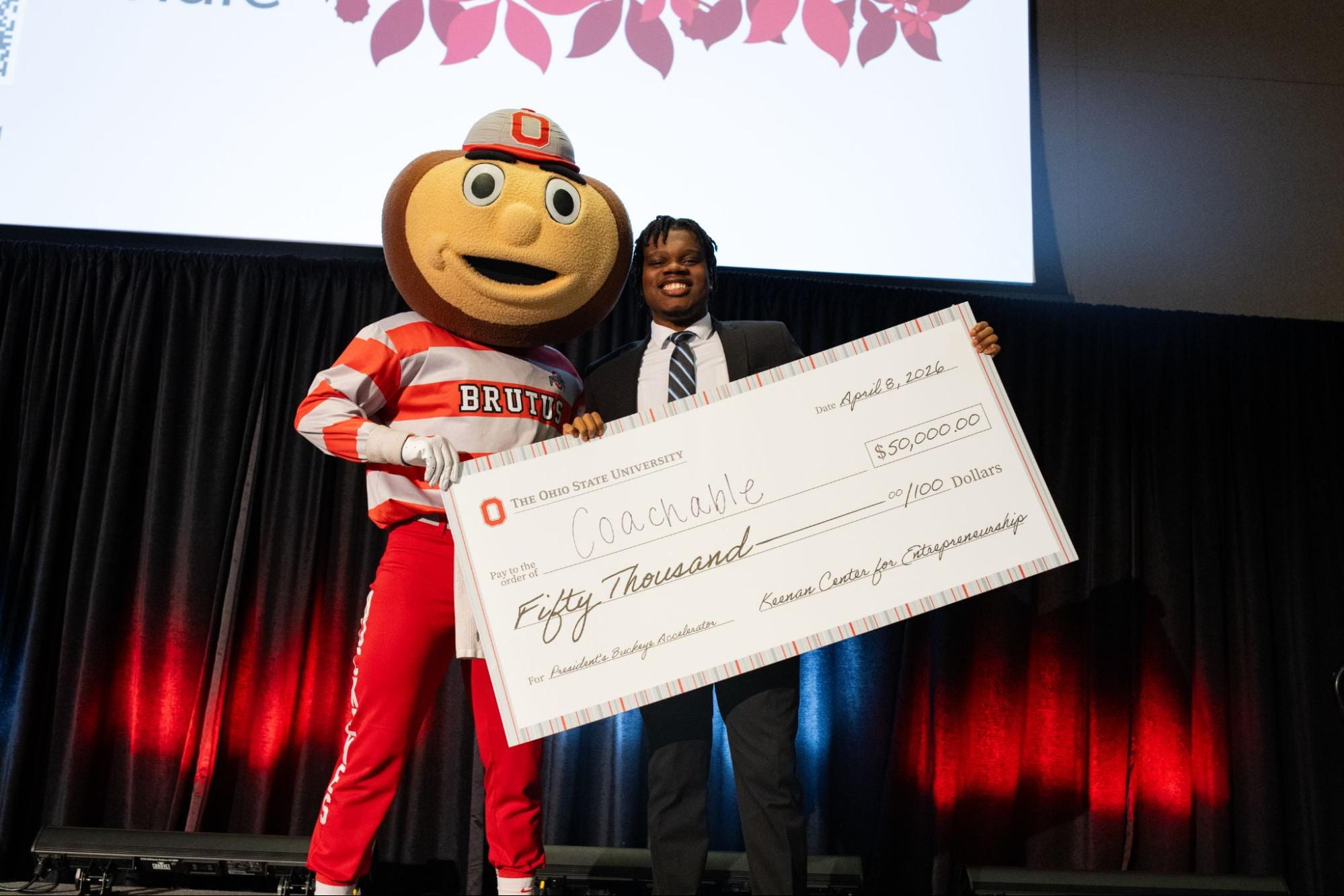
Eric Ishekwene and Brutus pose with the $50,000 award. Credit: Courtesy of Eric Ishekwene
Out of 50 competing ventures, Eric Ishekwene is turning sports strategies into digital gold after securing top honors and $50,000 in startup funding through the President’s Buckeye Accelerator.
As one of only six ventures chosen from the original 50, the second-year in computer science and engineering presented his app, “Coachable” The Buckeye Accelerator program allows student teams to pitch innovative ideas aimed at tackling challenges across industries, according to an Ohio State press release.
The app, Ishekwene said, aims to transform the global sports industry by allowing coaches to animate and share their playbooks digitally.
Ishekwene said winning the accelerator was exhilarating and the app’s success made it hard to sleep for days.
The win, he said, provides the initial capital and professional network he needs to improve on his vision for the venture and also be able to carve out a space for Black students to gain professional experience in the competitive tech market.
“Going into the program I struggled with comparing myself to other people who had businesses that had been worked on over multiple years,” Ishekwene said. “The general feeling of winning is something that I couldn’t shake off for multiple days.”
He said his primary goal for the app is to become the main place for sports plays, where coaches all over can create, adopt and share their strategies with their teams.
Despite the success, Ishekwene said navigating the growth of a tech company alone has presented challenges, specifically in areas outside of coding.
“The most challenging part is customer acquisition because I wasn’t business oriented in any aspect,” Ishekwene said. “The process of being able to go through customer acquisition, managing money, financial projections and things like this has been very difficult for me to navigate.”
Sam Storts, an Ohio State alum, CEO of Bilt Connections and Ishekwene’s mentor, said he saw his mentee continuously overcoming obstacles firsthand.
“Eric Ishekwene is truly an awe-inspiring individual,” Storts said. “We would have a discussion one week about a detail or feature in his program that I would personally have no idea how to implement into the software, it would feel like a major ask but by the next meeting we would have, Eric would have a second or third version ready for demo.”
Beyond the software, Ishekwene said he is focused on using his success to uplift other Black students on campus.
He said that navigating professional spaces as a Black student at a predominantly white institution is difficult due to the limited number of peer groups and lack of spotlight on academic achievements.
“Navigating the professional space as a Black student is pretty hard. We know things like Senate Bill 1 and the slow adherence to non-DEI initiatives have made it even harder for students who come from less privileged backgrounds to navigate the professional space, especially at a PWI,” Ishekwene said. “Black students naturally have a disadvantage, making up a smaller portion of campus, so we have fewer peers to develop our professional skills around.”
SB 1, passed over a year ago, prohibited diversity, equity and inclusion programming, per prior Lantern reporting.
Ishekwene said his personal drive comes from his status as the only member of his family that is currently in the United States, a circumstance making his professional success a necessity rather than an option.
“Me being a person of color and not having necessarily anything to rely on after I leave college, I know that it’s imperative that I have to make my own way,” Ishekwene said.
He also said he gave credit to a freshman year unpaid internship at Kino, according to his LinkedIn. The internship provided the “launchpad” for his upcoming summer internship at Amazon in San Francisco.
Storts said he believes the $50,000 award from the Presidents Buckeye Accelerator is just what Ishekwene needs to push his creation to the next level.
“[The program provides a] controlled environment to draw the creativity out of students and let them start their impactful careers even earlier,” Storts said.
Ishekwene said he is looking to partner with creators who are tired of going through college without building concrete products and encourages his peers to stop second-guessing their potential.
“To be successful, you have to be a real vulture. You can’t be scared or second-guess yourself when taking opportunities,” Ishekwene said “Put yourself out there, take opportunities, and do things. Don’t think that it’s too difficult for you, because that thinking is what held me back a little bit. I am a student, club athlete, DJ, entrepreneur, and a Black man trying to create opportunities for himself. I wouldn’t be halfway to the point I am at right now if I was too scared to put myself out there.”