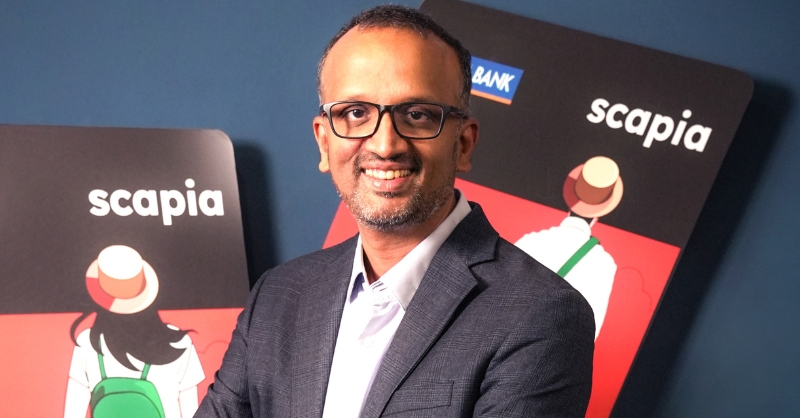
- Bengaluru-based Scapia has closed a $63M Series C led by General Catalyst at a valuation exceeding $500M, more than doubling its worth in just over a year.
- The raise puts Scapia on a collision course with Revolut, the London-headquartered fintech giant now pushing aggressively into India’s UPI market with a $670M five-year commitment.
- Scapia’s credit cards are used 15-20 times monthly per user — a frequency that signals genuine daily utility rather than a signup bonus play.
India’s travel-fintech space just got a lot more expensive to compete in. Scapia, the Bengaluru startup that has spent three years stitching together flight bookings, hotel reservations, co-branded credit cards, and UPI payments inside a single app, has closed a $63 million Series C led by General Catalyst — the same firm that runs one of the most active venture operations in Europe through its Berlin and Munich-based arm, formerly La Famiglia. Existing investors Peak XV Partners and Z47 also participated. The all-equity deal values Scapia at more than $500 million, more than doubling the roughly $200 million valuation it held just over a year ago.
The raise brings total funding to $135 million, following a $40 million Series B roughly a year ago.
What Scapia has built
Founded in 2022 by Anil Goteti, a former Flipkart executive, Scapia operates on the premise that a new generation of Indian consumers wants travel, credit, and payments inside one product rather than five. The platform combines flight and hotel bookings with co-branded credit cards issued through Federal Bank and Bank of Baroda, and offers dual-network cards spanning both Visa and RuPay — linked directly to UPI. The company claims to be the first in India to launch a dual-network co-branded card of this kind.
The growth numbers are hard to ignore. Flight bookings have grown 5-6x over the past year and hotel bookings 8x, with Tier-II and Tier-III cities taking an increasing share. Each card is used 15-20 times monthly — a frequency that distinguishes genuine daily utility from the one-time sign-up behaviour that inflates most fintech engagement metrics. Operating revenue rose to around $3.5 million in FY25 from roughly $2 million in FY24, while net losses narrowed slightly to approximately $10 million from $10.6 million.
“Scapia has evolved into a travel ecosystem built around a financial product designed for Indians who see travel as a lifestyle,” said Goteti. “The new funding will help us expand our offerings, strengthen our AI-first product approach, scale the brand, and attract top talent while continuing to build products that help users travel better and live richer lives.”
The European rival arriving at its door
The timing of Scapia’s raise is not incidental. Revolut — Europe’s most valuable fintech at a $75 billion valuation — launched in India in late 2025 and is moving fast. The London-headquartered company has invested more than £40 million to localise its technology for India’s data sovereignty requirements, received a prepaid payment instrument licence from the Reserve Bank of India, and integrated directly with UPI. It is targeting 20 million Indian users by 2030 and has committed $670 million to its India operation over five years — including plans to base 40% of its global workforce in the country by end of 2026.
Revolut is targeting the same demographic Scapia has spent three years cultivating: digitally-native, travel-spending, aspirational young Indians who want a single app for domestic and international financial life. The difference, for now, is that Scapia is purpose-built around travel rewards and co-branded credit — a product architecture Revolut does not yet replicate in the Indian market.
The competitive picture also includes Niyo, which targets international travellers with forex-focused products and raised $100 million in a Series C, and Ixigo, which listed in June 2024 and subsequently attracted a $146 million commitment from Prosus for a 10.1% stake.
What General Catalyst is signalling
General Catalyst’s involvement carries weight beyond the cheque size. The firm — which backs Mistral, Helsing, and Deel through its European operation and has committed $5 billion to India over five years — is increasingly concentrating capital into fewer, larger bets as overall fintech funding in India stays selective. Its India and MENA CEO Neeraj Arora was direct about the thesis: “India’s next generation of consumer companies will be built around entirely new behaviours, not just digital versions of old ones. Scapia recognised early that young Indians now see travel as a lifestyle expectation, and built a financial product around that shift. Its 7x customer growth and strong travel ecosystem give us confidence in its future.”
A significant portion of the new capital will go toward AI product development, engineering and design hiring, and adding one or two more banking partners. The company is also exploring lending through bank and NBFC partnerships.
The unresolved question is whether Scapia’s travel-first moat — built carefully over three years — proves durable enough against a $75 billion European fintech with a nine-figure India budget and the brand recognition to reframe what a global money app looks like to the same users Scapia is counting on.