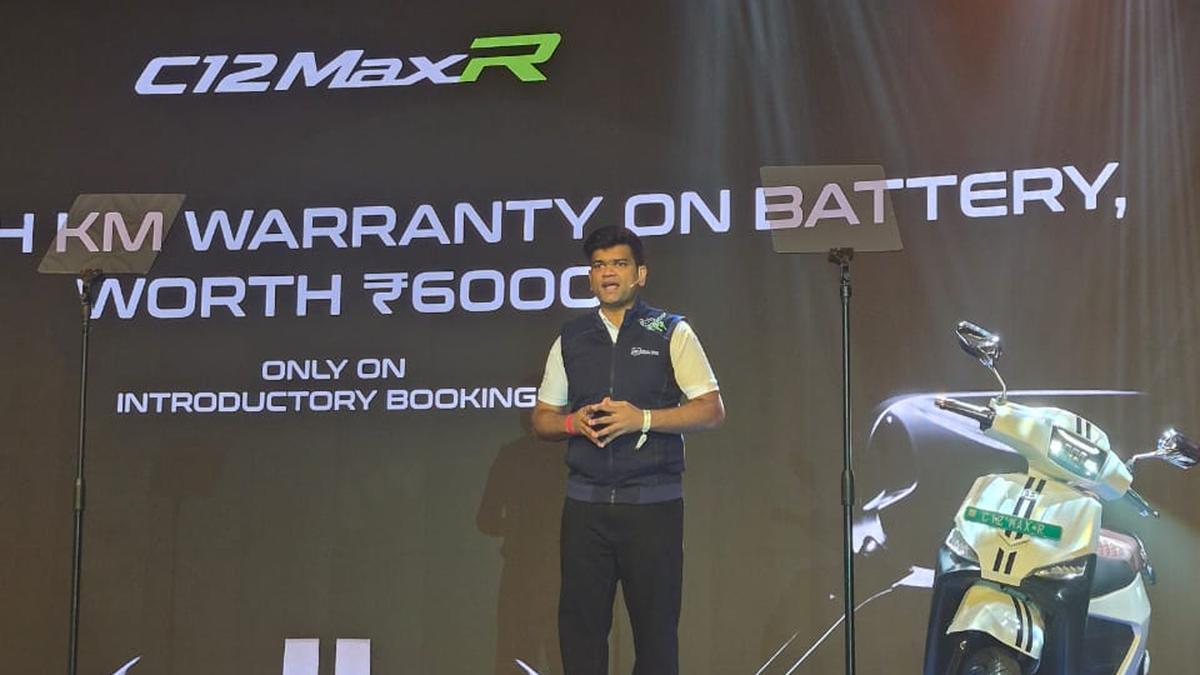

Hemant Kabra, Managing Director, BGauss
It took nearly four years for Hemant Kabra, Managing Director of Mumbai-based electric two-wheeler start-up BGauss, to take the company past 1 lakh cumulative retail sales.
He now plans to cover almost half that journey again in a single year, targeting close to 50,000 units by the end of FY27 as strong electric two-wheeler demand and growing acceptance of premium scooters encourage the company to widen its portfolio.
India’s electric two-wheeler market is expanding rapidly, with August 2026 registrations reaching about 1.84 lakh units, up 67.6 per cent year-on-year. EVs now account for nearly 11 per cent of total two-wheeler retail sales, up from 7.7 per cent a year earlier.
Against that backdrop, Kabra on Wednesday unveiled the C12 MaxR electric scooter at ₹1,45,990, betting the new model will help BGauss break into India’s top-five electric two-wheeler club.
New Model
“Once your platform is ready, once your motor platforms are ready, then your go-to-market strategy becomes faster,” Kabra told businessline, outlining the company’s next phase of growth.
Positioned at the premium end of BGauss’ portfolio, the C12 MaxR gets a 3.8-kWh LFP battery with a certified range of 178 km, peak output of 4.2 kW and a top speed of more than 75 kmph.
It also debuts BGauss’ HyperZen in-wheel motor system, integrating the motor, transmission, braking hardware and motor-control unit and eliminating a conventional belt or chain drive. The scooter offers three ride modes, reverse and cruise control, a 5-inch TFT display and 38 litres of storage.
Chasing Top-Five
BGauss sold 25,320 vehicles between January and August 2026, already surpassing its entire CY2025 sales of 25,131 units. August registrations jumped 191.7 per cent year-on-year to 5,044 units from 1,729, lifting market share to 2.7 per cent from 1.6 per cent.
The company is now part of a tightly packed mid-tier of electric two-wheeler makers. In August, BGauss’ 5,044 registrations compared with River Mobility’s 5,160 units and 2.8 per cent market share and Greaves Electric’s 8,615 units and 4.7 per cent. Simple Energy registered 1,655 units, giving it a 0.9 per cent share.
The numbers also show the distance BGauss must travel to enter the top five. Its current monthly volume would have to nearly triple to match fifth-placed Ola Electric’s August tally of 13,916 units.
Kabra said demand remains strong enough to support the next leg of growth, with BGauss scooters currently seeing waiting periods of close to a month.
The company is trying to capitalise on that demand through a wider product range and faster development cycles. The C12 MaxR is built on BGauss’ modular WSA platform, designed to accommodate different batteries, motors and wheel sizes and underpin future products.
“The amount of time you take to prove the component is way more than the amount of time you take to do the vehicle,” Kabra said.
Supplier and Retail Network Expands
Higher volumes are also changing BGauss’ sourcing model. Kabra said its Tier-1 supplier base has increased to about 150 from roughly 50 in its early years, while the company is increasingly qualifying multiple suppliers for individual components. “Now we are looking at two, three, or even more suppliers also for one product,” he said.
The retail footprint has expanded as well, with 252 showrooms across 209 cities. For BGauss, the next test is whether it can sustain a monthly run rate of around 5,000 units, convert waiting-list demand into deliveries, and use the C12 MaxR and its common platform to move from the mid-tier into the top-five club.
Published on September 10, 2026