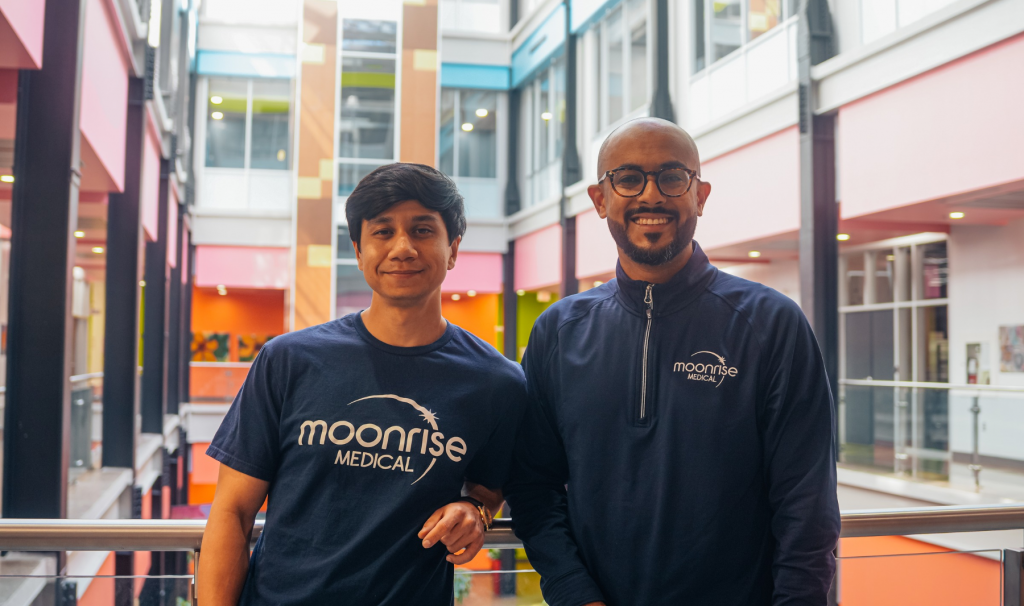
By the end of Mahip KC’s three-month work experience with Moonrise Medical, the team had made its feelings clear: “Mahip can’t go.”
The McMaster student had joined the Hamilton medtech startup during a demanding stretch. Moonrise was refining its ultrasound technology and preparing for a planned U.S. Food and Drug Administration (FDA) submission. KC quickly moved from learning how the system operated to contributing to its software quality assurance work.
For Moonrise founder Abubaker Khalifa, an intensive care physician and advisor in the Master of Biomedical Innovation program (MBI), KC’s adaptability stood out.
“Within a week, he was able to jump in and understand,” Khalifa says. “He was applying what he learned through the MBI in a real-world setting.”
Building on experience from Nepal
KC joined the MBI program with experience building medical devices of his own. In Nepal, he worked with a small team of engineers to develop a low-cost baby warmer for communities where imported medical equipment can be difficult to access.
The team built and deployed about 100 units in remote parts of the country to help prevent newborn deaths from hypothermia.
The experience showed KC what a locally built device could do. It also left him wanting to learn more about how to identify the right problem and develop a solution around it.
“I heard about needs-driven innovation,” he says. “It’s a really cool way of building technology. You know what problem you’re solving, and that’s the main point.”
The MBI program gave KC a framework for moving from a clinical need to a viable innovation.
In the program’s first week, students shadow local hospital teams where they learn how different conditions and health systems affect patients. They then work through the practical questions that shape a medical device’s path: intellectual property, regulation, reimbursement, business models and funding.
“I started in an uncertain state of needing to find the right problem to solve. By the end of the MBI program, I had the basic knowledge to start and sustain a business model,” KC says.
That foundation helped prepare him for his role at Moonrise. The company is developing an ultrasound automation platform to measure blood flow in the foot without bringing in a specialized sonographer.
The technology builds on the work of co-founder Jill Sommerset, a sonographer who developed and validated a way to assess blood flow below the ankle, helping clinicians identify patients at risk of serious wounds and amputation.
Moonrise’s system puts the technology in the hands of health-care providers, allowing them to make that assessment on demand and at scale, including in settings where vascular sonographers are in short supply.
Learning on the startup floor
The MBI connected students with work experience opportunities at McMaster-affiliated startups through a case exercise and interview process. KC knew Khalifa from the program and was familiar with Moonrise.
Once he joined the team, KC’s early work focused on understanding the system’s algorithms and the tests needed to verify that it performs safely and consistently. He tested how the system worked with simulated vessels and different settings, tracing how design inputs shaped the output.
The work drew on lessons from the MBI, including team communication and the discipline of a quality management system. Medical-device development requires careful documentation: changes to software must follow established processes and protocols.
“When I started at Moonrise, everyone here had so much experience,” KC says. “It was really important for me to work as a team and communicate effectively.”
Khalifa says the work also gave KC a close view of startup life, where priorities can shift quickly and the route to a goal is rarely a straight line. A team member might spend days on one task before realizing it needs to change. That experience can help students discover which parts of innovation work suit them, from research and development to quality assurance or working with customers.
For KC, that flexibility was one of the most striking parts of the experience.
“The end goal is static,” he says. “I know what we need to do, but it’s not linear. You need to learn a new skill set in a very short time.”
After his summer work experience, Moonrise invited KC to continue working at the startup in an official role, contributing to the company’s software quality assurance work as it prepares for its FDA submission.
He hopes the experience will also inform his future work when returns to Nepal, where he wants to help ensure medical devices are properly verified and validated before they reach patients.
“I think that’s going to be the most valuable thing for me to take back to Nepal,” he says.


